



الصفحة 16
الصفحة 16

Genetic programming : Theory and practice II
This volume explores the emerging interaction between theory and practice in the cutting-edge, machine learning method of Genetic Programming (GP). The contributions developed from a second workshop at the University of Michigan's Center for the Study of Complex Systems where leading international genetic programming theorists from major universities and active practitioners from leading industries and businesses met to examine how GP theory informs practice and how GP practice impacts GP theory. Chapters include such topics as financial trading rules, industrial statistical model building, population sizing, the roles of structure in problem solving by computer, stock picking, automated design of industrial-strength analog circuits, topological synthesis of robust systems, algorithmic chemistry, supply chain reordering policies, post docking filtering, an evolved antenna for a NASA mission and incident detection on highways.

Genetic algorithms: theory, design and programming
We present a series of scientific contributions that delve into the intricate theoretical foundations and practical nuances of genetic algorithms (GAs). Beyond the academic realm, GAs have demonstrated profound applications in societal decision-making and engineering optimization, showcased through real-world examples and case studies. A dedicated section on programming principles offers a thorough guide for implementing GAs across diverse languages. This edition, tailored for researchers and academics, serves as a testament to the scientific advancements within the field, inviting readers to explore the nuanced journey from theoretical constructs to pragmatic applications in the dynamic landscape of GAs.

Fuzzy-Neuro Approach to Agent Applications : From the AI Perspective to Modern Ontology
The book provides a full explanation of the concepts and theories of intelligent agents and agent-based systems. Providing a comprehensive theoretical background, the author covers modern artificial intelligence topics such as ontologies, neural networks, chaos theory, fuzzy logics and genetic algorithms. Finally, the author details how the iJADK toolkit (intelligent Java agent development kit for intelligent e-business applications) can be used in the design and implementation phases of real applications.

Fuzzy systems and knowledge discovery ; Vol. 4223 ; Third International Conference, FSKD 2006, Xi'an, China, September 24-28, 2006, Proceedings
ICNC-FSKD 2006 featured the most up-to-date research results in com- tational algorithms inspired from nature, including biological, ecological, and physical systems. It is an exciting and emerging interdisciplinary area in which a wide rangeof techniques and methods arebeing studied for dealing with large, complex, and dynamic problems.

Fuzzy systems and knowledge discovery ; Vol. 3614 ; 2nd International Conference, FSKD 2005, Changsha, China, August 27-29, 2005, Proceedings, Part II
This book and its sister volume, LNAI 3613 and 3614, constitute the proce- ings of the Second International Conference on Fuzzy Systems and Knowledge Discovery (FSKD 2005), jointly held with the First International Conference on Natural Computation (ICNC 2005, LNCS 3610, 3611, and 3612) from - gust 27–29, 2005 in Changsha, Hunan, China. FSKD 2005 successfully attracted 1249 submissions from 32 countries/regions (the joint ICNC-FSKD 2005 received 3136 submissions). After rigorous reviews, 333 high-quality papers, i. e. , 206 long papers and 127 short papers, were included in the FSKD 2005 proceedings, r- resenting an acceptance rate of 26. 7%. The ICNC-FSKD 2005 conference featured the most up-to-date research - sults in computational algorithms inspired from nature, including biological, e- logical, and physical systems. It is an exciting and emerging interdisciplinary area in which a wide range of techniques and methods are being studied for dealing with large, complex, and dynamic problems. The joint conferences also promoted cross-fertilization over these exciting and yet closely-related areas, which had a signi?cant impact on the advancement of these important technologies. Speci?c areas included computation with words, fuzzy computation, granular com- tation, neural computation, quantum computation, evolutionary computation, DNA computation, chemical computation, information processing in cells and tissues, molecular computation, arti?cial life, swarm intelligence, ants colony, arti?cial immune systems, etc. , with innovative applications to knowledge d- covery, ?nance, operations research, and more.

Fuzzy systems and knowledge discovery ; Vol. 3613 ; 2nd International Conference, FSKD 2005, Changsha, China, August 27-29, 2005, Proceedings, Part I
This book and its sister volume, LNAI 3613 and 3614, constitute the proce- ings of the Second International Conference on Fuzzy Systems and Knowledge Discovery (FSKD 2005), jointly held with the First International Conference on Natural Computation (ICNC 2005, LNCS 3610, 3611, and 3612) from - gust 27–29, 2005 in Changsha, Hunan, China. FSKD 2005 successfully attracted 1249 submissions from 32 countries/regions (the joint ICNC-FSKD 2005 received 3136 submissions). After rigorous reviews, 333 high-quality papers, i. e. , 206 long papers and 127 short papers, were included in the FSKD 2005 proceedings, r- resenting an acceptance rate of 26. 7%. The ICNC-FSKD 2005 conference featured the most up-to-date research - sults in computational algorithms inspired from nature, including biological, e- logical, and physical systems. It is an exciting and emerging interdisciplinary area in which a wide range of techniques and methods are being studied for dealing with large, complex, and dynamic problems. The joint conferences also promoted cross-fertilization over these exciting and yet closely-related areas, which had a signi?cant impact on the advancement of these important technologies. Speci?c areas included computation with words, fuzzy computation, granular com- tation, neural computation, quantum computation, evolutionary computation, DNA computation, chemical computation, information processing in cells and tissues, molecular computation, arti?cial life, swarm intelligence, ants colony, arti?cial immune systems, etc. , with innovative applications to knowledge d- covery, ?nance, operations research, and more.

Fuzzy Models and Algorithms for Pattern Recognition and Image Processing
Fuzzy Models and Algorithms for Pattern Recognition and Image Processing presents a comprehensive introduction of the use of fuzzy models in pattern recognition and selected topics in image processing and computer vision. Unique to this volume in the Kluwer Handbooks of Fuzzy Sets Series is the fact that this book was written in its entirety by its four authors. A single notation, presentation style, and purpose are used throughout. The result is an extensive unified treatment of many fuzzy models for pattern recognition. The main topics are clustering and classifier design, with extensive material on feature analysis relational clustering, image processing and computer vision. Also included are numerous figures, images and numerical examples that illustrate the use of various models involving applications in medicine, character and word recognition, remote sensing, military image analysis, and industrial engineering.

Fuzzy mathematical programming and fuzzy matrix games
This book presents a systematic and focused study of the application of fuzzy sets to two basic areas of decision theory, namely Mathematical Programming and Matrix Game Theory. Apart from presenting most of the basic results available in the literature on these topics, the emphasis is on understanding their natural relationship in a fuzzy environment

Fuzzy Logic with engineering applications
Latest advances in the field including material on expansion of the MLFE method using genetic algorithms, cognitive mapping, fuzzy agent-based models and total uncertainty. Redundant or obsolete topics have been removed, resulting in a more concise yet inclusive text that will ensure the book retains its broad appeal at the forefront of the literature.

Fuzzy Logic and Applications ; Vol. 3849 ; 6th International Workshop, WILF 2005, Crema, Italy, September 15-17, 2005, Revised Selected Papers
This volume contains the proceedings of the 6th International Workshop on Soft Computing and Applications (WILF 2005), which took place in Crema, Italy, on September 15–17, 2005, continuing an established tradition of biannual meetings among researchers and developers from both academia and industry to report on the latest scienti?c and theoretical advances, to discuss and debate major issues, and to demonstrate state-of-the-art systems. This edition of the workshop included two special sessions, sort of subwo- shops, focusing on the application of soft computing techniques (or compu- tional intelligence) to image processing (SCIP) and bioinformatics (CIBB).

Fuzzy Logic and Applications ; Vol. 2955 ; 5th International Workshop, WILF 2003, Naples, Italy, October 9-11, 2003, Revised Selected Papers
This volume constitutes the thoroughly refereed post-workshop proceedings of the 5th International Workshop on Fuzzy Logic and Applications held in Naples, Italy, in October 2003. The 40 revised full papers presented have gone through two rounds of reviewing and revision. All current issues of theoretical, experimental and applied fuzzy logic and related techniques are addressed with special attention to rough set theory, neural networks, genetic algorithms and soft computing.

Fundamentals of the New Artificial Intelligence: Neural, Evolutionary, Fuzzy and More
The significantly updated second edition of Fundamentals of the New Artificial Intelligence thoroughly covers the most essential and widely employed material pertaining to neural networks, genetic algorithms, fuzzy systems, rough sets, and chaos. In particular, this unique textbook explores the importance of this content for real-world applications.

Fundamentals of image data mining : Analysis, features, classification and retrieval
Presents a comprehensive review of the essentials of image data mining, and the latest cutting-edge techniques used in the field. The coverage spans all aspects of image analysis and understanding, offering deep insights into areas of feature extraction, machine learning, and image retrieval. The theoretical coverage is supported by practical mathematical models and algorithms, utilizing data from real-world examples and experiments. Topics and features: Describes essential tools for image mining, covering Fourier transforms, Gabor filters, and contemporary wavelet transforms / Develops many new exercises (most with MATLAB code and instructions) / Includes review summaries at the end of each chapter / Analyses state-of-the-art models, algorithms, and procedures for image mining / Integrates new sections on pre-processing, discrete cosine transform, and statistical inference and testing / Demonstrates how features like color, texture, and shape can be mined or extracted for image representation / Applies powerful classification approaches: Bayesian classification, support vector machines, neural / networks, and decision trees / Implements imaging techniques for indexing, ranking, and presentation, as well as database visualization

Fundamentals of computation theory ; 16th International Symposium, FCT 2007, Budapest, Hungary, August 27-30, 2007, Proceedings
This book constitutes the refereed proceedings of the 16th International Symposium Fundamentals of Computation Theory. The papers address all current topics in computation theory.

Fundamentals of computation theory ; 15th International symposium, FCT 2005, Lübeck, Gemany, August 17-20, 2005, Proceedings
This book constitutes the refereed proceedings of the 15th International Symposium Fundamentals of Computation Theory, FCT 2005, held in L]beck, Germany in August 2005. The 46 revised full papers presented together with 3 invited papers were carefully reviewed and selected from 105 submissions. The papers are organized in topical sections on circuits, automata, complexity, approximability, computational and structural complexity, graphs and complexity, computational game theory, visual cryptography and computational geometry, query complexity, distributed systems, automata and formal languages, semantics, approximation algorithms, average case complexity, algorithms, graph algorithms, and pattern matching.

Fundamentals and Methods of Machine and Deep Learning : Algorithms, Tools, and Applications
provides a practical approach by explaining the concepts of machine learning and deep learning algorithms, evaluation of methodology advances, and algorithm demonstrations with applications. In recent research studies, they are regarded as one of the disruptive technologies that will transform our future life, business, and the global economy. The recent explosion of digital data in a wide variety of domains, including science, engineering, Internet of Things, biomedical, healthcare, and many business sectors, has declared the era of big data, which cannot be analysed by classical statistics but by the more modern, robust machine learning and deep learning techniques. Since machine learning learns from data rather than by programming hard-coded decision rules, an attempt is being made to use machine learning to make computers that are able to solve problems like human experts in the field.

Fundamental approaches to software engineering ; Vol. 3922 ; 9th International Conference, FASE 2006, Held as Part of the Joint European Conferences on Theory and Practice of Software, ETAPS 2006, Vienna, Austria, March 27-28, 2006, Proceedings
ETAPS 2006 was the ninth instance of the European Joint Conferences on Theory and Practice of Software. ETAPS is an annual federated conference that was established in 1998 by combining a number of existing and new conferences. The events that comprise ETAPS address various aspects of the system devel- ment process, including speci?cation, design, implementation, analysis and impro- ment. The languages, methodologies and tools which support these activities are all well within its scope. Di?erent blends of theory and practice are represented, with an inclination towards theory with a practical motivation on the one hand and soundly based practice on the other. Many of the issues involved in software design apply to systems in general, including hardware systems, and the emphasis on software is not intended to be exclusive.

Fundamental approaches to software engineering ; 11th International Conference, FASE 2008, Held as Part of the Joint European conferences on theory and practice of software, ETAPS 2008, Budapest, Hungary, March 29-April 6, 2008. Proceedings
The fve main conferences received 571 submissions, 147 of which were accepted, giving an overall acceptance rate of less than 26%, with each conference below 27%.Congratulationsthereforetoallthe authorswhomadeittothe alprogramme! I hope that most of the other authors will still have found a way of participating in this exciting event, and that you will all continue submitting to ETAPS and contributing to make of it the best conference in the area،The events that comprise ETAPS address various aspects of the system velopment process,including specifcation, design, implementation, analysis and improvement.

Fun with algorithms ; 4th International conference, FUN 2007, Castiglioncello, Italy, June 3-5, 2007, Proceedings
This book constitutes the refereed proceedings of the 4th International Conference on Fun with Algorithms, FUN 2007, held in Castiglioncello, Italy in June 2007.
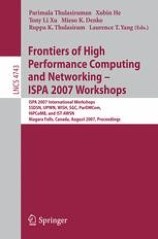
Frontiers of high performance computing and networking – ISPA 2007 workshops ; ISPA 2007 International workshops, SSDSN, UPWN, WISH, SGC, ParDMCom, HiPCoMB, and IST-AWSN, Niagara Falls, Canada, August, 28-September 1, 2007, Proceedings
This book constitutes the refereed joint proceedings of seven international workshops held in conjunction with the 5th International Symposium on Parallel and Distributed Processing and Applications, ISPA 2007, held in Niagara Falls, Canada in August 2007.
