



الصفحة 16
الصفحة 16

Euro-Par 2019 : Parallel Processing Workshops ; Euro-Par 2019 International Workshops, Göttingen, Germany, August 26–30, 2019, Revised Selected Papers
Euro-Par is an annual, international conference in Europe, covering all aspects of parallel and distributed processing. These range from theory to practice, from small to the largest parallel and distributed systems and infrastructures, from fundamental computational problems to full-edged applications, from architecture, compiler, language and interface design and implementation to tools, support infrastructures, and application performance aspects.

Euro-Par 2008 - Parallel Processing ; 14th International Euro-Par Conference, Las Palmas de Gran Canaria, Spain, August 26-29, 2008. Proceedings
This book constitutes the refereed proceedings of the 14th International Conference on Parallel Computing, Euro-Par 2008, held in Las Palmas de Gran Canaria, Spain, in August 2008.The 86 revised papers presented were carefully reviewed and selected from 264 submissions. The papers are organized in topical sections on support tools and environments; performance prediction and evaluation; scheduling and load balancing; high performance architectures and compilers; parallel and distributed databases; grid and cluster computing; peer-to-peer computing; distributed systems and algorithms; parallel and distributed programming.

Euro-Par 2007 Workshops : Parallel Processing ; HPPC 2007, UNICORE Summit 2007, and VHPC 2007, Rennes, France, August 28-31, 2007, Revised Selected Papers
Parallel and distributed processing , although within the focus of computer science research for along time ,is gainingmore and more importance in awidespectrum of applications. These proceedings aim to demonstrate the use of parallel and distributed processing concepts in diferent application felds, and attempt to spark interest in novel research directions to advance the embracing model of high-performance computing research in general. The objective of these workshops is to specifcally address researchers c- ing from university, industry and governmental research organizations and application-oriented companies, in order to close the gap between purely sentifc research and the applicability of the research ideas to real-life problems.

Euro-Par 2007 Parallel Processing ; 13th International Euro-Par Conference, Rennes, France, August 28-31, 2007, Proceedings
This book covering support tools and environments; performance prediction and evaluation; scheduling and load balancing; compilers for high performance; parallel and distributed databases; grid and cluster computing; peer-to-peer computing; distributed systems and algorithms; parallel and distributed programming; parallel numerical algorithms; distributed and high-performance multimedia; theory and algorithms for parallel computation; high performance networks; mobile and ubiquitous computing.

Euro-Par 2006 Parallel Processing ; 12th International Euro-Par Conference, Dresden, Germany, August 28-September 1, 2006, Proceedings
This book constitutes the refereed proceedings of the 12th International Conference on Parallel Computing, Euro-Par 2006. parallel and distributed databases, data mining and knowledge discovery; grid and cluster computing: models, middleware and architectures; parallel computer architecure and instruction-level parallelism.

Euro-Par 2005 Parallel Processing ; 11th International Euro-Par Conference, Lisbon, Portugal, August 30 - September 2, 2005, Proceedings
This book constitutes the refereed proceedings of the 11th International Conference on Parallel Computing, Euro-Par 2005, held in Lisbon, Portugal, in August/September 2005. The 120 revised papers presented together with 4 invited papers were carefully reviewed and selected from 388 submissions. The papers are organized in topical sections on support tools and environments, performance prediction and evaluation, scheduling and load balancing, compilers for high performance, parallel and distributed databases, data mining and knowledge discovery, grid and cluster computing: models, middleware and architectures, parallel computer architecture and instruction distributed systems and algorithms, parallel programming: models, methods, and languages, parallel numerical algorithms.

Ethereum Smart Contract Development in Solidity
This book introduces readers to the Solidity language from scratch, together with case studies and examples. It also covers advanced topics and explains the working mechanism of smart contracts in depth. Further, it includes relevant examples that shed new light on the forefront of Solidity programming. In short, it equips readers with essential practical skills, allowing them to quickly catch up and start using Solidity programming.
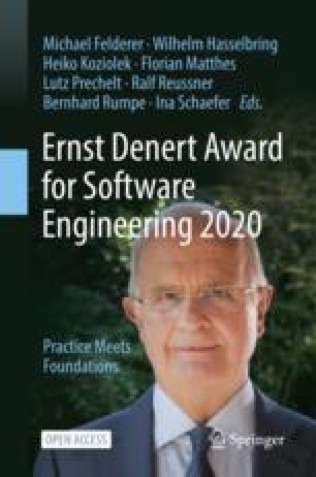
Ernst Denert Award for Software Engineering 2020 : Practice Meets Foundations
This book provides an overview of the dissertations of the eleven nominees for the Ernst Denert Award for Software Engineering in 2020. The prize, kindly sponsored by the Gerlind & Ernst Denert Stiftung, is awarded for excellent work within the discipline of Software Engineering, which includes methods, tools and procedures for better and efficient development of high quality software. An essential requirement for the nominated work is its applicability and usability in industrial practice.

Entertainment Computing - ICEC 2005 ; 4th International Conference, Sanda, Japan, September 19-21, 2005, Proceedings
First of all, we appreciate the hard work of all the authors who contributed to ICEC 2005 by submitting their papers. ICEC 2005 attracted 95 technical paper submissions, 8 poster submissions and 7 demo submissions, in total 110. This number is nearly equal to ICEC 2004. Based on a thorough review and selection process carried out by 76 international experts from academia and industry as members of the senior and international program committees, a high-quality program was compiled. The program committee consisted of experts from all over the world: 1 from Austria, 3 from Bulgaria, 2 from Canada, 4 from China, 1 from Finland, 4 from France, 10 from Germany, 1 from Greece, 1 from Ireland, 1 from Israel, 1 from Italy, 26 from Japan, 1 from Korea, 4 from The Netherlands, 1 from New Zealand, 1 from Norway, 1 from Singapore, 1 from Thailand, 4 from the UK, and 8 from the USA. In this number, reviewers are included. The final decision was made at the senior program committee meeting based on three reviewers' feedback, available online via the conference management tool. Through earnest and fair discussion at the meeting, 25 technical papers were accepted as long papers and 32 technical papers were accepted as short papers from 95 submitted technical papers. Moreover, 3 poster papers and 5 demo papers were accepted.

Enterprise service oriented architectures : Concepts, challenges, recommendations
Enterprise Service Oriented Architectures helps readers solve this challenge in making different applications communicate in a loosely coupled manner. This classic handbook leverages the experiences of thought leaders functioning in multiple industry verticals and provides a wealth of knowledge for creating the agile enterprise.

Enterprise Information Systems VII
The purpose of the 7th International Conference on Enterprise Information Systems (ICEIS) was to bring together researchers, engineers and practitioners interested in the advances and business applications of information systems. Five simultaneous tracks have been held, covering different aspects of Enterprise Information Systems Applications, including Enterprise Database Technology, Systems Integration, Artificial Intelligence, Decision Support Systems, Information Systems Analysis and Specification, Internet Computing, Electronic Commerce and Human Factors.

Enterprise Information Systems VI
This book contains the best papers of the Sixth International Conference on Enterprise Information Systems (ICEIS 2004), held in Porto (Portugal) and organized by INSTICC (Institute for Systems and Technologies of Information, Communication and Control) in collaboration with PORTUCALENSE UNIVERSITY, who hosted the event. Following the route started in 1999, ICEIS has become a major point of contact between research scientists, engineers and practitioners on the area of business applications of information systems. This conference has received an increased interest every year, from especially from the international academic community, and it is now one of the world largest conferences in its area. This year, five simultaneous tracks were held, covering different aspects related to enterprise computing, including: “Databases and Information Systems Integration”,

Engineering Stochastic Local Search Algorithms. Designing, Implementing and Analyzing Effective Heuristics ; International Workshop, SLS 2007, Brussels, Belgium, September 6-8, 2007, Proceedings
Stochastic local search (SLS) algorithms enjoy great popularity as powerful and versatile tools for tackling computationally hard decision and optimization pr- lems from many areas of computer science, operations research, and engineering. However, in recent years it has become evident that at the core of this development task there is a highly complex engineering process, which combines various aspects of algorithm design with empirical analysis techniques and problem-specific background, and which relies heavily on knowledge from a number of disciplines and areas, including computer science, operations research, artificial intelligence, and statistics. This development process needs to be - sisted by a sound methodology that addresses the issues arising in the various phases of algorithm design, implementation, tuning, and experimental eval- tion.

Engineering Societies in the Agents World VIII ; 8th International Workshop, ESAW 2007, Athens, Greece, October 22-24, 2007, Revised Selected Papers
This book constitutes the thoroughly refereed post-conference proceedings of the 7th International Workshop on Engineering Societies in the Agents World, ESAW 2007, held in Athens, Greece, in October 2007. The 19 revised full papers were carefully reviewed and selected for inclusion in this book. The papers are organized in topical sections on electronic institutions, models of complex distributed systems with agents and societies; interaction in agent societies; engineering social intelligence in multi-agent systems; trust and reputation in agent societies; analysis, design and development of agent societies.

Engineering Societies in the Agents World VII ; 7th International Workshop, ESAW 2006 Dublin, Ireland, September 6-8, 2006 Revised Selected and Invited Papers
It cover main themes: Engineering multi-agent systems, Methodologies for analysis, design, development and verification of agent societies, Interaction and coordination in agent societies, Autonomic agent societies, Trust in agent societies For

Engineering Societies in the Agents World VI ; 6th International Workshop, ESAW 2005, Kusadasi, Turkey, October 26-28, 2005, Revised Selected and Invited Papers
ESAW 2005 took place at the Pine Bay Hotel in Kusadasi, Turkey at the end of the October 2005. It was organized as a stand-alone event as were ESAW 2004and ESAW 2003.Following the initial ESAW vision,which wasset in 1999, by the members of the working group on “Communication, Coordination and Collaboration” of Agentlink, ESAW 2005 continued to focus on the engineering of complex software systems in terms of multi-agent societies, especially the social and environmental aspects of such societies.

Engineering self-organising systems Vol. 3910 ; 3rd International Workshop, ESOA 2005, Utrecht, The Netherlands, July 25, 2005, Revised Selected Papers
This book contains recent work from a broad range of areas with the common theme of utilising self-organisation productively. As distributed information infrastructures continue to spread (such as the Internet, wireless and mobile systems), new challenges have arisen demanding robust and scalable solutions. In these new challenging environments the - signers and engineers of global applications and services can seldom rely on centralised control or management, high reliability of devices, or secure en- ronments. At the other end of the scale, ad-hoc sensor networks and ubiquitous computing devices are making it possible to embed millions of smart computing agents into the local environment.

Engineering self-organising systems ; 4th International Workshop, ESOA 2006, Hakodate, Japan, May 9, 2006, Revised and Invited Papers
This book discusses a broad variety of topics in an effort to allow room for new ideas and discussion, and eventually a better understanding of the important directions and techniques of Engineering Self-Organizing.This book raises the important question of whether there are underlying statistical mechanics-like principles that apply to emergent multi-agent systems. Answering this question will in the long run provide an important part of the underlying theory of emergent distributed systems.

Engineering psychology and cognitive ergonomics ; 7th International Conference, EPCE 2007, Held as Part of HCI International 2007, Beijing, China, July 22-27, 2007, Proceedings
This book address the latest research and development efforts and highlight the human aspects of design and use of computing systems. It cover the entire field of Human-Computer Interaction, addressing major - vances in knowledge and effective use of computers in a variety of application areas. This volume contains papers in the thematic area of En- neering Psychology and Cognitive Ergonomics, addressing the following major topics: Cognitive and Affective Issues in User Interface Design, Cognitive Workload and Human Performance, Cognitive Modeling and Measuring, Safety Critical Applications and Systems

Engineering Multi-Agent Systems ; 7th International Workshop, EMAS 2019, Montreal, QC, Canada, May 13–14, 2019, Revised Selected Papers
This book constitutes the thoroughly refereed post-conference proceedings of the 7th International Workshop on Engineering Multi-Agent Systems, EMAS 2019, held in Montreal, QC, Canada, in May 2019. The 13 revised full papers presented in this book were carefully selected and reviewed from 20 submissions. The papers are grouped in the following topical sections: Multi-Agent Interaction and Organization; Simulation; Social Awareness and Explainability; Learning and Reconfiguration; and Implementation Techniques and Tools.
