



الصفحة 16
الصفحة 16

Guide to software systems development : Connecting novel theory and current practice
This book argues that the key problems of software systems development (SSD) are socio-technical rather than purely technical in nature. Software systems are unique. They are the only human artefacts that are both intangible and determinant. This presents unprecedented problems for the development process both in determining what is required and how it is developed. Primarily this is a problem of communications between stakeholders and developers, and of communications within the development team. Current solutions are not only inadequate in expressing the technical problem, they also evade the communications problems almost entirely.

Guide to RISC Processors : for Programmers and Engineers
This guidebook provides an accessible and all-encompassing compendium on RISC processors, introducing five RISC processors: MIPS, SPARC, PowerPC, ARM, and Itanium. Initial chapters explain the differences between the CISC and RISC designs and clearly discuss the core RISC design principles. The text then integrates instruction on MIPS assembly language programming, thereby enabling readers to concretely grasp concepts and principles introduced earlier. Readers need only have a basic knowledge of any structured, high-level language to obtain the full benefits here.

Guide to Assembly Language Programming in Linux
This unique guide provides comprehensive coverage of the key elements of Assembly language programming with in-depth coverage of the Linux operating system, which is the fastest-growing operating system with an estimated 18 million Linux users worldwide. The book specifically targets professionals who would like to learn Assembly and intend or expect to move to the Linux operating system. This highly useful guidebook comes complete with all the necessary software (Linux, NASM, debugger), making it an extremely valuable resource tool for all those who want to learn Assembly programming and Linux. Readers need only have a basic knowledge of any structured, high-level language such as C to obtain the full benefits of this guidebook.

Guide to assembly language : A concise introduction
This concise guide is designed to enable the reader to learn how to program in assembly language as quickly as possible. Through a hands-on programming approach, readers will also learn about the architecture of the Intel processor, and the relationship between high-level and low-level languages. This updated second edition has been expanded with additional exercises, and enhanced with new material on floating-point numbers and 64-bit processing.

Groupware : Design, Implementation, and Use ; 14th International Workshop, CRIWG 2008, Omaha, NE, USA, September 14-18, 2008, Revised Selected Papers
This book constitutes the refereed post-conference proceedings of the 14th International Workshop on Groupware: Design, Implementation, and Use, held in Omaha, Nebraska, USA, during September 14-18, 2008.The 30 papers presented were carefully reviewed and selected from numerous submission. The topics covered are groupware solutions, co-located groups, groupware for health care, collaborative systems development, collaborative emergency response, groupware approaches, patterns of collaboration.
Grouping Multidimensional Data : Recent Advances in Clustering
Clustering is one of the most fundamental and essential data analysis techniques. Clustering can be used as an independent data mining task to discern intrinsic characteristics of data, or as a preprocessing step with the clustering results then used for classification, correlation analysis, or anomaly detection.

Grippers in Motion : The Fascination of Automated Handling Tasks
This book shows you how to ensure process reliability on the basis of combining the right components with advanced application know-how. By explaining basic preconditions of the gripping process and highlighting the milestones of automation history, we guide you all the way through to the center of the handling process – the workpiece. Its ambient conditions and setup are clearly defined as well as the process of setting grippers in motion. Starting with simple linear movements up to multi-axis kinematics, you are provided with the details for practical solutions.

Grid Middleware and Services : Challenges and Solutions
This book aims to strengthen and advance scientific and technological excellence in the area of Grid Computing. The main focus in this volume is on Grid middleware and service level agreement.Grid middleware and Grid services are two pillars of grid computing systems and applications. This book includes high-level contributions by leading researchers in both areas and presents current solutions together with future challenges. This volume includes sections on knowledge and data management on grids, Grid resource management and scheduling, Grid information, resource and workflow monitoring services, and service level agreements.

Grid economics and business models ; 5th International workshop, GECON 2008, Las Palmas de Gran Canaria, Spain, August 26, 2008. Proceedings
This volume constitutes the refereed proceedings of the 5th International Workshop on Grid Economics and Business Models, GECON 2008, held in Las Palmas de Gran Canaria, Spain, August 2008.The 10 full papers included in this volume were carefully selected from 27 submission. They aim at presenting current results and innovative research in the area of grid economics. The papers are organized in topical sections on grid business modeling, market mechanisms for the grid, grid markets, and grid architectures.The proceedings are rounded off by 9 project reports that give an overview of the current and ongoing research in grid economics.

Grid computing in life science ; 1st International Workshop on Life Science Grid, LSGRID 2004 Kanazawa, Japan, May 31-June 1, 2004, Revised Selected and Invited Papers
Researchers in the ?eld of life sciences rely increasingly on information te- nology to extract and manage relevant knowledge. The complex computational and data management needs of life science research make Grid technologies an attractive support solution. However, many important issues must be addressed before the Life Science Grid becomes commonplace. The 1st International Life Science Grid Workshop (LSGRID 2004) was held in Kanazawa Japan, May 31–June 1, 2004. This workshop focused on life s- ence applications of grid systems especially for bionetwork research and systems biology which require heterogeneous data integration from genome to phenome, mathematical modeling and simulation from molecular to population levels, and high-performance computing including parallel processing, special hardware and grid computing.

Green, pervasive, and cloud computing ; 15th International conference, GPC 2020, Xi'an, China, November 13–15, 2020, Proceedings
This book constitutes the refereed proceedings of the 15th International Conference on Green, Pervasive, and Cloud Computing, GPC 2020, held in Xi'an, China, in November 2020. The 30 full papers presented in this book together with 8 short papers were carefully reviewed and selected from 96 submissions. They cover the following topics: Device-free Sensing; Machine Learning; Recommendation Systems; Urban Computing; Human Computer Interaction; Internet of Things and Edge Computing; Positioning; Applications of Computer Vision; CrowdSensing; and Cloud and Related Technologies.

Graphics Recognition. Recent Advances and New Opportunities ; 7th International Workshop, GREC 2007, Curitiba, Brazil, September 20-21, 2007. Selected Papers
This book constitutes the thoroughly refereed post-proceedings of the 7th International Workshop on Graphics Recognition, GREC 2007, held in Curitiba, Brazil in September 2007.The 30 revised full papers presented together with a panel discussion report were carefully selected and improved during two rounds of reviewing and revision. The papers are organized in topical sections on technical documents, maps and diagrams understanding; symbol and shape description and recognition; information retrieval, indexing and spotting; sketching interfaces and on-line processing; feature and primitive analysis and segmentation; performance evaluation and ground truthing.
Graphics Recognition : TenYears Review and Future Perspectives ; 6th International Workshop, GREC 2005, Hong Kong, China, August 25-26, 2005, Revised Selected Papers
This book contains refereed and improved papers presented at the 6th IAPR Workshop on Graphics Recognition (GREC 2005). This year is the tenth anniversary of GREC, Graphics recognition is a particular field in the domain of document analysis, which combines pattern recognition and image processing techniques for the analysis of any kind of graphical information in documents from either paper or electronic formats. In its 10 year history, the graphics recognition community has extended its research topics from the analysis and understanding of graphic documents (including engineering drawings vectorization and recognition), to graphics-based information retrieval and symbol recognition, to new media analysis, and even stepped into research areas of other communities

Graph-based representations in pattern recognition ; 6th IAPR-TC-15 International Workshop, GbRPR 2007, Alicante, Spain, June 11-13, 2007, Proceedings
Constitutes the refereed proceedings of the 6th IAPR-TC-15 International Workshop on Graph-Based Representations in Pattern Recognition, GbRPR 2007, held in Alicante, Spain in June 2007.
Graph Transformation ; 13th International Conference, ICGT 2020, Held as Part of STAF 2020, Bergen, Norway, June 25–26, 2020, Proceedings
This book constitutes the refereed proceedings of the 13th International Conference on Graph Transformation, ICGT 2020, in Bergen, Norway, in June 2020.* The 16 research papers and 4 tool paper presented in this book were carefully reviewed and selected from 40 submissions. One invited paper is also included. The papers deal with the following topics: theoretical advances; application domains; and tool presentations.

Grammatical Inference ; Algorithms and Applications : 9th International Colloquium, ICGI 2008 Saint-Malo, France, September 22-24, 2008 Proceedings
This book constitutes the refereed proceedings of the 9th International Colloquium on Grammatical Inference, ICGI 2008, held in Saint-Malo, France, in September 2008.The 21 revised full papers and 8 revised short papers presented were carefully reviewed and selected from 36 submissions. The topics of the papers presented vary from theoretical results of learning algorithms to innovative applications of grammatical inference, and from learning several interesting classes of formal grammars to applications to natural language processing.

Grammatical Inference : Algorithms and Applications ; 8th International Colloquium, ICGI 2006, Tokyo, Japan, September 20-22, 2006, Proceedings
The topics discussed range from theoretical results of learning algorithms to innovative applications of grammatical inference and from learning several interesting classes of formal grammars to applications to natural language processing.
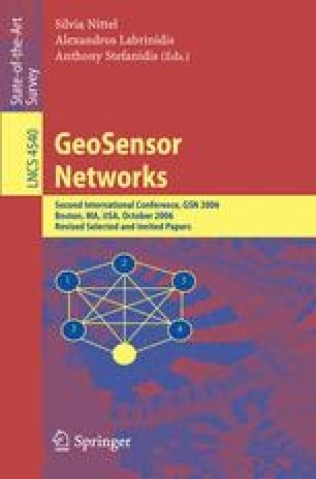
GeoSensor Networks : 2nd International Conference, GSN 2006, Boston, MA, USA, October 1-3, 2006, Revised Selected and Invited Papers
This book constitutes the thoroughly refereed proceedings of the Second GeoSensor Networks Conference, held in Boston, Massachusetts, USA, in October 2006. The conference addressed issues related to the collection, management, processing, analysis, and delivery of real-time geospatial data using distributed geosensor networks. This represents an evolution of the traditional static and centralized geocomputational paradigm.
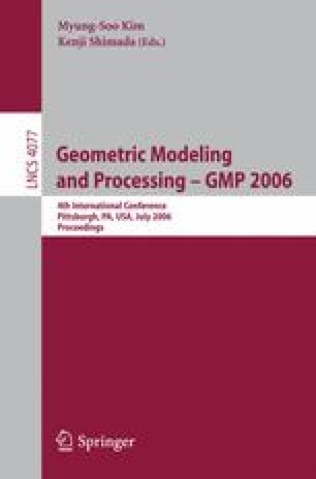
Geometric Modeling and Processing - GMP 2006 ; 4th International Conference, GMP 2006, Pittsburgh, PA, USA, July 26-28, 2006, Proceedings
This book constitutes the refereed proceedings of the 4th International Conference on Geometric Modeling and Processing, GMP 2006, held in Pittsburgh, PA, USA in July 2006. The 36 revised full papers and 21 revised short papers presented were carefully reviewed and selected from a total of 84 submissions. All current issues in the area of geometric modeling and processing are addressed and the impact in such areas as computer graphics, computer vision, machining, robotics, and scientific visualization is shown. The papers are organized in topical sections on shape reconstruction, curves and surfaces, geometric processing, shape deformation, shape description, shape recognition, geometric modeling, subdivision surfaces, and engineering applications.

Geographic Information Science ; 4th International Conference, GIScience 2006, Münster, Germany, September 20-23, 2006, Proceedings
The GIScience conference series (www. giscience. org) was created as a forum for all researchers who are interested in advancing research in the fundam- tal aspects of geographic information science.The conferences focus on emerging topics and basic research ?ndings across all s- tors of geographic information science. After three highly successful conferences in the United States, this year’s GIScience conference was held in Europe for the ?rst time. The GIScience conferences have been a meeting point for researchers coming from various disciplines, including cognitive science, computer science, engine- ing, geography,information science, mathematics, philosophy, psychology,social science, and statistics. The advancement of geographic information science - quiressuchinterdisciplinarybreadth,andthisisalsowhatmakestheconferences so exciting. In order to account for the di?erent needs of the involved scienti?c disciplines with regard to publishing their research results.
