



الصفحة 15
الصفحة 15
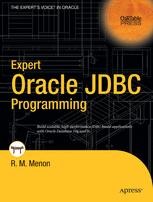
Expert Oracle JDBC Programming
JDBC is the most commonly used API in Java to access and manipulate data in a database. Oracle is one of the most popular and scalable databases in the world. This book is a must-have for any developer building an application that employs JDBC on Oracle database. Unlike other JDBC books, this book has been written to complement not rehash the contents of Oracle JDBC documentation and the JDBC specification. The book teaches you not just how to write JDBC code, but how to write effective JDBC code in a step-by-step fashion. This book does not assume any prior knowledge of JDBC, though it does assume basic knowledge of SQL and PL/SQL. It covers JDBC with a focus on writing high-performing, scalable and secure applications for Oracle 10g and 9i.
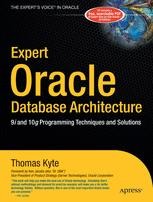
Expert Oracle Database Architecture : 9i and 10g Programming Techniques and Solutions
This is a defining book on the Oracle database for any developer or database administrator who works with Oracle-driven database applications. Tom Kyte has a simple philosophy: you can treat Oracle as a black box and just stick data into it or you can understand how it works and exploit it as a powerful computing environment. If you choose the latter, then you will find that there are few information management problems that you cannot solve quickly and elegantly. Expert Oracle Database Architecture is the first of a three-book series that completely explores and defines the Oracle database. It covers all of the most important Oracle architecture features, including: Files, memory structures and processes / Locking and latching / Transactions, concurrency and multi-versioning / Tables and Indexes / Datatypes / Partitioning and parallelism Each feature is taught in a proof-by-example manner, not only discussing what it is, but also how it works, how to implement software using it, and the common pitfalls associated with it.
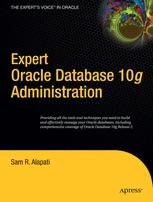
Expert Oracle Database 10g Administration
This book covers the new 10g management and performance tools and provides essential primers on Unix, Linux and Windows NT administration and on core SQL and PL/SQL programming techniques. And it provides everything the new and aspring Oracle database administrator needs to build and administer complex Oracle 10g databases.
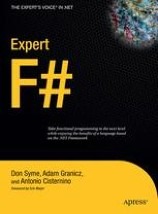
Expert F#
Expert F# is about practical programming in a beautiful language that puts the power and elegance of functional programming into the hands of .NET developers. In combination with .NET, F# achieves unrivaled levels of programmer productivity and program clarity. This books serves as: The authoritative guide to F# by the designer of F#. A comprehensive reference of F# concepts, syntax, and features. A treasury of expert F# techniques for practical, real–world programming.
Expert C++/CLI : .NET for Visual C++ Programmers
C++/CLI is Microsofts latest extension to C++ that targets the heart of .NET 2.0, the common language runtime. Expert Visual C++/CLI is written by visual C++ MVP Marcus Heege, who examines the core of the C++/CLI language. He explains both how the language elements work and how Microsoft intends them to be used.
Experimental and Efficient Algorithms ; 4th International Workshop, WEA 2005, Santorini Island, Greece, May 10-13, 2005, Proceedings
This proceedings volume contains the accepted papers and invited talks p- sented at the 4th International Workshop of E?cient and Experimental Al- rithms (WEA 2005), that was held May 10–13, on Santorini Island, Greece. The WEA events are intended to be an international forum for research on the design, analysis and especially the experimental implementation, evaluation and engineering of algorithms, as well as on combinatorial optimization and its applications. The?rstthreeworkshopsinthisserieswereheldinRiga(2001),MonteVerita (2003) and Rio de Janeiro (2004). Thisvolumecontains3invitedpapersrelatedtocorrespondingkeynotetalks.
Experimental Algorithms ; 7th International Workshop, WEA 2008 Provincetown, MA, USA, May 30-June 1, 2008 Proceedings
The Workshop on Experimental Algorithms, WEA, is intended to be an international forum for research on the experimental evaluation and engineering of algorithms, as well as in various aspects of computational optimization and its applications. The emphasis of the workshop is the use of experimental me- ods to guide the design, analysis, implementation, and evaluation of algorithms, heuristics, and optimization programs. WEA 2008 was held at the Provincetown Inn, Provincetown, MA, USA, on May 30 – June 1, 2008. This was the seventh workshop of the series.

Excel PivotTables Recipe Book : A Problem-Solution Approach
Excel Pivot Tables Recipe Book: A Problem-Solution Approach is for anyone who uses Excel frequently. This book follows a problem-solution format that covers the entire breadth of situations you might encounter when working with PivotTables—from planning and creating, to formatting and extracting data, to maximizing performance and troubleshooting. The author presents tips and techniques in this collection of recipes that cannot be found in Excel's Help section, and she carefully explains the most confusing features of PivotTables.

Excel 2007 PivotTables Recipes : A Problem-Solution Approach
You'll find this book when facing any new or difficult problem in PivotTables, covering the entire breadth of situations you could ever encounter, from planning and creating, to formatting and extracting data, to maximizing performance and troubleshooting.

Evolvable systems : From biology to hardware ; 8th International Conference, ICES 2008, Prague, Czech Republic, September 21-24, 2008. Proceedings
This book constitutes the refereed proceedings of the 8th International Conference on Evolvable Systems, ICES 2008, held in Prague, Czech Republic, in September 2008.The 28 revised full papers and 14 revised poster papers presented were carefully reviewed and selected from 52 submissions. The papers are organized in topical sections on evolution of analog circuits, evolution of digital circuits, hardware-software codesign and platforms for adaptive systems, evolutionary robotics, development, real-world applications, evolutionary networking, evolvable artificial neural networks, and transistor-level circuit evolution.

Evolvable Machines : Theory & Practice
Methods for the artificial evolution of active components, such as programs and hardware, are rapidly developing branches of adaptive computation and adaptive engineering. "Evolvable Machines" reports innovative and significant progress in automatic and evolutionary methodology applied to machine design. This book presents theoretical as well as practical chapters concentrating on Evolvable Robots, Evolvable Hardware Synthesis, as well as Evolvable Design.

Evolvable Hardware
The contributions in this book provide the basics of reconfigurable devices so that readers will be fully prepared to understand what EHW is, why it is necessary and how it is designed. The book also discusses the leading research in digital, analog and mechanical EHW. Selections from leading international researchers offer examples of cutting-edge research and applications, placing particular emphasis on their practical usefulness.

Evolutionary Synthesis of Pattern Recognition Systems
Evolutionary Synthesis of Pattern Recognition Systems presents novel effective approaches based on evolutionary computational techniques, such as genetic programming (GP), linear genetic programming (LGP), coevolutionary genetic programming (CGP) and genetic algorithms (GA) to automate the synthesis and analysis of object detection and recognition systems. The book’s concepts, principles, and methodologies will enable readers to automatically build robust and flexible systems—in a systematic manner—that can provide human-competitive performance and reduce the cost of designing and maintaining these systems. Its content covers all key aspects of object recognition: object detection, feature selection, feature discovery, object recognition, domain knowledge. Basic knowledge of programming and data structures, and some calculus, is presupposed.ing the book’s novel ideas
Evolutionary Multi-Criterion Optimization ; 4th International Conference, EMO 2007, Matsushima, Japan, March 5-8, 2007, Proceedings
Multicriterion optimization refers to problems with two or more objectives (normally in conflict with each other) which must be simultaneously satisfied. Evolutionary algorithms have been used for solving multicriterion optimization problems for over two decades, gaining an increasing attention from industry. This book included four keynote speakers: Hirotaka Nakayama on aspiration level methods, Kay Chen Tan on large and computationally intensive real-world MO optimization problems, Carlos Fonseca on decision making, and Gary B. Lamont on design of large-scale network centric systems.

Evolutionary Multi-Criterion Optimization ; 3rd International Conference, EMO 2005, Guanajuato, Mexico, March 9-11, 2005, Proceedings
Constitutes the refereed proceedings of the Third International Conference on Evolutionary Multi-Criterion Optimization, EMO 2005, held in Guanajuato, Mexico, in March 2005.

Evolutionary computation, machine learning and data mining in bioinformatics ; 6th European Conference, EvoBIO 2008, Naples, Italy, March 26-28, 2008. Proceedings
The feld of bioinformatics has two main objectives: the creation and main- nance of biological databases, and the discovery of knowledge from life sciences data in order to unravel the mysteries of biological function, leading to new drugs and therapies for human disease. Life sciences data come in the form of biological sequences, structures, pathways, or literature. One major aspect of discovering biological knowledge is to search, predict, or model specifc infortioninagivendatasetinorderto generate new in teresting knowledge.Computer science methods such as evolutionary computation, machine learning, and data mining all have a great deal to ofer the feld of bioinformatics.

Evolutionary Computation in Data Mining
This carefully edited book reflects and advances the state of the art in the area of Data Mining and Knowledge Discovery with Evolutionary Algorithms. It emphasizes the utility of different evolutionary computing tools to various facets of knowledge discovery from databases, ranging from theoretical analysis to real-life applications. "Evolutionary Computation in Data Mining" provides a balanced mixture of theory, algorithms and applications in a cohesive manner, and demonstrates how the different tools of evolutionary computation can be used for solving real-life problems in data mining and bioinformatics.
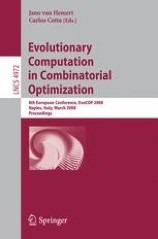
Evolutionary computation in combinatorial optimization ; 8th European Conference, EvoCOP 2008, Naples, Italy, March 26-28, 2008. Proceedings
Metaheuristics have been shown to be e?ective for di?cult combinatorial - timization problems appearing in various industrial, economical, and scientifc domains. Prominent examples of metaheuristics are evolutionary algorithms, tabu search, simulated annealing, scatter search, memetic algorithms, variable neighborhood search, iterated local search, greedy randomized adaptive search procedures, ant colony optimization and estimation of distribution algorithms. Problems solved successfully include scheduling, timetabling, network design, transportation and distribution, vehicle routing, the travelling salesman pr- lem, packing and cutting, satisfability and general mixed integer programming.

Event-Based Programming : Taking Events to the Limit
This book teaches you how to develop software based on parts that interact primarily through an event mechanism. You'll learn how to use events in many different situations, to solve recurring development problems without coupling. The book introduces Signal Wiring Diagram, a novel form of software diagram similar to the circuit diagrams used by hardware designers. The book concludes with a series of case studies, incorporating all featured concepts.
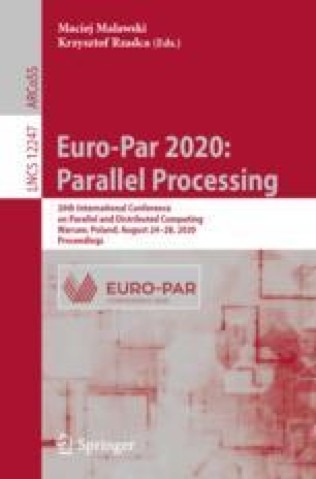
Euro-Par 2020 : Parallel Processing ; 26th International Conference on Parallel and Distributed Computing, Warsaw, Poland, August 24–28, 2020, Proceedings
This book constitutes the proceedings of the 26th International Conference on Parallel and Distributed Computing, Euro-Par 2020, held in Warsaw, Poland, in August 2020. The conference was held virtually due to the coronavirus pandemic. The 39 full papers presented in this volume were carefully reviewed and selected from 158 submissions. They deal with parallel and distributed computing in general, focusing on support tools and environments; performance and power modeling, prediction and evaluation; scheduling and load balancing; high performance architectures and compilers; data management, analytics and machine learning; cluster, cloud and edge computing; theory and algorithms for parallel and distributed processing; parallel and distributed programming, interfaces, and languages; multicore and manycore parallelism; parallel numerical methods and applications; and accelerator computing.
