



الصفحة 15
الصفحة 15
Formal Models of Operating System Kernels
The purpose of this book is to show that the formal specification of kernels is not only possible but also necessary if operating systems are to achieve the levels of reliability and security that is demanded of them today. Specifications of a sequence of kernels of increasing complexity are included, acting as models to enable the designer to identify and reason about the properties of the design – thus making explicit that which is too often left implicit or even unknown.
Formal Modeling and Analysis of Timed Systems ; Vol. 3829 ; 3rd International Conference, FORMATS 2005, Uppsala, Sweden, September 26-28, 2005, Proceedings
This book constitutes the thoroughly refereed post-proceedings of the Third International Conference on Formal Modeling and Analysis of Timed Systems, FORMATS 2005, held in Uppsala, Sweden in September 2005 in conjunction with ARTIST2 summer school on Component Modelling, Testing and Verification, and Static analysis of embedded systems. The 19 revised full papers presented together with the abstracts of 3 invited talks were carefully selected from 43 submissions. The papers cover work on semantics and modeling of timed systems, formalisms for modeling and verification including timed automata, hybrid automata, and timed petri nets, games for verification and synthesis, model-checking, case studies and issues related to implementation, security and performance analysis.

Formal Methods in Systems Biology ; 1st International Workshop, FMSB 2008, Cambridge, UK, June 4-5, 2008. Proceedings
This book constitutes the refereed proceedings of the First International Workshop on Formal Methods in Systems Biology, FMSB 2008, held in Cambridge, UK, in June, 2008.The 9 revised full papers presented were carefully reviewed and selected from the workshop lectures that all were invited contributions. The purpose of this meeting was to identify techniques for the specification, development and verification of biological models. It also focused on the design of tools to execute and analyze biological models that can significantly advance our understanding of biological systems.
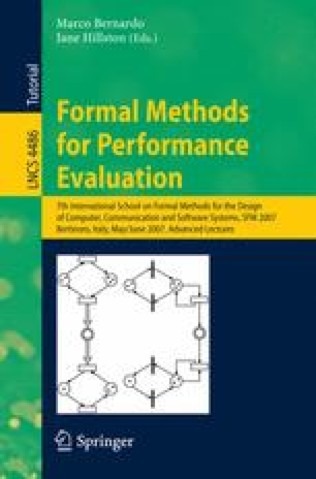
Formal Methods for Performance Evaluation ; 7th International School on Formal Methods for the Design of Computer, Communication, and Software Systems, SFM 2007, Bertinoro, Italy, May 8-June 2, 2007, Advanced Lectures
This book presents a set of 11 papers accompanying the lectures of leading researchers given at the 7th edition of the International School on Formal Methods for the Design of Computer, Communication and Software Systems, SFM 2007.

Formal Methods for Open Object-Based Distributed Systems ; Vol. 4037 ; 8th IFIP WG 6.1 International Conference, FMOODS 2006, Bologna, Italy, June 14-16, 2006, Proceedings
This book constitutes the refereed proceedings of the 8th IFIP WG 6.1 International Conference on Formal Methods for Open Object-Based Distributed Systems, FMOODS 2006, held in Bologna, Italy, June 2006. The book presents 16 revised full papers together with an invited paper and abstracts of 2 invited talks. Coverage includes component- and model-based design, service-oriented computing, software quality, modeling languages implementation, formal specification, verification, validation, testing, and service-oriented systems.
Formal Methods for Open Object-Based Distributed Systems ; Vol. 3535 ; 7th IFIP WG 6.1 International Conference, FMOODS 2005, Athens, Greece, June 15-17, 2005, Proceedings
This volume contains the proceedings of FMOODS2005, the 7th IFIPWG6. 1 International Conference on Formal Methods for Open Object-Based Distributed Systems. The conference was held in Athens, Greece on June 15-17, 2005. The eventwasthe seventh meeting ofthis conference series, whichis held roughly every year and a half, with the earlier events held respectively in Paris, Canterbury, Florence, Stanford, Twente, and Paris. The goal of the FMOOD Sseries of conferences is to bring together researchers whose work encompasses three important and related fields: - formal methods; - distributed systems; - object-based technology. Sucha convergenceis representative of recent advances in the field of distributed systems, and provides links between several scientific and technological communities, as represented by the conferences FORTE, CONCUR, and ECOOP. The objective of FMOODS is to provide an integrated forum for the pres- tation of research in the above-mentioned fields, and the exchange of ideas and experiences in the topics concerned with the formal methods support for open object-based distributed systems.

Formal Methods for Open Object-Based Distributed Systems ; 9th IFIP WG 6.1 International Conference, FMOODS 2007, Paphos, Cyprus, June 6-8, 2007, Proceedings
This book constitutes the refereed proceedings of the 9th IFIP WG 6.1 International Conference on Formal Methods for Open Object-Based Distributed Systems, FMOODS 2007, held in Paphos, Cyprus in June 2007. The papers are organized in topcical sections on model checking rewriting logic components and services algebraic calculi specification, verification and refinenment, and quality of service.
Formal Methods for Open Object-Based Distributed Systems ; 10th IFIP WG 6.1 International Conference, FMOODS 2008, Oslo, Norway, June 4-6, 2008 Proceedings
This book constitutes the refereed proceedings of the 10th IFIP WG 6.1 International Conference on Formal Methods for Open Object-Based Distributed Systems, FMOODS 2008, held in Oslo, Norway, in June 2008.The 14 revised full papers presented together with 1 invited lecture were carefully reviewed and selected from 35 submissions. The papers cover topcics such as semantics of object-oriented programming; formal techniques for specification, analysis, and refinement; model checking; theorem proving and deductive verification.
Formal Methods for Mobile Computing ; 5th International School on Formal Methods for the Design of Computer, Communication, and Software Systems, SFM-Moby 2005, Bertinoro, Italy, April 26-30, 2005, Advanced Lectures
This book presents 8 tutorial survey papers by leading researchers who lectured at the 5th International School on Formal Methods for the Design of Computer, Communication, and Software Systems, SFM 2005, held in Bertinoro, Italy in April 2005. SFM 2005 was devoted to formal methods and tools for the design of mobile systems and mobile communication infrastructures. The 8 lectures are organized into topical sections on models and languages, scalability and performance, dynamic power management, and middleware support.
Formal Methods for Hardware Verification ; 6th International School on Formal Methods for the Design of Computer, Communication, and Software Systems, SFM 2006, Bertinoro, Italy, May 22-27, 2006, Advances Lectures
This book presents 8 papers accompanying the lectures of leading researchers given at the 6th edition of the International School on Formal Methods for the Design of Computer, Communication and Software Systems (SFM 2006). SFM 2006 was devoted to formal techniques for hardware verification and covers several aspects of the hardware design process, including hardware design languages and simulation, property specification formalisms, automatic test pattern generation, symbolic trajectory evaluation, and more.

Formal Methods for Computational Systems Biology ; 8th International School on Formal Methods for the Design of Computer, Communication, and Software Systems, SFM 2008 Bertinoro, Italy, June 2-7, 2008 Advanced Lectures
This volume presents the set of papers accompanying the lectures of the eighth International School on Formal Methods for the Design of Computer, Com- nication, and Software Systems (SFM). This series of schools addresses the use of formal methods in computer science asaprominent approach to theri gorousdesign of computer, communication, and software systems. The main aim of the SFM series is to ofer a good spectrum of current research in foundations as well as applications of formal methods, which can be of help for graduate students and young researchers who intend to approach the feld.

Formal Methods for Components and Objects ; Vol. 4111 ; 4th International Symposium, FMCO 2005, Amsterdam, The Netherlands, November 1-4, 2005, Revised Lectures
This book presents 19 revised invited keynote lectures and revised tutorial lectures given by top-researchers at the 4th International Symposium on Formal Methods for Components and Objects, FMCO 2005, held in Amsterdam, Netherlands, in November 2005. The book provides a unique combination of ideas on software engineering and formal methods that reflect the current interest in the application or development of formal methods for large scale software systems such as component-based systems and object systems.

Formal Methods for Components and Objects ; Vol. 3657 ; 3rd International Symposium, FMCO 2004, Leiden, The Netherlands, November 2-5, 2004, Revised Lectures
This book presents revised tutorial lectures given by invited speakers at the Third International Symposium on Formal Methods for Components and Objects, FMCO 2004, held in Leiden, The Netherlands, in November 2004. The 14 revised lectures by leading researchers present a comprehensive account of the potential of formal methods applied to large and complex software systems such as component-based systems and object systems. The book provides an unique combination of ideas on software engineering and formal methods that reflect the expanding body of knowledge on modern software systems.

Formal Methods for Components and Objects ; 6th International Symposium, FMCO 2007, Amsterdam, The Netherlands, October 24-26, 2007, Revised Lectures
Formal methods have been applied successfully to the verification of medium-sized programs in protocol and hardware design.This book presents 12 revised papers submitted after the symposium by the speakers of each of the following European IST projects: the IST-FP6 project Mobius, developing the technology for establishing trust and security for the next generation of global computers; the IST-FP6 project SelfMan on self management for large-scale distributed systems based on structured overlay networks and components

Formal Methods and Testing : An Outcome of the FORTEST Network, Revised Selected Papers
This book constitutes the thoroughly refereed and peer-reviewed outcome of the Formal Methods and Testing (FORTEST) network - formed as a network established under UK EPSRC funding that investigated the relationships between formal (and semi-formal) methods and software testing - now being a subject group of two BCS Special Interest Groups: Formal Aspects of Computing Science (BCS FACS) and Special Interest Group in Software Testing (BCS SIGIST).

Formal Methods and Software Engineering; 9th International Conference on Formal Engineering Methods, ICFEM 2007, Boca Raton, Florida, USA, November 14-15, 2007, Proceedings
This book constitutes the refereed proceedings of the 9th International Conference on Formal Engineering Methods, ICFEM 2007, held in Boca Raton, Florida, USA, November 14-15, 2007. The papers address all current issues in formal methods and their applications in software engineering.
Formal Methods and Software Engineering ; Vol. 3785 ; 7th International Conference on Formal Engineering Methods, ICFEM 2005, Manchester, UK, November 1-4, 2005, Proceedings
This volume contains papers presented at the 7th International Conference on Formal Engineering Methods (ICFEM 2005), 1-4 November 2005, Manchester, UK. Formal engineering methods are changing the way that systems are dev- oped. With language and tool support, these methods are being used for se- automatic code generation, and for the automatic abstraction and checking of implementations. In the future, they will be used at every stage of development: requirements, speci?cation, design, implementation, testing, anddocumentation. The aim of ICFEM 2005 was to bring together those interested in the - plication of formal engineering methods to computer systems. Researchers and practitioners, from industry, academia, and government, were encouraged to - tend, and to help advance the state of the art. The conference was supported by sponsorships from Microsoft Research, USA, the Software Engineers Association of Japan, the University of Man- ester, Manchester City Council, FormalMethods Europe (FME) and the British Computer Society FormalAspects ofComputing Specialist Group(BCS-FACS). We wish to thank these sponsors for their generosity. The ?nal programme consisted of 3 invited talks and 30 technical papers selected from a total of 74 submissions. The invited speakers were: Anthony Hall, independent consultant, UK; Egon B] orger, University of Pisa, Italy; John Rushby, SRI, USA. Their talks were sponsored by BCS-FACS, Microsoft - search and FME respectively. We wish to thank the invited speakers for their inspiring talks.

Formal Methods and Hybrid Real-Time Systems : Essays in Honour of Dines Bjorner and Zhou Chaochen on the Occasion of Their 70th Birthdays
This paper presents a few of these, including a distributed garbage collection problem, distributed consensus problems for reconciling tree-like data structures, using model-based test case generation, and the use of software model checking in design and development process.

Formal aspects in security and trust ; Vol. 3866 ; 3rd International Workshop, FAST 2005, Newcastle upon Tyne, UK, July 18-19, 2005, Revised Selected Papers
This book constitutes the thoroughly refereed post-proceedings of the Third International Workshop on Formal Aspects in Security and Trust, FAST 2005, held in Newcastle upon Tyne, UK in July 2005. The papers focus on formal aspects in security and trust policy models, security protocol design and analysis, formal models of trust and reputation, logics for security and trust, distributed trust management systems, trust-based reasoning, digital assets protection, data protection, privacy and ID issues, information flow analysis, language-based security, security and trust aspects in ubiquitous computing, validation/analysis tools, web service security/trust/privacy, GRID security, security risk assessment, and case studies.
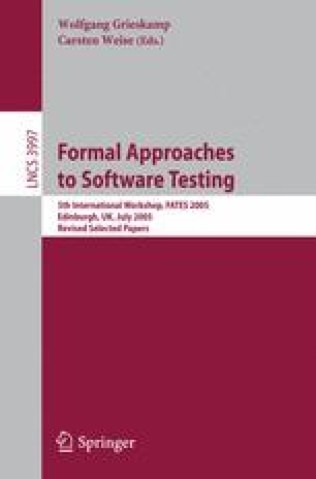
Formal approaches to software testing ; Vol. 3997 ; 5th International Workshop, FATES 2005, Edinburgh, UK, July 11, 2005, Revised Selected Papers
This book constitutes the thoroughly refereed post-proceedings of the 5th International Workshop on Formal Approaches to Software Testing, FATES 2005, held in Edinburgh, UK, in July 2005 in conjunction with CAV 2005.
