



الصفحة 12
الصفحة 12
Foundations of software science and computation structures ; 24th International conference, FOSSACS 2021, Held as Part of the European joint conferences on theory and practice of software, ETAPS 2021, Luxembourg City, Luxembourg, March 27 – April 1, 2021, proceedings
This book constitutes the proceedings of the 24th International Conference on Foundations of Software Science and Computational Structures, FOSSACS 2021, which was held during March 27 until April 1, 2021, as part of the European Joint Conferences on Theory and Practice of Software, ETAPS 2021. The conference was planned to take place in Luxembourg and changed to an online format due to the COVID-19 pandemic.

Foundations of software science and computation structures ; 23rd International conference, FOSSACS 2020, Held as part of the European joint conferences on theory and practice of software, ETAPS 2020, Dublin, Ireland, April 25–30, 2020, proceedings
This book constitutes the proceedings of the 23rd International Conference on Foundations of Software Science and Computational Structures, FOSSACS 2020, which took place in Dublin, Ireland, in April 2020, and was held as Part of the European Joint Conferences on Theory and Practice of Software, ETAPS 2020.
Foundations of software science and computation structures ; 22nd International conference, FOSSACS 2019, Held as part of the European joint conferences on theory and practice of software, ETAPS 2019, Prague, Czech Republic, April 6–11, 2019, proceedings
This book constitutes the proceedings of the 22nd International Conference on Foundations of Software Science and Computational Structures, FOSSACS 2019, which took place in Prague, Czech Republic, in April 2019, held as part of the European Joint Conference on Theory and Practice of Software, ETAPS 2019. The 29 papers presented in this volume were carefully reviewed and selected from 85 submissions. They deal with foundational research with a clear significance for software science.

Foundations of software science and computation structures ; 21st International conference, FOSSACS 2018, Held as part of the European joint conferences on theory and practice of software, ETAPS 2018, Thessaloniki, Greece, April 14–20, 2018. proceedings
Contains the papers presented at the 21st International Conference on Foundations of Software Science and Computation Structures (FoSSaCS 2018), which was held April 16–19, 2018, in Thessaloniki, Greece. The conference is dedicated to foundational research with a clear significance for software science and brings together research on theories and methods to support the analysis, integration, synthesis,transformation, and verification of programs and software systems.
Foundations of software science and computation structures ; 11th International conference, FOSSACS 2008, Held as part of the joint European conferences on theory and practice of software, ETAPS 2008, Budapest, Hungary, March 29 - April 6, 2008. proceedings
The fve main conferences received 571 submissions, 147 of which were accepted, giving an overall acceptance rate of less than 26%, with each conference below 27%.Congratulations there foretoall the authorswhomadeittothe fnalprogramme! I hope that most of the other authors will still have found a way of participating in this exciting event, and that you will all continue submitting to ETAPS and contributing to make of it the best conference in the area. The events that comprise ETAPS address various aspects of the system velopment process, including specifcation, design, implementation, analysis and improvement
Foundations of Security : What Every Programmer Needs to Know
Foundations of Security: What Every Programmer Needs to Know teaches new and current software professionals state-of-the-art software security design principles, methodology, and concrete programming techniques they need to build secure software systems.

Foundations of Qt Development
Foundations of Qt Development is based on Qt 4.2, and is aimed at C++ programmers who want to become proficient using this excellent toolkit to create graphical applications that can be ported to all major platforms. The book is focused on teaching you to write your own code in addition to using existing code. Common areas of confusion are identified, addressed, and answered.

Foundations of Popfly : Rapid Mashup Development
Author Eric Griffin shows you how to mix applications and share your hybrids with the world, using the Popfly Mashup Creator and Popfly Web Page Creator.
Foundations of Object-Oriented Programming Using .NET 2.0 Patterns
Foundations of Object-Oriented Programming Using .NET 2.0 Patterns solves the object-oriented and pattern-programming problem by mixing the two—the book teaches object-oriented concepts using patterns, or a solutions-based approach. The book's material is organized around tasks and patterns, and illustrated through development problems and solutions that include persistence, code efficiency, and good design. This book is of special interest to those who want to learn how to use .NET 2.0 Generics in conjunction with patterns. This unique book is based on the author's lectures, and the information unfolds in a practical manner.
Foundations of Java for ABAP Programmers
The only beginning book of its kind, this book will teach you SAP/ABAP developers the skills you need for Java 5 programming. The book emphasizes the fundamentals of core Java SE 5 and Java EE 5, to get you up to speed with these technologies. You'll learn about the most important enterprise Java API found in the new Java EE 5 platform, which you can immediately use and integrate. Furthermore, the book elaborates on connecting to a database, SAP Java Connector, servlets, Java Server Pages, Enterprise JavaBeans, and Java Messaging.
Foundations of Intelligent Systems ; Vol. 4203 ; 16th International Symposium, ISMIS 2006, Bari, Italy, September 27-29, 2006, Proceedings
This book constitutes the refereed proceedings of the 16th International Symposium on Methodologies for Intelligent Systems, ISMIS 2006. The book presents 81 revised papers together with 3 invited papers. Topical sections include active media human-computer interaction, computational intelligence, intelligent agent technology, intelligent information retrieval, intelligent information systems, knowledge representation and integration, knowledge discovery and data mining, logic for AI and logic programming, machine learning, text mining, and Web intelligence.
Foundations of Intelligent Systems ; Vol. 3488 ; 15th International Symposium ISMIS 2005, Saratoga Springs, NY, USA, May 25-28, 2005, Proceedings
This volume contains the papers selected for presentation at the 15th International S- posiumonMethodologiesforIntelligentSystems, ISMIS2005, heldinSaratogaSprings, NewYork,25-28May,2005. ThesymposiumwasorganizedbySUNYatAlbany. Itwas sponsored by the Army Research Of?ce and by several units of the University at Albany including its Division for Research, College of Arts and Sciences, Department of C- puter Science, and Institute for Informatics, Logics, and Security Studies (formerly the Institute for Programming and Logics). The Program Committee selected the following major areas for ISMIS 2005: intelligent information systems, knowledge discovery and data mining, knowledge - formation and integration, knowledge representation, logic for arti?cial intelligence, soft computing, Web intelligence, Web services, and papers dealing with applications of intelligent systems in complex/novel domains. The contributed papers were selected from almost 200 full draft papers by the Program Committee members.
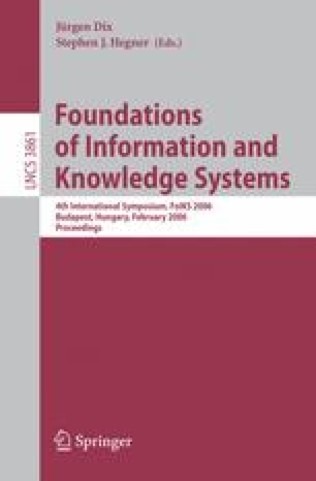
Foundations of information and knowledge systems ; 4th International Symposium, FoIKS 2006, Budapest, Hungary, February 14-17, 2006, Proceedings
This book constitutes the refereed proceedings of the 4th International Symposium on Foundations of Information and Knowledge Systems, held in February 2006. The 14 revised full papers presented together with three revised short papers and one invited paper were carefully reviewed and selected from 54 submissions. Among the topics covered are the theoretical foundations of information and knowledge systems, as well as mathematical fields such as discrete mathematics, combinatorics, logics and finite model theory, and applications thereof for research on database and knowledge base theory.

Foundations of GTK+ Development
GTK+ is one of the most influential graphical toolkits for the Linux operating system. It is the technology upon which the GNOME and XFCE desktop environments are based, and its crucial to have clear understanding of its complexities to build even a simple Linux desktop application. Foundations of GTK+ Development guides you through these complexities, laying the foundation that will allow you to cross from novice to professional.

Foundations of Genetic Algorithms ; 9th International Workshop, FOGA 2007, Mexico City, Mexico, January 8-11, 2007, Revised Selected Papers
Readers will find here a fascinating text that is the thoroughly refereed post-proceedings of the 9th Workshop on the Foundations of Genetic Algorithms, FOGA 2007, held in Mexico City in January 2007.

Foundations of genetic algorithms ; 8th International Workshop, FOGA 2005, Aizu-Wakamatsu City, Japan, January 5-9, 2005, Revised Selected Papers
The8thWorkshopontheFoundationsofGeneticAlgorithms,FOGA-8,washeld at the University of Aizu in Aizu-Wakamatsu City, Japan, January 5–9, 2005. This series of workshops was initiated in 1990 to encourage further research on the theoretical aspects of genetic algorithms, and the workshops have been held biennially ever since. The papers presented at these workshops are revised, edited and published as volumes during the year following each workshop. This series of (now eight) volumes provides an outstanding source of reference for the theoretical work in this ?eld. At the same time this series of volumes provides a clear picture of how the theoretical research has grown and matured along with the ?eld to encompass many evolutionary computation paradigms including evolution strategies (ES), evolutionary programming (EP), and genetic programming (GP), as well as the continuing growthininteractionswith other ?elds suchas mathematics,physics, and biology.

Foundations of F#
F# is much more than just an FP language. Every professional .NET programmer needs to learn about FP, and there's no better way to do it than by learning F#, and no easier way to learn F# than from Foundations of F#, and this is the first book to bring F# to the world.
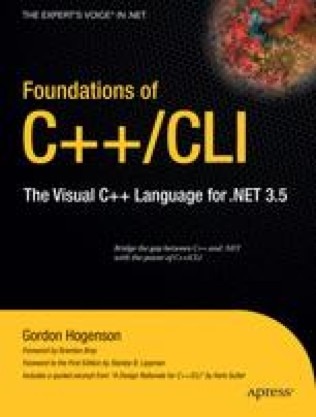
Foundations of C++/CLI : The Visual C++ Language for .NET 3.5
Foundations of C++/CLI: The Visual C++ Language for .NET 3.5 introduces C++/CLI, Microsoft's extensions to the C++ syntax that allow you to target the common language runtime, the key to the heart of the .NET Framework 3.5. This book gives you a small, fast–paced primer that will kick–start your journey into the world of C++/CLI. In 13 no–fluff chapters, Microsoft insiders take readers into the core of the C++/CLI language and explain both how the language elements work and how Microsoft intends them to be used. This book is a beginner's guide, but it assumes a familiarity with programming basics. And it concentrates on explaining the aspects of C++/CLI that make it the most powerful and fun language of the .NET Framework. As such, this book is ideal if you're thinking of migrating to C++/CLI from another language.
Foundations of AOP for J2EE Development
Foundations of AOP for J2EE Development covers a relatively new programming paradigm: aspect-oriented programming, or AOP. Presented are the core concepts of AOP: AspectJ 5, JBoss AOP, Spring AOP, and JAC. Specific features of these tools are compared. The book also explores the potential uses of AOP in everyday programming life, such as design patterns implementation, program testing, and application management. In the latter part of the book, the authors show how AOP can ease the task of J2EE application development (J2EE is known for being a rich and somewhat complicated framework).

Foundations of Agile Python Development
You've long been enamored with the Python language, and have mastered its many nuances. Yet something seems to be missing—a productivity boost that you know is possible but you're not sure how to go about it. This was the sentiment of so many developers before discovering Agile programming paradigm, which embraces concepts such as automation, effective code management, and test–driven development. Foundations of Agile Python Development is the first book to apply these sought–after principles to Python developers, introducing both the tools and techniques built and supported by the Python community. Authored by Jeff Younker, a well–known member of Python's agile community who is perhaps best known for his creation of a popular Python testing framework
