



Page 1
Page 1

Nonlinear Speech Modeling and Applications : Advanced Lectures and Revised Selected Papers
Presents the revised tutorial lectures given at the International Summer School on Nonlinear Speech Processing-Algorithms and Analysis held in Vietri sul Mare, Salerno, Italy in September 2004. The 14 revised tutorial lectures by leading international researchers are organized in topical sections on dealing with nonlinearities in speech signals, acoustic-to-articulatory modeling of speech phenomena, data driven and speech processing algorithms, and algorithms and models based on speech perception mechanisms. Besides the tutorial lectures, 15 revised reviewed papers are included presenting original research results on task oriented speech applications.
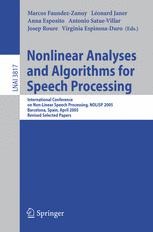
Nonlinear Analyses and Algorithms for Speech Processing ; International Conference on Non-Linear Speech Processing, NOLISP 2005, Barcelona, Spain, April 19-22, 2005, Revised Selected Papers
We present in this volume the collection of ?nally accepted papers of NOLISP 2005 conference. It has been the third event in a series of events related to N- linear speech processing, in the framework of the European COST action 277 “Nonlinear speech processing”. Many speci?cs of the speech signal are not well addressed by conv- tional models currently used in the ?eld of speech processing. The purpose of NOLISP is to present and discuss novel ideas, work and results related to alternative techniques for speech processing, which depart from mainstream approaches. With this intention in mind, we provide an open forum for discussion. Alt- nate approaches are appreciated, although the results achieved at present may not clearly surpass results based on state-of-the-art methods. The call for papers was launched at the beginning of 2005, addressing the following domains: 1. Non-Linear Approximation and Estimation 2. Non-Linear Oscillators and Predictors 3. Higher-Order Statistics 4. Independent Component Analysis 5. Nearest Neighbors 6. Neural Networks 7. Decision Trees 8. Non-Parametric Models 9. Dynamics of Non-Linear Systems 10. Fractal Methods 11. Chaos Modeling 12. Non-Linear Di?erential Equations 13. Others All the main ?elds of speech processing are targeted by the workshop, namely: 1. Speech Coding:Thebit rateavailablefor speechsignalsmustbe strictly l- ited in order to accommodate the constraints of the channel resource.

New trends in computational vision and bio-inspired computing : Selected works presented at the ICCVBIC 2018, Coimbatore, India
Gathers selected, peer-reviewed original contributions presented at the International Conference on Computational Vision and Bio-inspired Computing (ICCVBIC) conference which was held in Coimbatore, India, on November 29-30, 2018. The works included here offer a rich and diverse sampling of recent developments in the fields of Computational Vision, Fuzzy, Image Processing and Bio-inspired Computing. The topics covered include computer vision; cryptography and digital privacy; machine learning and artificial neural networks; genetic algorithms and computational intelligence; the Internet of Things; and biometric systems, to name but a few. The applications discussed range from security, healthcare and epidemic control to urban computing, agriculture and robotics.

Multimedia Forensics
Media forensics has never been more relevant to societal life. Not only media content represents an ever-increasing share of the data traveling on the net and the preferred communications means for most users, it has also become integral part of most innovative applications in the digital information ecosystem that serves various sectors of society, from the entertainment, to journalism, to politics. Undoubtedly, the advances in deep learning and computational imaging contributed significantly to this outcome. The underlying technologies that drive this trend, however, also pose a profound challenge in establishing trust in what we see, hear, and read, and make media content the preferred target of malicious attacks.

MICAI 2007 : Advances in artificial intelligence ; 6th Mexican International Conference on Artificial Intelligence, Aguascalientes, Mexico, November 4-10, 2007, Proceedings
The Mexican International Conference on Artificial Intelligence (MICAI), a yearly international conference series organized by the Mexican Society for Artificial Intelligence (SMIA), is a major international AI forum and the main event in the academic life of the country’s growing AI community.

Introduction to Video Search Engines
Their book has a practical emphasis with the goal of bringing readers up to date on the state of the art in multimedia search technologies and systems. It explains the overall process of video content acquisition, indexing and retrieval with browsing, it provides overviews of constituent technologies such as information retrieval, Internet video systems, video and multimedia processing to extract index data, and it gives examples of research prototypes and existing commercial systems and describes their features.

Intelligent system algorithms and applications in science and technology
Explores the application of intelligent techniques in various fields of engineering and technology. It addresses diverse topics in such areas as machine learning-based intelligent systems for healthcare, applications of artificial intelligence and the Internet of Things, intelligent data analytics techniques, intelligent network systems and applications, and inequalities and process control systems. The authors explore the full breadth of the field, which encompasses data analysis, image processing, speech processing and recognition, medical science and healthcare monitoring, smart irrigation systems, insurance and banking, robotics and process control, and more.

Implementation and application of automata ; Vol. 3317 ; 9th International Conference, CIAA 2004, Kingston, Canada, July 22-24, 2004, Revised Selected Papers
Contains the revised versions of the papers presented at the 9th International Conference on Implemen- tion and Application of Automata, CIAA 2004. Also included are the extended abstracts of the posters accepted to the conference. The conference was held at Queen’s University in Kingston, Ontario, Canada on July 22–24, 2004. As for its predecessors, the theme of CIAA 2004 was the implementation of automata and grammars of all types and their application in other fields. The topics of the papers presented at the conference range from applications of automata in natural language and speech processing to protein sequencing and genecompression, and from state complexity and new algorithms for automata operations to applications of quantum finite automata.
Fundamentals of multimedia ; 3rd ed.
Addresses real issues commonly faced in the workplace. The essential concepts are explained in a practical way to enable students to apply their existing skills to address problems in multimedia. Fully revised and updated, this new edition now includes coverage of such topics as 3D TV, social networks, high-efficiency video compression and conferencing, wireless and mobile networks, and their attendant technologies.

Fundamentals of multimedia ; 2nd ed.
Addresses real issues commonly faced in the workplace. The essential concepts are explained in a practical way to enable students to apply their existing skills to address problems in multimedia. Fully revised and updated, this new edition now includes coverage of such topics as 3D TV, social networks, high-efficiency video compression and conferencing, wireless and mobile networks, and their attendant technologies.

Fundamentals of Artificial Intelligence
Fundamentals of Artificial Intelligence introduces the foundations of present day AI and provides coverage to recent developments in AI such as Constraint Satisfaction Problems, Adversarial Search and Game Theory, Statistical Learning Theory, Automated Planning, Intelligent Agents, Information Retrieval, Natural Language & Speech Processing, and Machine Vision. The book features a wealth of examples and illustrations, and practical approaches along with the theoretical concepts. It covers all major areas of AI in the domain of recent developments. The book is intended primarily for students who major in computer science at undergraduate and graduate level but will also be of interest as a foundation to researchers in the area of AI.

Digital Image Processing : An Algorithmic Introduction using Java
This modern, self-contained, textbook explains the fundamental algorithms of digital image processing through practical examples and complete Java implementations.

Deep learning architecture and application
As one of the fastest-growing topics in machine learning, deep learning algorithms have achieved unprecedented success in recent years. Novel paradigms (such as contrastive learning and few-shot learning) in deep learning and rising neural network architectures (e.g., transformer and masked autoencoder) are dramatically changing the field of data-driven algorithms. More importantly, deep learning models are redefining the next generation of industrial applications spanning image recognition, speech processing, language translation, healthcare, and other sciences. For example, recent advances in deep representation learning are allowing us to learn about protein 3D structures, which sheds new light on fundamental medicine and biology along with potentially bringing in billions of dollars (e.g., in the pharmaceutical market).

Constraint solving and language processing
Contains selected and thoroughly revised papers plus contributions from invited speakers presented at the First International Workshop on C- straint Solving and Language Processing, held in Roskilde, Denmark, September 1–3, 2004. Constraint Programming and Constraint Solving, in particular Constraint Logic Programming, appear to be a very promising platform, perhaps the most promising present platform, for bringing forward the state of the art in natural language processing, this due to the naturalness in speci?cation and the direct relation to e?cient implementation. Language, in the present context, may - fer to written and spoken language, formal and semiformal language, and even general input data to multimodal and pervasive systems, which can be handled in very much the same ways using constraint programming. The notion of constraints, with slightly differing meanings, apply in the characterization of linguistic and cognitive phenomena, in formalized linguistic m- els as well as in implementation-oriented frameworks. Programming techniques for constraint solving have been, and still are, in a period with rapid devel- ment of new eficient methods and paradigms from which language processing can prompt. A common metaphor for human language processing is one big c- straint solving process in which the differently specified linguistic and cognitive phases take place in parallel and with mutual cooperation, which ?ts quite well with current constraint programming paradigms.

Computer and Information Sciences - ISCIS 2005 ; 20th International Symposium, Istanbul, Turkey, October 26 -- 28, 2005, Proceedings
This book constitutes the refereed proceedings of the 20th International Symposium on Computer and Information Sciences, ISCIS 2005, held in Istanbul, Turkey in October 2005. The 92 revised full papers presented together with 4 invited talks were carefully reviewed and selected from 491 submissions. The papers are organized in topical sections on computer networks, sensor and satellite networks, security and cryptography, performance evaluation, e-commerce and Web services, multiagent systems, machine learning, information retrieval and natural language processing, image and speech processing, algorithms and database systems, as well as theory of computing.

Computational Science - ICCS 2006 ; Vol. 3991 ; 6th International Conference, Reading, UK, May 28-31, 2006, Proceedings, Part I
The four-volume set LNCS 3991-3994 constitutes the refereed proceedings of the 6th International Conference on Computational Science, ICCS 2006, held in Reading, UK, in May 2006. The papers span the whole range of computational science.
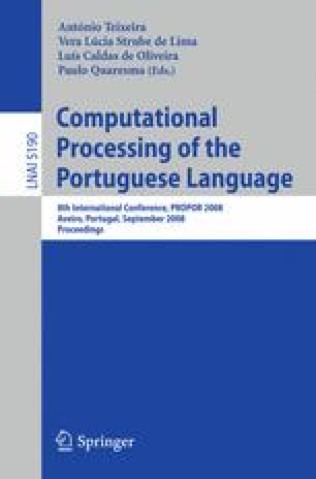
Computational Processing of the Portuguese Language ; 8th International Conference, PROPOR 2008 Aveiro, Portugal, September 8-10, 2008 Proceedings
This book constitutes the thoroughly refereed proceedings of the 8th International Workshop on Computational Processing of the Portuguese Language, PROPOR 2008, held in Aveiro, Portugal, in September 2008.

Computational Processing of the Portuguese Language ; 7th International Workshop, PROPOR 2006, Itatiaia, Brazil, May 13-17, 2006, Proceedings
Since 1993, PROPOR Workshops have become an important forum for - searchers involved in the Computational Processing of Portuguese,both written and spoken. The workshop and this book were structured around the following main t- ics, seven for full papers: (i) automatic summarization; (ii) resources; (iii) au- matic translation; (iv) named entity recognition; (v) tools and frameworks; (vi) systems and models; and another ?ve topics for short papers; (vii) information extraction; (viii) speech processing; (ix) lexicon; (x) morpho-syntactic studies; (xi) web, corpus and evaluation.

Computational linguistics and intelligent text processing ; Vol. 3878 ; 7th International Conference, CICLing 2006, Mexico City, Mexico, February 19-25, 2006, Proceedings
CICLing 2006 (www.CICLing.org) was the 7th Annual Conference on Intelligent Text Processing and Computational Linguistics. The CICLing conferences are intended to provide a wide-scope forum for discussion of the internal art and craft of natural language processing research and the best practices in its applications.
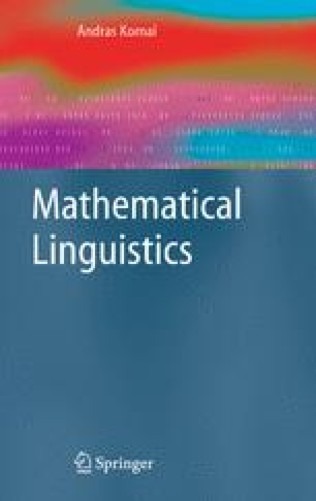
Mathematical Linguistics
Mathematical Linguistics introduces the mathematical foundations of linguistics to computer scientists, engineers, and mathematicians interested in natural language processing. The book presents linguistics as a cumulative body of knowledge from the ground up, with no prior knowledge of linguistics being assumed, covering more than the average two-semester introductory course in linguistics.This comprehensive, reader-friendly volume offers readers a high-level orientation, discussing the foundations of the field and presenting both the classical work and the most recent results. It covers an extremely rich array of topics including not only syntax and semantics but also phonology and morphology, probabilistic approaches, complexity, learnability, and the analysis of speech and handwriting.
