



Page 1
Page 1

Fiber-Optic Communication Systems
Contains substantial additions covering the topics of coherence detection, space division multiplexing, and more advanced subjects. You'll learn about topics like fiber’s losses, dispersion, and nonlinearities, as well as coherent lightwave systems. The latter subject has undergone major changes due to the extensive development of digital coherent systems over the last decade. Space-division multiplexing is covered as well, including multimode and multicore fibers developed in just the last ten years.
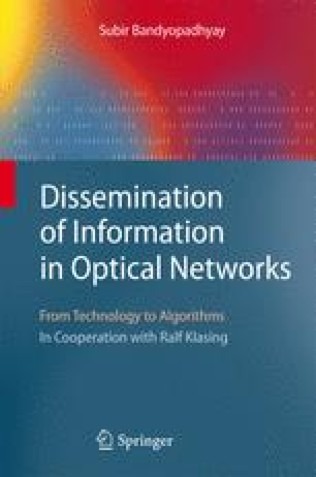
Dissemination of Information in Optical Networks : From Technology to Algorithms In Cooperation with Ralf Klasing
This book gives a broad overview of techniques used in the design of WDM networks for efficient dissemination of information in computer networks.

Laser additive manufacturing: design, materials, processes and applications
Laser-based additive manufacturing (LAM) is a revolutionary advanced digital manufacturing technology developed in recent decades, which is also a key strategic technology for technological innovation and industrial sustainability. This technology unlocks the design and constraints of traditional manufacturing and meets the needs of complex geometry fabrication and high-performance part fabrication. A deeper understanding of the design, materials, processes, structures, properties and applications is desired to produce novel functional devices, as well as defect-free structurally sound and reliable LAM parts.The topics in this Special Issue reprint include macro- and micro-scale additive manufacturing with lasers, such as structure/material design, fabrication, modeling and simulation, in situ characterization of additive manufacturing processes and ex situ materials characterization and performance, with an overview that covers various applications in aerospace, biomedicine, optics and energy.

Basic theoretical physics : A concise overview
This concise treatment embraces, in four parts, all the main aspects of theoretical physics (I . Mechanics and Basic Relativity, II. Electrodynamics and Aspects of Optics, III. Non-relativistic Quantum Mechanics, IV. Thermodynamics and Statistical Physics). It summarizes the material that every graduate student, physicist working in industry, or physics teacher should master during his or her degree course. It thus serves both as an excellent revision and preparation tool, and as a convenient reference source, covering the whole of theoretical physics. It may also be successfully employed to deepen its readers' insight and add new dimensions to their understanding of these fundamental concepts. Recent topics such as holography and quantum cryptography are included, thus making this a unique contribution to the learning material for theoretical physics.

Basic Principles of Fresnel Antenna Arrays
This book provides us a with the basics of the various Fresnel Antenna approaches, in order to achieve low-cost, low-profile, and lightweight antenna in the microwave/millimeter wave band. The book further presents a novel hexagonal FZPL antenna which can be more effectively packed in an array due to its shape.

Advances in optical fiber communications
Given the increasing importance of a globally interconnected world, driven by modern digital services and the need for fast and reliable access to digital resources, communication networks are one of the key infrastructures in today’s society. In this scenario, fiber optics and optical devices play a leading role, as they allow for unprecedented growth in our capacity to cope with the ever-increasing traffic demand. Optical transmission solutions range from high-speed networks based on coherent detection and advanced modulation formats for long-haul-level communications, to networks still relying on traditional intensity modulation and direct detection receivers for short-reach communications, down to intra-data center scenarios.

3-D Shape Estimation and Image Restoration : Exploiting Defocus and Motion-Blur
Images contain information about the spatial properties of the scene they depict. When coupled with suitable assumptions, images can be used to infer three-dimensional information. This useful volume concentrates on motion blur and defocus, which can be exploited to infer the 3-D structure of a scene—as well as its radiance properties—and which in turn can be used to generate novel images with better quality. 3-D Shape Estimation and Image Restoration presents a coherent framework for the analysis and design of algorithms to estimate 3-D shape from defocused and motion blurred images, and to eliminate defocus and motion blur to yield "restored" images. It provides a collection of algorithms that are optimal with respect to the chosen model and estimation criterion.
