



Page 9
Page 9

Distributed Applications and Interoperable Systems ; Vol. 4025 ; 6th IFIP WG 6.1 International Conference, DAIS 2006, Athens, Greece, June 14-16, 2006
This volume contains the proceedings of the IFIP WG 6.1 International Working Conference on Distributed Applications and Interoperable Systems VI held in Bologna, Italy, on June 14-16, 2006. The conference program presents the state of the art in research on d- tributed and interoperable systems. In recent years, distributed applications have indeed gained a practical and widely-known footing in everyday computing.

Distributed applications and interoperable systems ; Vol. 3543 ; 5th IFIP WG 6.1 International conference, DAIS 2005, Athens, Greece, June 15-17, 2005, Proceedings
ThisvolumecontainstheproceedingsoftheIFIPWG6. 1InternationalWorking Conference on Distributed Applications and Interoperable Systems V held in Athens, Greece, on June 15–17, 2005. The conference program presented the state of the art in research concerning distributed and interoperable systems. The emergence of 4th-generation c- munication systems, the evolution of Internet technologies, the convergence of telecom and datacom, wireless and ?xed communication systems and appli- tions pave the path for ubiquitous service and application provision. Innovative solutions are required for the development, implementation and operation of distributed applications in complex IT environments full of diversity and h- erogeneity. Today, the emerging wide spectrum of distributed systems.

Distributed Applications and Interoperable Systems ; 8th IFIP WG 6.1 International Conference, DAIS 2008, Oslo, Norway, June 4-6, 2008. Proceedings
This volume contains the proceedings of DAIS 2008, the 8th IFIP International Conference on Distributed Applications and Interoperable Systems.

Discrete geometry for computer imagery ; Vol. 3429 ; 12th International Conference, DGCI 2005, Poitiers, France, April 11-13, 2005, Proceedings
This book constitutes the refereed proceedings of the 12th International Conference on Discrete Geometry for Computer Imagery, DGCI 2005, held in Poitiers, France in April 2005. The 36 revised full papers presented together with an invited paper were carefully reviewed and selected from 53 submissions. The papers are organized in topical sections on applications, discrete hierarchical geometry, discrete tomography, discrete topology, object properties, reconstruction and recognition, uncertain geometry, and visualization.
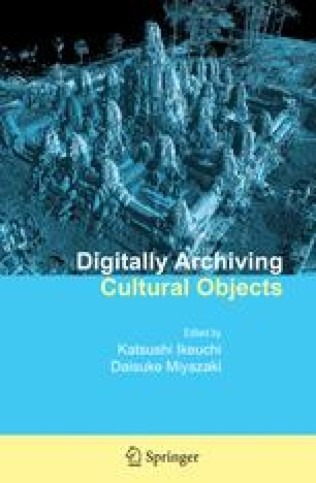
Digitally Archiving Cultural Objects
Digitally Archiving Cultural Objects describes thorough research and methods for preserving cultural heritage objects through the use of 3D digital data. These methods were developed through using computer vision and computer graphics technologies.

Digital twin : Architectures, networks, and applications
Offers comprehensive, self-contained knowledge on digital twin (DT), which is a very promising technology for achieving digital intelligence in the next-generation wireless communications and computing networks. DT is a key technology to connect physical systems and digital spaces in Metaverse. The objectives of this book are to provide the basic concepts of DT, to explore the promising applications of DT integrated with emerging technologies, and to give insights into the possible future directions of DT. For easy understanding, this book also presents several use cases for DT models and applications in different scenarios. The book starts with the basic concepts, models, and network architectures of DT. Then, we present the new opportunities when DT meets edge computing, Blockchain and Artificial Intelligence, and distributed machine learning (e.g., federated learning, multi-agent deep reinforcement learning).

Digital Libraries : Research and Development; 1st International DELOS Conference, Pisa, Italy, February 13-14, 2007, Revised Selected Papers
This book presented similarity search, architectures, personalization, interoperability, evaluation, miscellaneous, preservation, video data management, 3D objects, and peer to peer.

Digital Design of Nature : Computer Generated Plants and Organics
The reproduction of nature via computer has fascinated scientists in computer graphics and artists ever since synthetic imaging was thought possible. This book illustrates and exemplifies methods for the creation of artificial plant models, and the application of these methods within areas such as simulation, virtual reality, botany, landscaping, and architecture.The models are combined to create gardens, parks, and even entire landscapes.The range of creating representational forms reaches from deceptively authentic looking pictures to abstract presentations. In addition, with similar methods organic objects can be produced, changed, and animated.

Diagrammatic Representation and Inference ; 11th International Conference, Diagrams 2020, Tallinn, Estonia, August 24–28, 2020, Proceedings
This book constitutes the refereed proceedings of the 11th International Conference on the Theory and Application of Diagrams, Diagrams 2020, held in Tallinn, Estonia, in August 2020.* The 20 full papers and 16 short papers presented together with 18 posters were carefully reviewed and selected from 82 submissions. The papers are organized in the following topical sections: diagrams in mathematics; diagram design, principles, and classification; reasoning with diagrams; Euler and Venn diagrams; empirical studies and cognition; logic and diagrams; and posters.
Deterministic and statistical methods in Machine Learning ; 1st International Workshop, Sheffield, UK, September 7-10, 2004. Revised Lectures
This book consitutes the refereed proceedings of the First International Workshop on Machine Learning held in Sheffield, UK, in September 2004. The 19 revised full papers presented were carefully reviewed and selected for inclusion in the book. They address all current issues in the rapidly maturing field of machine learning that aims to provide practical methods for data discovery, categorisation and modelling. The particular focus of the workshop was advanced research methods in machine learning and statistical signal processing.

Designing virtual reality systems : The structured approach
Virtual Reality (VR) is a field of study that aims to create a system that provides a synthetic experience for its users. Developing and maintaining a VR system is a very difficult task, requiring in-depth knowledge in many different disciplines, such as sensing and tracking technologies, stereoscopic displays, multimodal interaction and processing, computer graphics and geometric modeling, dynamics and physical simulation, performance tuning, etc. The difficulty lies in the complexity of having to simultaneously consider many system goals, some of which are conflicting.

Designing machine learning systems : An iterative process for production-ready applications
Machine learning systems are both complex and unique. Each design decision--such as how to process and create training data, which features to use, how often to retrain models, and what to monitor--in the context of how it can help your system as a whole achieve its objectives. The iterative framework in this book uses actual case studies backed by ample references. The book will help you tackle scenarios such as: Engineering data and choosing the right metrics to solve a business problem Automating the process for continually developing, evaluating, deploying, and updating models Developing a monitoring system to quickly detect and address issues your models might encounter in production Architecting an ML platform that serves across use cases Developing responsible ML systems

Design Patterns in Modern C++20 : Reusable Approaches for Object-Oriented Software Design
As well as covering traditional design patterns, this book fleshes out new design patterns and approaches that will be useful to modern C++ developers. Author Dmitri Nesteruk presents concepts as a fun investigation of how problems can be solved in different ways, along the way using varying degrees of technical sophistication and explaining different sorts of trade-offs. You will: Use creational patterns such as builder, factories, prototype and singleton / Implement structural patterns such as adapter, bridge, decorator, facade and more / Work with the behavioral patterns such as chain of responsibility, command, iterator, mediator and more / Apply functional design patterns such as the Maybe Monad

Dependable computing ; 2nd Latin-American symposium, LADC 2005, Salvador, Brazil, October 25-28, 2005 : proceedings
Contains the proceedings of the 'Second Latin-American Symposium' on Dependable Computing, LADC 2005. This book comprises 16 papers presented together with 3 invited talks. The papers are organized in topical sections on evaluation, certification, modelling, embedded systems, time, and distributed systems algorithms.

Deepfake detection = اكتشاف التزييف العميق
In the rapidly evolving era of artificial intelligence, addressing the escalating threats of deepfake technology becomes a necessity because of the increasing sophistication of AI algorithms in generating deceptive content, and since it threatens the integrity of information across diverse data. The main objective is to build a sophisticated AI-driven system to detect different types of deepfake in text, audio, and images. In English text deepfake detection, multiple pre-trained tokenizers have been used, but XLNET and BERT stand out with identifying objects outside the dataset with an accuracy of 0.9809 and both have been generalized & trained using LSTM. In Arabic text deepfake detection, Arabert has been trained using LSTM which led with an accuracy of 99.53% by generalizing the model. Both English and Arabic datasets have been generated to enhance the accuracy and effectiveness of the models. Audio deepfake detection has been generalized too, using Random Forest with an accuracy of 98.259%.

Deep structure, singularities, and computer vision ; 1st international workshop, DSSCV 2005, Maastricht, The Netherlands, June 9-10, 2005, revised selected papers
Constitutes the refereed post-proceedings of the First International Workshop on Deep Structure, Singularities, and Computer Vision, DSSCV 2005, held in Maastricht. This book represents in understanding the relation between structural, topological information represented by singularities and metric information of signals, shapes, and colors.

Deep Statistical Comparison for Meta-heuristic Stochastic Optimization Algorithms
Presents a comprehensive comparison of the performance of stochastic optimization algorithms / Includes an introduction to benchmarking and statistical analysis / Provides a web-based tool for making statistical comparisons of optimization algorithms / Overviews of the current approaches used to analyze algorithm performance in a range of common scenarios, while also addressing issues that are often overlooked. In turn, it shows how these issues can be easily avoided by applying the principles that have produced Deep Statistical Comparison and its variants. The focus is on statistical analyses performed using single-objective and multi-objective optimization data. At the end of the book, examples from a recently developed web-service-based e-learning tool (DSCTool) are presented. The tool provides users with all the functionalities needed to make robust statistical comparison analyses in various statistical scenarios. The book is intended for newcomers to the field and experienced researchers alike. For newcomers, it covers the basics of optimization and statistical analysis, familiarizing them with the subject matter before introducing the Deep Statistical Comparison approach. Experienced researchers can quickly move on to the content on new statistical approaches.

Deep Learning to See : Towards New Foundations of Computer Vision
Topics and features: Presents a curiosity-driven approach, posing questions to stimulate readers to design novel computational models of vision Offers a rethinking of computer vision, arguing for an approach based on vision in nature, versus regarding visual signals as collections of images Provides an interdisciplinary commentary, aiming to unify computer vision, machine learning, human vision, and computational neuroscience Serving to inspire and stimulate critical reflection and discussion, yet requiring no prior advanced technical knowledge, the text can naturally be paired with classic textbooks on computer vision to better frame the current state of the art, open problems, and novel potential solutions.

Database Schema Evolution and Meta-Modeling ; 9th International Workshop on Foundations of Models and Languages for Data and Objects FoMLaDO/DEMM 2000 Dagstuhl Castle, Germany, September 18-21, 2000 Selected Papers
The Ninth International Workshop on Foundations of Models and Languages for Data and Objects (FoMLaDO) took place in Dagstuhl Germany, Sept- ber 18{21, 2000. The topic of this workshop was Database schema Evolution and Meta-Modeling; this FoMLaDO Workshop was hence assigned the acronym DEMM 2000.

Data Warehousing and Knowledge Discovery ; 4th International Conference, DaWaK 2002, Aix-en-Provence, France, September 4-6, 2002. Proceedings
Within the last few years Data Warehousing and Knowledge Discovery technology has established itself as a key technology for enterprises that wish to improve the quality of the results obtained from data analysis, decision support, and the automatic extraction of knowledge from data. The Fourth International Conference on Data Warehousing and Knowledge Discovery (DaWaK 2002) continues a series of successful conferences dedicated to this topic. Its main objective is to bring together researchers and practitioners to discuss research issues and experience in developing and deploying data warehousing and knowledge discovery systems, applications, and solutions.
