



Page 6
Page 6

Biological and medical data analysis ; Vol. 4345 : 7th International Symposium, ISBMDA 2006, Thessaloniki, Greece, December 7-8, 2006. Proceeding
This book constitutes the refereed proceedings of the 7th International Symposium on Biological and Medical Data Analysis, ISBMDA 2006, held in Thessaloniki, Greece, December 2006. Coverage in this volume includes functional genomics, sequence analysis, biomedical models, information modeling, biomedical signal processing, biomedical image analysis, biomedical data analysis, as well as decision support systems and diagnostic tools.
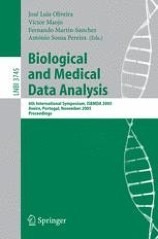
Biological and medical data analysis ; Vol. 3745 ; 6th International symposium, ISBMDA 2005, Aveiro, Portugal, November 10-11, 2005, Proceedings
The 6th International Symposium on Biological and Medical Data Analysisaimed to become a place where researchersinvolved in these diverse but increas-ingly complementary areas could meet topresent and discuss their scientificresults.The papers in this volume discuss issues from statistical models to archi-tectures and applications to bioinformatics and biomedicine. They cover bothpractical experience and novel research ideas and concepts.
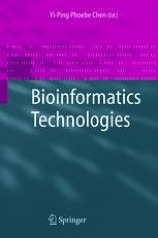
Bioinformatics technologies
Solving modern biological problems requires advanced computational methods. Bioinformatics evolved from the active interaction of two fast-developing disciplines, biology and information technology. The central issue of this emerging field is the transformation of often distributed and unstructured biological data into meaningful information. This book describes the application of well-established concepts and techniques from areas like data mining, machine learning, database technologies, and visualization techniques to problems like protein data analysis, genome analysis and sequence databases. Chen has collected contributions from leading researchers in each area. The chapters can be read independently, as each offers a complete overview of its specific area, or, combined, this monograph is a comprehensive treatment that will appeal to students, researchers, and R&D professionals in industry who need a state-of-the-art introduction into this challenging and exciting young field.
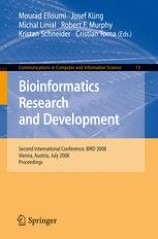
Bioinformatics research and development ; 2nd International Conference, BIRD 2008 Vienna, Austria, July 7-9, 2008 Proceedings
This book constitutes the refereed proceedings of the Second International Bioinformatics Research and Development Conference, BIRD 2008, held in Vienna, Austria in July 2008.
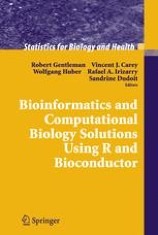
Bioinformatics and Computational Biology Solutions Using R and Bioconductor
Bioconductor is a widely used open source and open development software project for the analysis and comprehension of data arising from high-throughput experimentation in genomics and molecular biology. Bioconductor is rooted in the open source statistical computing environment R. This volume's coverage is broad and ranges across most of the key capabilities of the Bioconductor project, including: Importation and preprocessing of high-throughput data from microarray, proteomic, and flow cytometry platforms / Curation and delivery of biological metadata for use in statistical modeling and interpretation. / Statistical analysis of high-throughput data, including machine learning and visualization,modeling and visualization of graphs and networks. This book is a dynamic document. Code underlying all of the computations that are shown is made available on a companion website, and readers can reproduce every number, figure, and table on their own computers.
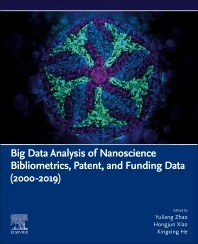
Big data analysis of nanoscience bibliometrics, patent, and funding data (2000-2019)
Presents an evaluation of nanotechnologies outputs (academic outputs and patents) and their impact from 2000-2019. The evaluation uses Elsevier’s Scopus (the largest abstract and citation database of peer-reviewed literature), SciVal (a scientific research analysis platform), Funding Institutional (a funding database), and PatentSight (a patent analysis platform). It covers four key topics regarding nanoscience research, including: 1) An overview of nano-related scholarly output, 2) Nanoscience and its contribution to basic science, 3) Nanoscience and its impact on and collaboration with industry partners, and 4) Key factors that promote the development of nanoscience.
Big Data : An Art of Decision Making
Manipulating and processing masses of digital data is never a purely technical activity. It requires an interpretative and exploratory outlook - already well known in the social sciences and the humanities - to convey intelligible results from data analysis algorithms and create new knowledge. Big Data is based on an inquiry of several years within Proxem, a software publisher specializing in big data processing. The book examines how data scientists explore, interpret and visualize our digital traces to make sense of them, and to produce new knowledge. Grounded in epistemology and science and technology studies, Big Data offers a reflection on data in general, and on how they help us to better understand reality and decide on our daily actions.
Beginning relational data modeling
Data storage design, and awareness of how data needs to be utilized within an organization, is of prime importance in ensuring that company data systems work efficiently. 'Beginning Data Modeling' leads readers you step by step through the process of developing an effective logical data model for a relational database model.

Beginning Excel What-If Data Analysis tools : Getting started with goal seek, data tables, scenarios, and solver
Excels what-if data analysis tools let you experiment with your data to project future results. In turn, these predictions will lead to better decision making and unlock the mystery of many business analysis scenarios. For example, what-if data analysis tools will enable you to forecast how lowering the price per unitwhile increasing projected unit salesmight affect your profit margins. Beginning Excel What-If Data Analysis Tools explores the use of Goal Seek, Data Tables, Scenarios, and Solver to help you get insight on your data. This book is focused and to the point, and it provides tutorial treatment of what-if tools in a practical, hands-on manner.
Bayesian reliability
Bayesian Reliability presents modern methods and techniques for analyzing reliability data from a Bayesian perspective. The adoption and application of Bayesian methods in virtually all branches of science and engineering have significantly increased over the past few decades. This increase is largely due to advances in simulation-based computational tools for implementing Bayesian methods. The authors extensively use such tools throughout this book, focusing on assessing the reliability of components and systems with particular attention to hierarchical models and models incorporating explanatory variables. Such models include failure time regression models, accelerated testing models, and degradation models. The authors pay special attention to Bayesian goodness-of-fit testing, model validation, reliability test design, and assurance test planning. Throughout the book, the authors use Markov chain Monte Carlo (MCMC) algorithms for implementing Bayesian analyses--algorithms that make the Bayesian approach to reliability computationally feasible and conceptually straightforward.
Artificial neural networks : Formal Models and Their Applications – ICANN 2005 ; 15th International Conference, Warsaw, Poland, September 11-15, 2005, Proceedings, Part II
The second volume contains 162 contributions related to Formal Models and their Applications and deals with new neural network models, supervised learning algorithms, ensemble-based learning, unsupervised learning, recurent neural networks, reinforcement learning, bayesian approaches to learning, learning theory, artificial neural networks for system modeling, decision making, optimalization and control, knowledge extraction from neural networks, temporal data analysis, prediction and forecasting, support vector machines and kernel-based methods, soft computing methods for data representation, analysis and processing, data fusion for industrial, medical and environmental applications, non-linear predictive models for speech processing, intelligent multimedia and semantics, applications to natural language processing, various applications, computational intelligence in games, and issues in hardware implementation.

Artificial neural networks : Biological Inspirations – ICANN 2005 ; 15th International Conference, Warsaw, Poland, September 11-15, 2005, Proceedings, Part I
The two volume set LNCS 3696 and LNCS 3697 constitutes the refereed proceedings of the 15th International Conference on Artificial Neural Networks, ICANN 2005, held in Warsaw, Poland in September 2005. The over 600 papers submitted to ICANN 2005 were thoroughly reviewed and carefully selected for presentation. The first volume includes 106 contributions related to Biological Inspirations; topics addressed are modeling the brain and cognitive functions, development of cognitive powers in embodied systems spiking neural networks, associative memory models, models of biological functions, projects in the area of neuroIT, evolutionary and other biological inspirations, self-organizing maps and their applications, computer vision, face recognition and detection, sound and speech recognition, bioinformatics, biomedical applications, and information- theoretic concepts in biomedical data analysis.

Artificial neural networks - ICANN 2008 ; 18th International Conference, Prague, Czech Republic, September 3-6, 2008, Proceedings, Part II
This two volume set LNCS 5163 and LNCS 5164 constitutes the refereed proceedings of the 18th International Conference on Artificial Neural Networks, ICANN 2008, held in Prague Czech Republic, in September 2008.

Artificial neural networks – ICANN 2007 ; 17th International Conference, Porto, Portugal, September 9-13, 2007, Proceedings, Part I
This book contains learning theory, advances in neural network learning methods, ensemble learning, spiking neural networks, advances in neural network architectures neural network technologies, neural dynamics and complex systems, data analysis, estimation, spatial and spatio-temporal learning, evolutionary computing, meta learning, agents learning, complex-valued neural networks, as well as temporal synchronization and nonlinear dynamics in neural networks.

Artificial intelligence and security ; 6th International Conference, ICAIS 2020, Hohhot, China, July 17–20, 2020, Proceedings, Part II
This two-volume set LNCS 12239-12240 constitutes the refereed proceedings of the 6th International Conference on Artificial Intelligence and Security, ICAIS 2020, which was held in Hohhot, China, in July 2020. The conference was formerly called “International Conference on Cloud Computing and Security” with the acronym ICCCS. The total of 142 full papers presented in this two-volume proceedings was carefully reviewed and selected from 1064 submissions. The papers were organized in topical sections as follows: Part I: Artificial intelligence and internet of things. Part II: Internet of things, information security, big data and cloud computing, and information processing.

Artificial intelligence and security ; 6th International Conference, ICAIS 2020, Hohhot, China, July 17–20, 2020, Proceedings, Part I
This two-volume set LNCS 12239-12240 constitutes the refereed proceedings of the 6th International Conference on Artificial Intelligence and Security, ICAIS 2020, which was held in Hohhot, China, in July 2020. The conference was formerly called “International Conference on Cloud Computing and Security” with the acronym ICCCS. The total of 142 full papers presented in this two-volume proceedings was carefully reviewed and selected from 1064 submissions. The papers were organized in topical sections as follows: Part I: Artificial intelligence and internet of things. Part II: Internet of things, information security, big data and cloud computing, and information processing.
Applied Informatics; Third International Conference, ICAI 2020, Ota, Nigeria, October 29–31, 2020, Proceedings
This book constitutes the thoroughly refereed papers of the Second International Conference on Applied Informatics, ICAI 2020, held in Ota, Nigeria, in October 2020. The 35 full papers were carefully reviewed and selected from 101 submissions. The papers are organized in topical sections on artificial intelligence; business process management; cloud computing; data analysis; decision systems; health care information systems; human-computer interaction; image processing; learning management systems; software design engineering.

Applied and computational mathematics for digital environments
Contains the 11 papers that were accepted and published in the Special Issue “Applied and Computational Mathematics for Digital Environments” of the MDPI Mathematics journal. The topics of interest include, among others, scientific research, applied tasks, and problems in the following areas: The construction of mathematical and information models of intelligent computer systems for monitoring and controlling the parameters of digital environments; The development of intelligent optimization algorithms that search for optimal parameter values of mathematical and information models in digital environments; Software and mathematical technologies in the implementation of intelligent monitoring and computer control of the parameters of digital environments; The development and application of mathematical and information models, machine learning methods, and artificial intelligence for the analysis and processing of big data in digital environments.

An Invitation to Statistics in Wasserstein Space
This book presents the key aspects of statistics in Wasserstein spaces, i.e. statistics in the space of probability measures when endowed with the geometry of optimal transportation.
Algorithms in Bioinformatics ; Vol. 3692 ; 5th international workshop, WABI 2005, Mallorca, Spain, October 3-6, 2005, Proceedings
this book present the proceedings of the 5th Workshop on Algorithmsin Bioinformatics (WABI 2005) which took place in Spain, 2005. The Workshop on Algorithms in Bioinformatics highlights research workspecifically developed to address algorithmic problems in biosequence analysis. The emphasis is therefore on statistical and probabilistic algorithms that addressimportant problems in the field of molecular and structural biology. the workshop aims to present recent research results, includingsignificant work in progress, and to identify and explore directions of futureresearch.Original research papers (including significant work in progress) or state-of-the-art surveys were solicited on all aspects of algorithms in bioinformatics,including, but not limited to: exact and approximate algorithms for genomics,genetics, sequence analysis, gene and signal recognition, alignment, molecularevolution, phylogenetics, structure determination or prediction, gene expressionand gene networks, proteomics, functional genomics, and drug design.
