



Page 2
Page 2

Gesture in Human-Computer Interaction and Simulation ; 6th International Gesture Workshop, GW 2005, Berder Island, France, May 18-20, 2005, Revised Selected Papers
The international Gesture Workshops have become the leading interdisciplinary events for dissemination of the latest results on gesture-based communication. The goal of these workshops is to bring together researchers who want to meet and share ideas on advanced research on gesture related to multidisciplinary scienti?c ?elds. Depending on the ?elds, the objectives can be very di?erent. While physiology and biomechanics aim to extract fundamental knowledge of physical gesture, computer sciences try to capture di?erent aspects of gesture and extract features that help to identify, interpret or rebuild the underlying mechanisms of communication gestures. Other approaches and methodologies are followed by cognitive sciences and linguistics, bringing a complementary - derstanding of motor control and gesture meaning. The results can be enhanced by technological applications or demonstrations.

From Program to Product : Turning Your Code into A Saleable Product
Many would–be software entrepreneurs with expertise in many fields attempt to turn a homegrown application—one developed for use in their own business or profession—into a commercial product. Lack of knowledge, experience, or skills often prevents the idea from ever taking shape, let alone achieving its potential. Entering a new field to start a business leaves many developers unprepared and not even fully aware that it's something they know so little about. They will also often have a job that conflicts with the time commitment required to market the program well enough for it to become a complete success.

First Steps : Developing BizTalk Applications
First Steps: Developing BizTalk Applications is a primer to most other introductory BizTalk books. If you feel like traditional beginning books are too abstract, and that you are mired in detail and missing the “big picture,” check out this book. It's a jumpstart to learning BizTalk. You'll learn about the product in a phased approach.

Eye Tracking Methodology : Theory and Practice
Despite the availability of cheap, fast, accurate and usable eye trackers, there is still little information available on how to develop, implement and use these systems. This second edition of Andrew Duchowski’s successful guide to these systems contains significant additional material on the topic and fills this gap in the market with this accessible and comprehensive introduction. Opening with useful background information, including an introduction to the human visual system and key issues in visual perception and eye movement, the second part surveys eye-tracking devices and provides a detailed introduction to the technical requirements necessary for installing a system and developing an application program. The book focuses on video-based, corneal-reflection eye trackers – the most widely available and affordable type of system, before closing with a look at a number of interesting and challenging applications in human factors, collaborative systems, virtual reality, marketing and advertising.

Enabling things to talk : Designing IoT solutions with the IoT architectural reference model
The Internet of Things (IoT) is an emerging network superstructure that will connect physical resources and actual users. It will support an ecosystem of smart applications and services bringing hyper-connectivity to our society by using augmented and rich interfaces. Whereas in the beginning IoT referred to the advent of barcodes and Radio Frequency Identification (RFID), which helped to automate inventory, tracking and basic identification, today IoT is characterized by a dynamic trend toward connecting smart sensors, objects, devices, data and applications. The next step will be “cognitive IoT,” facilitating object and data re-use across application domains and leveraging hyper-connectivity, interoperability solutions and semantically enriched information distribution.

E-Business@Print : Internet-based services and processes
The Internet has opened up exciting new opportunities for print media companies, enabling information to be processed for both paper and online output. It also offers new possibilities for print media companies to work increasingly closely with customers and production partners. The author provides a comprehensive overview of the new services that are now available and the new processes that the Internet enables. The reader is systematically guided through the various specialist terms, and numerous examples are used to illustrate possible applications, e.g. online editing systems, Web-based project management tools and online tracking of print jobs.

Dynamical Vision ; ICCV 2005 and ECCV 2006 Workshops, WDV 2005 and WDV 2006, Beijing, China, October 21, 2005, Graz, Austria, May 13, 2006, Revised Papers
Classical multiple-view geometry studies the reconstruction of a static scene - served by a rigidly moving camera. However, in many real-world applications the scene may undergo much more complex dynamical changes. For instance, the scene may consist of multiple moving objects (e.g., a trafic scene) or arti- lated motions (e.g., a walking human) or even non-rigid dynamics (e.g., smoke, fire, or a waterfall). In addition, some applications may require interaction with the scene through a dynamical system (e.g., vision-guided robot navigation and coordination). To study the problem of reconstructing dynamical scenes, many new al- braic, geometric, statistical, and computational tools have recently emerged in computer vision, computer graphics, image processing, and vision-based c- trol.
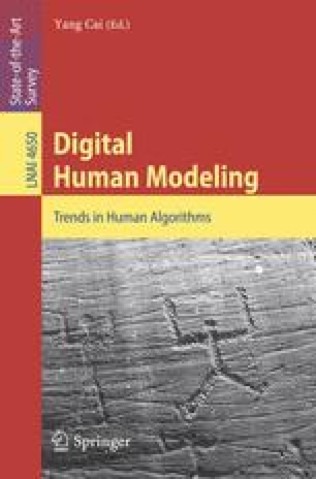
Digital Human Modeling : Trends in Human Algorithms
The emerging information technologies have given rise to new human patterns in terms of both physiological and psychological interactions. Human Algorithms aim to model human forms, interactions, and dynamics in this new context.

Diagrammatic Representation and Inference ; 5th International Conference, Diagrams 2008, Herrsching, Germany, September 19-21, 2008. Proceedings
This book constitutes the refereed proceedings of the 5th International Conference on Theory and Application of Diagrams, Diagrams 2008, held in Herrsching, Germany, in September 2008.

Diabetes genetic finder & predictor = أداة البحث والتنبؤ الجيني لمرض السكري
The diabetes genetic finder & predictor app is a comprehensive, user-friendly solution that revolutionizes diabetes care. This powerful app integrates a wide array of features designed to empower diabetes patients and enhance their overall well-being. A standout feature of the app is its ability to predict the risk of hereditary diabetes diseases, offering users early detection and intervention opportunities. It also predicts general diabetes risk, diabetic foot complications, and retinopathy. Users can monitor their blood sugar levels, heart rate, and oxygenation either manually or through smart watch integration. Additionally, users can enter their diabetes type and HbA1c levels.The app's medication management feature simplifies the complex task of tracking and organizing medications, providing timely reminders to ensure adherence to treatment plans. Users can scan QR codes on products to check their sugar content and suitability, schedule their medications, generate reports for specific periods, and access a comprehensive list of frequently asked questions about diabetes..

Designing virtual reality systems : The structured approach
Virtual Reality (VR) is a field of study that aims to create a system that provides a synthetic experience for its users. Developing and maintaining a VR system is a very difficult task, requiring in-depth knowledge in many different disciplines, such as sensing and tracking technologies, stereoscopic displays, multimodal interaction and processing, computer graphics and geometric modeling, dynamics and physical simulation, performance tuning, etc. The difficulty lies in the complexity of having to simultaneously consider many system goals, some of which are conflicting.

Deep Learning-Based Face Analytics
Provides an overview of different deep learning-based methods for face recognition and related problems. Specifically, the authors present methods based on autoencoders, restricted Boltzmann machines, and deep convolutional neural networks for face detection, localization, tracking, recognition, etc. The authors also discuss merits and drawbacks of available approaches and identifies promising avenues of research in this rapidly evolving field.

Database systems for advanced applications ; Vol. 3453 ; 10th international conference, DASFAA 2005, Beijing, China, April 17-20, 2005, Proceedings
Data Stream Mining and Resource Adaptive Computation.- Purpose Based Access Control for Privacy Protection in Database Systems.- Complex Networks and Network Data Mining.- Bioinformatics.- Indexing DNA Sequences Using q-Grams.- PADS: Protein Structure Alignment Using Directional Shape Signatures.- LinkageTracker: A Discriminative Pattern Tracking Approach to Linkage Disequilibrium Mapping.- Watermarking and Encryption.- Query Optimization in Encrypted Database Systems.- Watermarking Spatial Trajectory Database.- Effective Approaches for Watermarking XML Data.- XML Query Processing.- A Unifying Framework for Merging and Evaluating XML Information.- Efficient Evaluation of Partial Match Queries for XML Documents Using Information Retrieval Techniques.- PathStack: A Holistic Path Join Algorithm for Path Query with Not-Predicates on XML Data.- XML Coding and Metadata Management.- An Improved Prefix Labeling Scheme: A Binary String Approach for Dynamic Ordered XML.- Efficiently Coding and Indexing XML Document.- XQuery-Based TV-Anytime Metadata Management.- Data Mining.- Effective Database Transformation and Efficient Support Computation for Mining Sequential Patterns.

Covid-19 tracking application with user helping features
The era of mobile technology opens the windows to the mobile apps. The websites are vanishing and the mobile phones are emerging. In light of the development of applications on mobile and their widespread spread, especially Service (SOA) ones. It’s the time to change from conventional websites to apps, which has become the part of our daily routine. We are introducing “Covid 19 Tracker” “Covid 19 Tracker” is an interactive App used to assist the Ministry of Health to provide protection and health care for citizens and residents referred to domestic isolation or quarantine; to ensure their safety and enhance their recovery procedures.

Control Reconfiguration of Dynamical Systems : Linear Approaches and Structural Tests
The book addresses advanced engineering students, developers and researchers that have a specific interest in control reconfiguration. A good understanding of multi-variable dynamic systems is helpful, but the second part is accessible even without this.

Control of Robot Manipulators in Joint Space
Robot control is the backbone of robotics, an essential discipline in the maintenance of high quality and productivity in modern industry. The most common method of control for industrial robotic manipulators relies on the measurement and amendment of joint displacement: so-called "joint-space control

Computer Vision in Human-Computer Interaction ; Vol.3979 ; ECCV 2006 Workshop on HCI, Graz, Austria, May 13, 2006, Proceedings
This volume presents the proceedings of the HCI 2006 Workshop, held in conjunction with ECCV 2006 (European Conference on Computer Vision) in Graz, Austria. The goal of this workshop was to bring together researchers from the field of computer vision whose work is related to human–computer interaction.

Computer vision in human-computer interaction ; Vol. 3766
Human-Computer Interaction (HCI) lies at the crossroads of many scienti?c areas including arti?cial intelligence, computer vision, face recognition, motion tracking, etc. In order for HCI systems to interact seamlessly with people, they need to understand their environment through vision and auditory input. Mo- over, HCI systems should learn how to adaptively respond depending on the situation. The goal of this workshop was to bring together researchers from the ?eld of computer vision whose work is related to human-computer interaction. The selected articles for this workshop address a wide range of theoretical and - plication issues in human-computer interaction ranging from human-robot - teraction, gesture recognition, and body tracking, to facial features analysis and human-computer interaction systems.

Computer Vision and Internet of Things : Technologies and Applications
Explores the utilization of Internet of Things (IoT) with computer vision and its underlying technologies in different applications areas. Using a series of present and future applications – including business insights, indoor-outdoor securities, smart grids, human detection and tracking, intelligent traffic monitoring, e-health departments, and medical imaging – this book focuses on providing a detailed description of the utilization of IoT with computer vision and its underlying technologies in critical application areas, such as smart grids, emergency departments, intelligent traffic cams, insurance, and the automotive industry.

Computer vision - ECCV 2008 ; 10th European conference on computer vision, Marseille, France, October 12-18, 2008, Proceedings, Part IV
The four-volume set comprising LNCS volumes 5302/5303/5304/5305 constitutes the refereed proceedings of the 10th European Conference on Computer Vision, ECCV 2008, held in Marseille, France, in October 2008.
