



Page 10
Page 10
Advanced Intelligent Computing Theories and Applications : With Aspects of Artificial Intelligence ; 3rd International Conference on Intelligent Computing, ICIC 2007, Qingdao, China, August 21-24, 2007, Proceedings
The International Conference on Intelligent Computing (ICIC) was formed to provide an annual forum dedicated to the emerging and challenging topics in artificial intelligence, machine learning, bioinformatics, and computational biology, etc. It aims to bring gether researchers and practitioners from both academia and industry to share ideas, problems and solutions related to the multifaceted aspects of intelligent computing.This year, the conference concentrated mainly on the theories and methodologies as well as the emerging applications of intelligent computing. Its aim was to unify the picture of contemporary intelligent computing techniques as an integral concept that highlights the trends in advanced computational intelligence and bridges theoretical research with applications.

Advanced driver assistance system (ADAS)
The purpose of Advanced Driver Assistance Systems (ADAS) is to reduce or eliminate driver errors, and to enhance efficiency in traffic and transportation. Our project is a means and a great contribution to safe driving, and the user does not need to install sensors or hard tools to the vehicle, and through it, the cost can be reduced and maintenance cost can be eliminated. The images are processed and segmented to find different features in the image. Segmented images are used for identification and classification based on various machine learning algorithms and neural networks. The main focus of ADAS technologies is to contribute to factors such as safety management and automated, stress-free driving for the driver
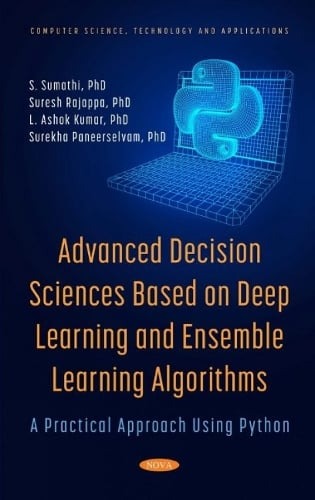
Advanced Decision Sciences Based on Deep Learning and Ensemble Learning Algorithms : A Practical Approach Using Python
Describes the deep learning models and ensemble approaches applied to decision-making problems. The authors have addressed the concepts of deep learning, convolutional neural networks, recurrent neural networks, and ensemble learning in a practical sense providing complete code and implementation for several real-world examples. The authors of this book teach the concepts of machine learning for undergraduate and graduate-level classes and have worked with Fortune 500 clients to formulate data analytics strategies and operationalise these strategies.
Adaptive and Natural Computing Algorithms ; 8th International Conference, ICANNGA 2007, Warsaw, Poland, April 11-14, 2007, Proceedings, Part I
Constitutes the refereed proceedings of the 8th International Conference on Adaptive and Natural Computing Algorithms, ICANNGA 2007, held in Warsaw, Poland, in April 2007. The 178 revised full papers presented were carefully reviewed and selected from a total of 474 submissions. The 94 papers of the first volume are organized in topical sections on evolutionary computation, genetic algorithms, particle swarm optimization, learning, optimization and games, fuzzy and rough systems, just as classification and clustering. The second volume contains 84 contributions related to neural networks, support vector machines, biomedical signal and image processing, biometrics, computer vision, as well as to control and robotics.
A Matrix Algebra Approach to Artificial Intelligence
The book consists of two parts: the first discusses the fundamentals of matrix algebra in detail, while the second focuses on the applications of matrix algebra approaches in AI. Highlighting matrix algebra in graph-based learning and embedding, network embedding, convolutional neural networks and Pareto optimization theory, and discussing recent topics and advances, the book offers a valuable resource for scientists, engineers, and graduate students in various disciplines
