



Page 10
Page 10
Implementation of functional languages ; 15th International Workshop, IFL 2003, Edinburgh, UK, September 8-11, 2003. Revised Papers
This book constitutes the thoroughly refereed post-proceedings of the 15th International Workshop on the Implementation of Functional Languages, IFL 2003, held in Edinburgh, UK in September 2003. The 11 revised full papers presented were carefully selected during two rounds of reviewing and revision from 32 workshop presentations. The papers are organized in topical sections on language constructs and programming, static analysis and types, parallelism, and generic programming.
Implementation and Applications of Automata ; 13th International Conference, CIAA 2008, San Francisco, California, USA, July 21-24, 2008. Proceedings
This book constitutes the thoroughly refereed post-proceedings of the 13th International Conference on Implementation and Application of Automata, CIAA 2008, held in San Francisco, USA, in July 2008.The 26 revised full papers togehter with 4 invited papers were carefully reviewed and selected from 40 submissions and have gone through two rounds of reviewing and improvement. The papers cover various topics in the theory, implementation, and applications of automata and related structures.

Implementation and Application of Automata ; Vol. 4094 ; 11th International Conference, CIAA 2006, Taipei, Taiwan, August 21-23, 2006, Proceedings
This book constitutes the refereed proceedings of the 11th International Conference on Implementation and Application of Automata, CIAA 2006, held in Taipei, Taiwan, in August 2006.

Implementation and Application of Automata ; Vol. 3845 ; 10th International Conference, CIAA 2005, Sophia Antipolis, France, June 27-29, 2005, Revised Selected Papers
Contains the notes of the two invited lectures, the 26 papers selected for presentation at the conference, and the abstracts of the eight posters that were displayed.

Implementation and application of automata ; Vol. 3317 ; 9th International Conference, CIAA 2004, Kingston, Canada, July 22-24, 2004, Revised Selected Papers
Contains the revised versions of the papers presented at the 9th International Conference on Implemen- tion and Application of Automata, CIAA 2004. Also included are the extended abstracts of the posters accepted to the conference. The conference was held at Queen’s University in Kingston, Ontario, Canada on July 22–24, 2004. As for its predecessors, the theme of CIAA 2004 was the implementation of automata and grammars of all types and their application in other fields. The topics of the papers presented at the conference range from applications of automata in natural language and speech processing to protein sequencing and genecompression, and from state complexity and new algorithms for automata operations to applications of quantum finite automata.

Impact of artificial intelligence on organizational transformation
Covers the areas like artificial intelligence & its impact on professions, as well as machine learning algorithms and technologies. The context of applications of AI in business process innovation primarily includes new business models, AI readiness and maturity at the organizational, technological, financial, and cultural levels. The book has extensive details on machine learning and the applications such as robotics, blockchain, Internet of Things. Also discussed are the influence of AI on financial strategies and policies, human skills & values, procurement innovation, production innovation, AI in marketing & sales platforms.

Image and video retrieval ; Vol. 3568 ; 4th International conference, CIVR 2005, Singapore, July 20-22, 2005, Proceedings
It was our great pleasure to host the 4th International Conference on Image and Video Retrieval (CIVR) at the National University of Singapore on 20–22 July 2005. CIVR aims to provide an international forum for the discussion of research challenges and exchange of ideas among researchers and practitioners in image/video retrieval technologies. It addresses innovative research in the broad ?eld of image and video retrieval. A unique feature of this conference is the high level of participation by researchers from both academia and industry. Another unique feature of CIVR this year was in its format – it o?ered both the traditional oral presentation sessions, as well as the short presentation cum poster sessions. The latter provided an informal alternative forum for animated discussions and exchanges of ideas among the participants.After a rigorous review process, 20 papers were accepted for oral presentations, and 42 papers were accepted for poster presentations. In addition to the accepted submitted papers, the program also included 4 invited papers, 1 keynote industrial paper, and 4 invited industrial papers. Altogether, we o?ered a diverse and interesting program, addressing the current interests and future trends in this area.

Image Analysis and Recognition ; 4th International Conference, ICIAR 2007, Montreal, Canada, August 22-24, 2007, Proceedings
These papers cover image restoration and enhancement, image and video processing and analysis, image segmentation, computer vision, pattern recognition for image analysis, shape and matching, motion analysis, tracking, and more.

Identification of nonlinear systems using neural networks and polynomial models : A block-oriented approach
The book gives a comparative study of their gradient approximation accuracy, computational complexity, and convergence rates and furthermore presents some new and original methods concerning the model parameter adjusting with gradient-based techniques. "Identification of Nonlinear Systems Using Neural Networks and Polynomal Models".

Hyperparameter tuning for machine and deep learning with R : A practical guide
Equips readers with the ability to achieve better results with significantly less time, costs, effort and resources using the methods described here. The case studies presented in this book can be run on a regular desktop or notebook computer. The content focuses on the hyperparameter tuning of ML and DL algorithms, and is divided into two main parts: theory (Part I) and application (Part II). Essential topics covered include: a survey of important model parameters; four parameter tuning studies and one extensive global parameter tuning study; statistical analysis of the performance of ML and DL methods based on severity; and a new, consensus-ranking-based way to aggregate and analyze results from multiple algorithms.

Hydra = هايدرا
Forgery involves the use of advanced algorithms to replicate and distribute deceptive products across various categories, casting shadows of doubt on the authenticity of goods. Although counterfeit detection can be useful in identifying and mitigating fraudulent activities, the widespread presence of counterfeit goods poses significant dangers, undermining consumer confidence and brand reputation. To underscore the severity of this issue, consider instances such as fake luxury items flooding the market, counterfeit electronics compromising safety, or bogus pharmaceuticals endangering health. Addressing this issue is critical in maintaining the integrity of brands, safeguarding consumer well-being, and preserving trust in the marketplace. The ability to distinguish between authentic and counterfeit products is paramount in ensuring accurate decision-making and preventing the harmful consequences of fraudulent goods. This technological context underscores the urgency of developing and deploying cutting-edge solutions to combat the evolving landscape of product forgery. Hydra emerges as a robust solution, utilizing a comprehensive approach that includes extracting posts and images from search engine tools, and is integrated with AI models to detect forgery. The Hydra platform not only provides users with a powerful tool for detecting counterfeit products but also offers tangible benefits such as enhanced brand security, increased awareness about the prevalence of forgeries, and the opportunity to actively participate in a real-time community.

Hybrid Systems : Computation and Control ; Vol.3927 ; 9th International Workshop, HSCC 2006, Santa Barbara, CA, USA, March 29-31, 2006, Proceedings
The focus is on modeling, analysis, and implementation of dynamic and reactive systems involving both discrete and continuous behaviors. Topics addressed include tools for analysis and verification, control and optimization, modeling, engineering applications, and new directions in language support and implementation.

Hybrid Systems : Computation and Control ; 11th International Workshop, HSCC 2008, St. Louis, MO, USA, April 22-24, 2008. Proceedings
Contains the proceedings ofthe 11th Workshop on Hybrid Systems: Computation and Control (HSCC 2008) held in St. Louis, Missouriduring April 22–24,2008.The annual workshop on hybrid systems focuses on research inbedded ,reactive systems in volving theinterplay between symbolic/switchingand continuous dynamical behaviors. HSCC attracts academic as well as industrial researchers to exchange information on the latest developments of applications and theoretical advancements in the design, analysis, control, optimization, and implementation of hybrid systems, with particular attention to embedded and networked control systems. We would like to thank the Program Committee members and the reviewers for an excellent job of evaluating the submissions and participating in the online Program Committee discussions.

Hybrid Systems : Computation and Control ; Vol. # 3414 ; 8th International Workshop, HSCC 2005, Zurich, Switzerland, March 9-11, 2005, Proceedings
Contains the proceedings of the 8th Workshop on Hybrid S- tems: Computation and Control(HSCC2005)heldinZurich, Switzerlandduring March 9-11, 2005. The annual workshop on hybrid systems attracts researchers from academia and industry interested in modeling, analysis, and implemen- tion of dynamic and reactive systems involving both discrete and continuous - haviors. This year's HSCC was technically co-sponsored by the IEEE Control Systems Society. The program consisted of 3 invited talks and 40 regular papers selected from 91 regular submissions. The program covered topics such as tools for analysis and verification, control and optimization, modeling, engineering applications, and emerging directions in programming language support and implementation. We would like to thank the Program Committee members and reviewers for an excellent job of evaluating the submissions and participating in the online Program Committee discussions.

Hybrid metaheuristics ; Vol. 4030 ; 3rd International Workshop, HM 2006, Gran Canaria, Spain, October 13-14, 2006, Proceedings
The selection of papers for HM 2006 consolidated some of the mainstream issues that have emerged from the past editions. Firstly, there are prominent examples of e?ective hybrid techniques whose design and implementation were motivated by challenging real-world applications. We believe this is particularly important for two reasons: on the one hand, researchers are conscious that the primary goal of developing algorithms is to solve relevant real-life problems; on the other hand, the path towarde?cient solving methods for practical problems is a source of new outstanding ideas and theories. A second important issue is that the research community on metaheur- tics has become increasingly interested in and open to techniques and methods known from arti?cial intelligence (AI) and operations research (OR). So far, the most representative examples of such integration have been the use of AI/OR techniques as subordinates of metaheuristic methods. As a historical and - ymological note, this is in perfect accordance with the original meaning of a metaheuristic as a “general strategy controlling a subordinate heuristic. ” The awareness of the need for a sound experimental methodology is a third keypoint.
Hybrid metaheuristics ; Vol. 3636 ; 2nd International Workshop, HM 2005, Barcelona, Spain, August 29-30, 2005. Proceedings
Constitutes the refereed proceedings of the Second International Workshop on Hybrid Metaheuristics, HM 2005, held in Barcelona, Spain, in August 2005. In this book, the papers addresses topics such as: low-level hybridization, high-level hybridization, portfolio techniques, expert systems, co-operative search, taxonomy, terminology, and more.
Hybrid metaheuristics ; 4th International Workshop,HM 2007, Dortmund, Germany, October 8-9, 2007, Proceedings
This book constitutes the refereed proceedings of the 4th International Workshop on Hybrid Metaheuristics, HM 2007, held in Dortmund, Germany. The 14 revised full papers discuss specific aspects of hybridization of metaheuristics, hybrid metaheuristics design, development and testing.

Hybrid Intelligent Systems for Pattern Recognition Using Soft Computing : An Evolutionary Approach for Neural Networks and Fuzzy Systems
This monograph describes new methods for intelligent pattern recognition using soft computing techniques including neural networks, fuzzy logic, and genetic algorithms. Hybrid intelligent systems that combine several soft computing techniques are needed due to the complexity of pattern recognition problems.
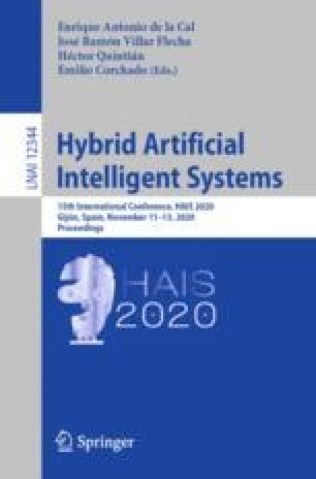
Hybrid Artificial Intelligent Systems ; 15th International Conference, HAIS 2020, Gijón, Spain, November 11-13, 2020, Proceedings
This book constitutes the refereed proceedings of the 15th International Conference on Hybrid Artificial Intelligent Systems, HAIS 2020, held in Gijón, Spain, in November 2020. The 65 regular papers presented in this book were carefully reviewed and selected from 106 submissions. The papers are grouped into these topics: advanced data processing and visualization techniques; bio-inspired models and optimization; learning algorithms; data mining, knowledge discovery and big data; and hybrid artificial intelligence applications.

Human-centered visualization environments : GI-Dagstuhl Research Seminar, Dagstuhl Castle, Germany, March 5-8, 2006, Revised Papers
This tutorial book features an augmented selection of the material presented at the GI-Dagstuhl Research Seminar on Human-Centered Visualization Environments, HCVE 2006, held in Dagstuhl Castle, Germany in March 2006. It presents eight tutorial lectures that are the thoroughly cross-reviewed and revised versions of the summaries and findings presented and discussed at the seminar.
