



الصفحة 1
الصفحة 1

Information Systems Reengineering and Integration
This text takes a practical approach to re-engineering existing systems and looks at data integration, and focuses on proven methods and tools for: •the conversion of hierarchical or network database systems into relational database technology, or from relational to object-oriented and XML databases •the integration of database systems and expert systems to produce MIS and EIS systems Taking a very practical approach, the book describes in detail database conversion techniques, reverse engineering and forward engineering, and re-engineering methodology for information systems, offering a systematic software engineering approach for reusing existing database systems built with "old" technology. Many examples, illustrations and case studies are used, making the methodology easy to follow.

Fuzzy database modeling with XML
Fuzzy Database Modeling with XML aims to provide a single record of current research and practical applications in the fuzzy databases. This volume is the outgrowth of research the author has conducted in recent years. Fuzzy Database Modeling with XML introduces state of the art information to the database research, while at the same time serving the information technology professional faced with a non-traditional application that defeats conventional approaches. The research on fuzzy conceptual models and fuzzy object-oriented databases is receiving increasing attention, in addition to fuzzy relational database models. With rapid advances in network and internet techniques as well, the databases have been applied under the environment of distributed information systems. It is essential in this case to integrate multiple fuzzy database systems. Since databases are commonly employed to store and manipulate XML data, additional requirements are necessary to model fuzzy information with XML. Second, this book maps fuzzy XML model to the fuzzy databases. Very few efforts at investigating these issues have thus far occurred.

Foundation XML for Flash
XML is a completely platform-agnostic data medium. Flash is able to make use of XML data, which is very useful when creating rich Internet applications. It allows you to populate Flash web interfaces with data from almost any source that supports XML as a data medium, be it databases, raw XML files, or more excitingly, .NET applications, Web Services, and even Microsoft Office applications like Excel and Word! In this book, Sas Jacobs first introduces XML itself—what it is, its syntax, its associated technologies (such as CSS and XSLT,) and how to get XML out of your applications in a format Flash can use. Then, she shows how to use the XML object to stream XML data into Flash, and how to use the XMLConnector component and XML Sockets to build advanced Flash/XML applications.

Database systems for advanced applications ; Vol. 3453 ; 10th international conference, DASFAA 2005, Beijing, China, April 17-20, 2005, Proceedings
Data Stream Mining and Resource Adaptive Computation.- Purpose Based Access Control for Privacy Protection in Database Systems.- Complex Networks and Network Data Mining.- Bioinformatics.- Indexing DNA Sequences Using q-Grams.- PADS: Protein Structure Alignment Using Directional Shape Signatures.- LinkageTracker: A Discriminative Pattern Tracking Approach to Linkage Disequilibrium Mapping.- Watermarking and Encryption.- Query Optimization in Encrypted Database Systems.- Watermarking Spatial Trajectory Database.- Effective Approaches for Watermarking XML Data.- XML Query Processing.- A Unifying Framework for Merging and Evaluating XML Information.- Efficient Evaluation of Partial Match Queries for XML Documents Using Information Retrieval Techniques.- PathStack: A Holistic Path Join Algorithm for Path Query with Not-Predicates on XML Data.- XML Coding and Metadata Management.- An Improved Prefix Labeling Scheme: A Binary String Approach for Dynamic Ordered XML.- Efficiently Coding and Indexing XML Document.- XQuery-Based TV-Anytime Metadata Management.- Data Mining.- Effective Database Transformation and Efficient Support Computation for Mining Sequential Patterns.
Database and XMLTechnologies ; 5th International XML Database Symposium, XSym 2007, Vienna, Austria, September 23-24, 2007, Proceedings
This book discuss the use of and synergy between databases and XML. It provided theory and practice of XML data management and its applications. This volume also contains current research in XPath and XQuery processing, XML Updates, Temporal XML and Constraints.

Database and XML Technologies ; Vol. 4156 ; 4th International XML Database Symposium, XSym 2006, Seoul, Korea, September 10-11, 2006, Proceedings
The theme of the XML Database Symposium (XSym) is the convergence of database technology with XML technology. Since the first International XML Symposium in 2003, XSym has continued to provide a forum for academics, practitioners, users and vendors to discuss the use of and synergy between advanced XML technologies. XSym 2006 received 32 full paper submissions. Each submitted paper underwent a rigorous review by independent referees. These proceedings represent a collection of eight excellent research papers. Their focus is on building XML repositories and covers the following topics: XML query processing, caching, indexing and navigation support, structural matching, temporal XML, and XML updates.
Database and XML Technologies ; Vol. 3671 ; 3rd international XML database symposium, XSym 2005, Trondheim, Norway, August 28-29, 2005, Proceedings
Constitutes the proceedings of the Third International XML Database Symposium, XSym 2005, held in Trondheim, Norway in August 2005. The 15 papers are organized in sections on indexing support for the evaluation of XPath and XQuery; benchmarks and algorithms for XQuery and XPath evaluation; algorithms for constraint satisfaction checking, and more.

Data Management. Data, Data Everywhere ; 24th British National Conference on Databases, BNCOD 24, Glasgow, UK, July 3-5, 2007, Proceedings
One of the most pressing challenges is to ?nd ways of evolving database technology to cope with its new role in underpinning the massively distributed and heterogeneous applications built on top of the Internet. This has afiected both the ways in which data has been accessed and the ways in which it is represented, with XML data management becoming an important issue and, as such, heavily represented at this conference. It has also brought back issues of performance that might have been considered largely solved by the improvements in hardware, since data now has to be managed on devices of low power and small memory as well as on standard client and powerful server machines. We therefore invited papers on all aspects of data management, particularly related to how dataisused in the ubiquitous environment of the modern Internet by complex distributed and scientific applications.
Knowledge Discovery from XML Documents ; 1st International Workshop, KDXD 2006, Singapore, April 9, 2006, Proceedings
The KDXD 2006 (Knowledge Discovery from XML Documents) workshop is the ?rst international workshop running this year in conjunction with the 10th Pacific-Asia Conference on Knowledge Discovery and Data Mining, PAKDD 2006. The workshop provided an important forum for the dissemination and exchange of new ideas and research related to XML data discovery and retrieval. The eXtensible Markup Language (XML) has become a standard language for data representation and exchange. With the continuous growth in XML data sources,the ability to manage collections of XML documents and discover knowledge from them for decision support becomes increasingly important. Due to the inherent ?exibility ofXML, in both structure and semantics, inferring important knowledge from XML data is faced with new challenges as well as bene?ts. The objective of the workshop was to bring together researchers and practitioners to discuss all aspects of the emerging XML data management challenges.

Beginning xml with C# 2008 : From novice to professional
Beginning XML with C# 2008 focuses on XML and how it is used within .NET 3.5. As you'd expect of a modern application framework, .NET 3.5 has extensive support for XML in everything from data access to configuration, from raw parsing to code documentation. This book demystifies all of this. It explains the basics of XML as well as the namespaces and objects you need to know in order to work efficiently with XML. You will see clear, practical examples that illustrate best practices in action. With this book, you'll learn everything you need to know from the basics of reading and writing XML data to using the DOM, from LINQ and SQL Server integration to SOAP and web services.
Beginning VB 2008 Databases : From novice to professional
Beginning VB 2008 Databases teaches you everything you need to know about relational databases, SQL, and ADO.NET 2.0, giving you a sound start in developing console and Windows database applications. The book also includes chapters on the SQL Server XML data type and the LINQ enhancements to the next version of Visual Basic. In addition to teaching you database basics like using SQL to communicate with databases, this book provides you with detailed, code-practical techniques to access data in Visual Basic 2008 across a range of coding situations. Code-heavy and full of practical detail, this book has been fully revised and upgraded for .NET 3.5 and offers you the best contemporary practice in this core programming area, so that you'll find yourself using it in nearly all your .NET projects.
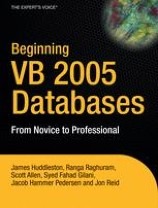
Beginning VB 2005 Databases : From novice to professional
Beginning Visual Basic 2005 Databases teaches you everything you need to know about relational databases, SQL, and ADO.NET 2.0, giving you a sound start in developing console and Windows database applications. The book also includes chapters on the new SQL Server XML data type and the forthcoming LINQ enhancements to the next version of Visual Basic.

Advances in XML information retrieval and Evaluation ; 4th International workshop of the initiative for the evaluation of XML retrieval, INEX 2005, Dagstuhl Castle, Germany, November 28-30, 2005. Revised and Selected Papers
Content-oriented XML retrieval has been receiving increasing interest due to the widespread use of eXtensible Markup Language (XML), which is becoming a standard document format on the Web, in digital libraries,and publishing. By exploiting the enriched source of syntactic and semantic information that XML markup provides, XML information retrieval (IR) systems aim to implement a more focused retrieval strategy and return document components, so-called XML elements – instead of complete documents – in response to a user query. This focused retrieval approach is of particular bene?t for collections containing long documents or documents covering a wide variety of topics (e.g., books, user manuals, legal documents, etc.), where users’ e?ort to locate relevant content can be reduced by directing them to the most relevant parts of the documents.

Advances in XML information retrieval ; 3rd International workshop of the Initiative for the evaluation of XML retrieval, INEX 2004, Dagstuhl Castle, Germany, December 6-8, 2004
The ultimate goal of many information access systems (e.g., digital libraries, the Web, intranets) is to provide the right content to their end-users. This content is increasingly a mixture of text, multimedia, and metadata, and is formatted according to the adopted –W3C standard for information repositories, the so-called eXtensible Markup L- guage (XML). Whereas many of today’s information access systems still treat do- ments as single large (text) blocks, XML offers the opportunity to exploit the internal structure of documents in order to allow for more precise access thus providing more specific answers to user requests. Providing effective access to XML-based content is therefore a key issue for the success of these systems. The aim of the INEX campaign (Initiative for the Evaluation of XML Retrieval), which was set up at the beginning of 2002, is to establish infrastructures, XML test suites, and appropriate measurements for evaluating the performance of information retrieval systems that aim at giving effective access to XML content. More precisely, the goal of the INEX initiative is to provide means, in the form of a large XML test collection and appropriate scoring methods, for the evaluation of content-oriented XML retrieval systems.
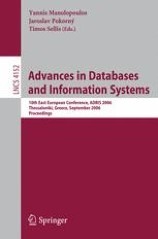
Advances in databases and information Systems ; Vol. 4152 : 10th East European Conference, ADBIS 2006, Thessaloniki, Greece, September 3-7, 2006, Proceedings
This book constitutes the refereed proceedings of the 10th East European Conference on Advances in Databases and Information Systems, ADBIS 2006, held in Thessaloniki, Greece, in September 2006. The 29 high-quality papers were selected in a rigorous reviewing process out of 126 submissions. The papers address a wide range of hot research issues and are organized in topical sections on: XML databases and semantic web, materialized views, database modelling, web information systems and middleware, query processing and indexing, data mining and clustering, and modelling and design issues.

Advances in databases : Concepts, systems and applications ; 12th International Conference on database systems for advanced applications, DASFAA 2007, Bangkok, Thailand, April 9-12, 2007 Proceedings
Coverage includes query language and query optimization, data mining and knowledge discovery, P2P and grid-based data management, XML databases, database modeling and information retrieval, Web and information retrieval, database applications and security.
