



الصفحة 1
الصفحة 1

Mobile and Wireless Communications with Practical Use-Case Scenarios
While wireless technologies had a spectacular evolution over the past years, the present trend is to adopt a global heterogeneous network of shared standards that enables the provisioning of Quality of Service and Quality of Experience to the end-user. To this end, enabling technologies like Machine Learning, Internet of Things, Digital Twins, are seen as promising solutions for next generation networks that will enable an intelligent adaptive interconnected environment with support for prediction and decision making so that the heterogeneous applications and users requirements can be highly satisfied. The aim of this textbook is to provide the readers with a comprehensive technical foundation of the mobile communication systems and wireless network design, operations and applications of various radio access technologies. Additionally, it also introduces the reader to the latest advancements in technologies in terms of Internet of Things ecosystem, Machine Learning and Digital Twins for IoT-enabled intelligent environments. Furthermore, this textbook also includes practical use-case scenarios using Altair WinProp Software as well as Phyton, TensorFlow and Jupiter as support for practice-based laboratory sessions"

Inclusive radio communications for 5G and beyond
Based on the COST IRACON project that consists of 500 researchers from academia and industry, with 120 institutions from Europe, US and the Far East involved. The book presents state-of-the-art design and analysis methods for 5G (and beyond) radio communication networks, along with key challenges and issues related to the development of 5G networks.

E-business and telecommunication networks ; 2nd International conference, ICETE 2005, Reading, UK, October 3-7, 2005. Selected Papers
This book contains fields of e-business and telecommunication networks, including aspects related to security, wireless systems, signal processing, and all sorts of applications, who are bringing new services and technologies into the lives of ordinary consumers. Four simultaneous tracks were held, covering different aspects, namely: “Global Communication Information Systems and Services”, “Security and Reliability in Information Systems and Networks”, “Wireless Communication Systems and Networks” and “Multimedia Signal Processing”.

Combinatorial Optimization in Communication Networks
Combinatorial optimization algorithms are used in many applications including the design, management, and operations of communication networks. The objective of this book is to advance and promote the theory and applications of combinatorial optimization in communication networks. The book collects a distinguished set of papers on subjects such as wireless communication systems, satellite networks, optical networks, and ad hoc networks. The topics covered range from topology control, routing optimization, and resource allocation to QoS provisioning. It is the first book that integrates rich theory from operations research with cutting-edge research in communication networks.

Antennas & propagation for wireless communication systems ; 2nd ed.
Antennas and propagation are of fundamental importance to the coverage, capacity and quality of all wireless communication systems. This book provides a solid grounding in antennas and propagation, covering terrestrial and satellite radio systems in both mobile and fixed contexts. Building on the highly successful first edition, this fully updated text features significant new material and brand new exercises and supplementary materials to support course tutors. A vital source of information for practising and aspiring wireless communication engineers as well as for students at postgraduate and senior undergraduate levels, this book provides a fundamental grounding in the principles of antennas and propagation without excessive recourse to mathematics. It also equips the reader with practical prediction techniques for the design and analysis of a very wide range of common wireless communication systems.
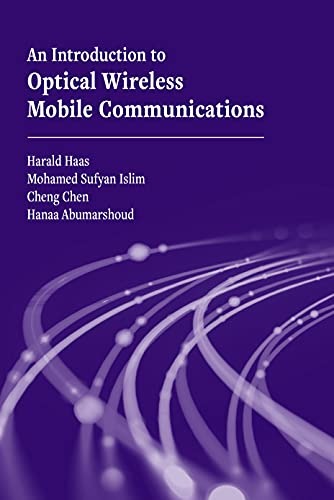
An Introduction to Optical Wireless Mobile Communications
Discusses existing conventional radio frequency (RF)-based wireless access technology and presents the challenges that can impact the requirements of the future wave of new wireless services in the context of artificial intelligence (AI) driven autonomous systems and machine-type communications. The relationship between visible light communications (VLC) and light fidelity (LiFi), is explored, and the major advantages of VLC and LiFi such as security and data density, and discuss existing research challenges are also introduced. Channel modeling techniques are provided for mobile multiuser scenarios, and will introduce key building blocks to achieve LiFi cellular networks achieving orders of magnitude improvements of area spectral efficiency compared to state-of-the-art. Challenges that arise from moving from a static point-to-point visible light link to a LiFi network that is capable of serving hundreds of mobile and fixed nodes are discussed. An overview of recent standardization activities and the commercialization challenges of this disruptive technology is also provided.
