



الصفحة 1
الصفحة 1

News bot
The process of gathering and organizing news content has become a challenging task for emerging news sites, necessitating the employment of highly experienced personnel with specialized skills in the field. However, recent advancements in artificial intelligence technology have led to the development of news bots that can efficiently fetch, classify, and rephrase news content from various sources, enabling users to access the latest and well-formulated news without the need for RSS (Really Simple Syndication).

Network Control and Engineering for QOS, Security and Mobility, III ; IFIP TC6 / WG6.2, 6.6, 6.7 and 6.8. Third International Conference on Network Control and Engineering for QoS, Security and Mobility, NetCon 2004 on November 2-5, 2004, Palma de Mallorca, Spain
This volume contains the proceedings of the Third International Conference on Network Control and Engineering for Quality of Service, Security and Mobility (Net-Con'2004), celebrated in Palma de Mallorca (Illes Balears, Spain) during November 2-5, 2004. This IFIP TC6 Conference was organized by the Universitat de les Illes Balears and sponsored by the following Working Groups: WG6.2 (Network and Internetwork Architectures), WG6.6 (Management of Networks and Distributed Systems), WG6.7 (Smart Networks) and WG6.8 (Mobile and Wireless Communications). The rapid evolution of the networking industry introduces new exciting challenges that need to be explored by the research community. The adoption of Internet as the global network infrastructure places the issue of quality of service among one of the hot topics nowadays: a huge diversity of applications with quite different service requirements must be supported over a basic core of protocols. Also, the open and uncontrolled nature of Internet enforces the need to guarantee secure transactions among users, thus placing security as another hot topic. Finally, the explosion of mobility and its integration as part of the global infrastructure are probably now the most challenging issues in the networking field.

Natural Language Processing and Information Systems ; Vol. 3513 ; 10th International Conference on Applications of Natural Language to Information Systems, NLDB 2005, Alicante, Spain, June 15-17, Proceedings
The development and convergence of computing, telecommunications and information systems has already led to a revolution in the way that we work, communicate with each other, buy goods and use services, and even in the way that we entertain and educate ourselves.The revolution continues, and one of its results is that large volumes of information will increasingly be held in a form which is more natural for users than the data presentation formats typical of computer systems of the past. Natural language processing (NLP) is crucial in solving these problems, and language technologies will make an indispensable contribution to the success of information systems. We hope that NLDB 2005 was a modest contribution to this goal. NLDB 2005 contributed to advancing the goals and the high international standing of these conferences, largely due to its Program Committee, composed of renowned researchers in the field of natural language processing and inf- mation system engineering. Papers were reviewed by three reviewers from the Program Committee. This clearly contributed to the significant number of - pers submitted (95). Twenty-nine were accepted as regular papers, while 18 were accepted as short papers.

Natural language and information systems ; 13th International Conference on Applications of Natural Language to Information Systems, NLDB 2008 London, UK, June 24-27, 2008 Proceedings
This volume contains the papers presented at NLDB 2008, the 13th Inter- tional Conference on Natural Language and Information Systems, held June 25-27,2008.It also containssome of the best researchproposalsas submitted to the NLDB2008 doctoral symposium heldonJune24,2008.Theprogrammealso includes three invited talks covering the main perspectives of the application of naturallanguageto informationsystems: the wayhumansprocess, communicate and understand natural language, what are the implications and challenges - wardssemanticsearchfor the new Webgeneration, how naturallanguageapplies to the well-established database way of querying as a means to unlock data and information for end users.

Multiparadigm Programming in Mozart/Oz ; 2nd International Conference, MOZ 2004, Charleroi, Belgium, October 7-8, 2004, Revised Selected Papers
Oz's concurrency model yields simplicity and clarity (because Oz makes it easier to express complex programs with many interacting components), g- erality, and better interfaces (because the data?ow model automatically makes interfaces more lightweight). Constraint programming in Oz again yields simplicity and clarity (because theprogrammercanexpresswhatneedstobetrueratherthanthemorecomplex issue of how to make it true), and o?ers a powerful mathematical notation that is di?cult to implement on top of languages that do not support it natively. Mozart's distributed computing model makes for improved interfaces and eases the evolution of systems. In my own work, one of the most important concernsistobeabletoquicklyscaleupaprototypeimplementationintoalar- scale service that can run reliably on thousands of computers, serving millions of users.

Multimedia Forensics
Media forensics has never been more relevant to societal life. Not only media content represents an ever-increasing share of the data traveling on the net and the preferred communications means for most users, it has also become integral part of most innovative applications in the digital information ecosystem that serves various sectors of society, from the entertainment, to journalism, to politics. Undoubtedly, the advances in deep learning and computational imaging contributed significantly to this outcome. The underlying technologies that drive this trend, however, also pose a profound challenge in establishing trust in what we see, hear, and read, and make media content the preferred target of malicious attacks.

Multiagent System Technologies ; Vol. 3550 : 3rd German Conference, MATES 2005, Koblenz, Germany, September 11-13, 2005, Proceedings
After two successful MATES conferences in Erfurt 2003 and 2004, the 3rd G- man conference on Multi-agent System Technologies (MATES 2005) took place in Koblenz, Germany, in September 2005, and was co-located with the 28th German Conference on Arti?cial Intelligence (KI 2005). Building onotheragent-related events in Germany in the past, and organized by the GI German Special Interest Group on Distributed Arti?cial Intelligence, the MATES conference series aims at promoting the theory and applications of agents and multiagent systems. In corporating the 9th International Workshopon Cooperative Information Agents (CIA 2005), the topics of interest for MATES 2005 also covered the ?elds of intelligent information agents and systems for the Internet and the (Semantic) Web. As in recent years, MATES 2005 provided a distinguished, lively and int- disciplinary forum for researchers, users, and developers of agent technology, to present and discuss the latest advances of research and development in the area of autonomous agents and multiagent systems. Accordingly, the topics of MATES 2005 covered the whole range from the theory to applications of age- and multiagent technology. The technical program included a total of 24 sci- ti?c talks, and demonstrations of selected running agent systems, and both the MATES 2005 Best Paper and the CIA 2005 System Innovation awards.

Mobility Aware Technologies and Applications ; 2nd International Workshop, MATA 2005, Montreal, Canada, October 17 -- 19, 2005, Proceedings
The beginning of the twenty-first century is characterized by global markets, and the mobility of people is becoming an important fact of life. Consequently, the mobile user is demanding appropriate technical solutions to make use of customized information and communication services. In this context the notion of next-generation networks (NGNs), which are driven by the convergence of the entertainment sector, the mobile Internet, and fixed/mobile telecommunications, is emerging. Such NGNs are aggregating a variety of different access networks and supporting the seamless connection of an open set of end-user devices, and due to the adoption of an all-IP network paradigm they enable a much better integration of voice and data services. Coincidently the buzzword ‘fixed mobile convergence’ (FMC) describes the current trend towards providing common services across fixed and mobile networks resulting in the medium term in the full integration of fixed and mobile telecommunication networks. The adoption of appropriate middleware technologies and the provision of - called service delivery platforms driven by the ongoing innovation in the field of information technologies provides today the technical foundation for supporting terminal, personal and service mobility and thus the implementation of real seamless information and communication services. Furthermore, users are nowadays looking, in light of an omnipresent service environment, for a much higher degree of customization and context awareness in the services they use. The papers in this volume look at these enabling mobility-aware technologies and their use for implementing mobility-aware and context-aware applications.

Mobile health technologies for ambient assisted living and healthcare
The use of telemedicine and mobile devices is growing, and sensors might aid in creating creative solutions. Developing these solutions is crucial for monitoring senior citizens, lifestyles, and medical procedures. The development of assistive technology for various users to follow sports and other activities is strongly tied to this study area. Data protection is crucial, and the development of these solutions for medical uses should be verified. The security and privacy of the information may be tied to other recognized research projects for their acceptability. ICT research has considerably improved quality of life and has fully assimilated all citizens into society through medical rehabilitation and assistive technology. The technologies and research fields that influence medical informatics include databases, networking, graphical user interfaces, data mining, machine learning, intelligent decision support systems, and specialized programming languages.

Mobile and Wireless Communications with Practical Use-Case Scenarios
While wireless technologies had a spectacular evolution over the past years, the present trend is to adopt a global heterogeneous network of shared standards that enables the provisioning of Quality of Service and Quality of Experience to the end-user. To this end, enabling technologies like Machine Learning, Internet of Things, Digital Twins, are seen as promising solutions for next generation networks that will enable an intelligent adaptive interconnected environment with support for prediction and decision making so that the heterogeneous applications and users requirements can be highly satisfied. The aim of this textbook is to provide the readers with a comprehensive technical foundation of the mobile communication systems and wireless network design, operations and applications of various radio access technologies. Additionally, it also introduces the reader to the latest advancements in technologies in terms of Internet of Things ecosystem, Machine Learning and Digital Twins for IoT-enabled intelligent environments. Furthermore, this textbook also includes practical use-case scenarios using Altair WinProp Software as well as Phyton, TensorFlow and Jupiter as support for practice-based laboratory sessions"
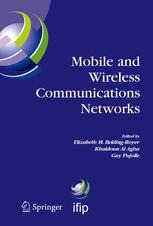
Mobile and Wireless Communications Networks ; IFIP TC6 / WG6.8 Conference on Mobile and Wireless Communication Networks (MWCN 2004) October 25-27, 2004 Paris, France
Mobile Ad hoc NETworks (MANETs) has attracted great research interest in recent years. A Mobile Ad Hoc Network is a self-organizing multi-hop wireless network where all hosts (often called nodes) participate in the routing and data forwarding process. The dependence on nodes to relay data packets for others makes mobile ad hoc networks extremely susceptible to various malicious and selfish behaviors. This point is largely overlooked during the early stage of MANET research. Many works simply assume nodes are inherently cooperative and benign. However, experiences from the wired world manifest that the reverse is usually true; and many works [3] [10] [9] [8] [12] [19] have pointed out that the impact of malicious and selfish users must be carefully investigated. The goal of this research is to address the cooperation problem and related security issues in wireless ad hoc networks. As a rule of thumb, it is more desirable to include security mechanisms in the design phase rather than continually patching the system for security breaches. As pointed out in [2] [1], there can be both selfish and malicious nodes in a mobile ad hoc network. Selfish nodes are most concerned about their energy consumption and intentionally drop packets to save power. The purpose of malicious nodes, on the other hand, is to attack the network using various intrusive techniques. In general, nodes in an ad hoc network can exhibit Byzantine behaviors.

Maturing Usability : Quality in Software, Interaction and Value
Divided into three parts, ‘Quality in Software’ looks at how using development tools can enhance usability of a system, and how methods and models can be integrated into the development process to produce effective user interfaces. ‘Quality in Interaction’ addresses theoretical frameworks on the nature of interactions; techniques and metrics for evaluation interaction quality; and the transfer of concepts and methods from research to practice. Finally, ‘Quality in Value’ assesses the impact that a system has in the real world, focusing on increasing the value of usability practice for software development and on increasing value for the users.

Introduction to development engineering
Introduces the emerging field of development engineering and its constituent theories, methods, and applications. It is both an instructional text for students and a resource for researchers and practitioners involved in the design and scaling of technologies for low-resource communities. The scope is broad, ranging from the development of mobile applications for low-literacy users to hardware and software solutions for providing electricity and water in remote environments. It is also highly interdisciplinary, drawing on methods and theories from the social sciences as well as engineering and the natural sciences.

Internet of things, artificial intelligence and blockchain technology
Explores the concepts and techniques of IoT, AI, and blockchain. Also discussed is the possibility of applying blockchain for providing security in various domains. The specific highlight of this book is focused on the application of integrated technologies in enhancing data models, better insights and discovery, intelligent predictions, smarter finance, smart retail, global verification, transparent governance, and innovative audit systems. Explains how blockchain can significantly increase data privacy and security while boosting accuracy and integrity in IoT generated data and AI processed information; Gives insight into blockchain’s numerous potential applications, starting with recent technologies that give users control over sharing and privacy; Shows readers how to employ blockchain in IoT and AI, helping them to understand what they can and cannot do with blockchain.

Interactive drink machine company - (IDM company)
This project is a continuation of our previous project for a hot drink machine by adding the capability for electronic payment and developing the company's management system and making the hot drink machine linkable with the company's server via the Internet and more interactive with the customer through the development of this project according to several aspects. On the software level: An integrated system that allows recording customer requests and executed operations, in addition to information about users, including their personal information, current balance, and executed requests. On the level of employees, their personal information, their work tasks and the operations carried out by them (Receipt and delivery of materials and servicing of machines).

Intelligent Techniques for Web Personalization ; IJCAI 2003 Workshop, ITWP 2003, Acapulco, Mexico, August 11, 2003, Revised Selected Papers
Web personalizationcan be de?ned as any set of actions that can tailor the Web experience to a particular user or set of users. The experience can be something as casualas browsinga Web site oras (economically)signi?cantas tradingstock or purchasing a car. The actions can range from simply making the presentation more pleasing to anticipating the needs of a user and providing customized and relevant information. To achieve e?ective personalization, organizations must rely on all available data, including the usage and click-stream data (re?e- ing user behavior), the site content, the site structure, domain knowledge, user demographics and pro?les. In addition, e?cient and intelligent techniques are needed to mine these data for actionable knowledge, and to e?ectively use the discovered ...

Intelligent glasses store
Technology has been found to facilitate humankind's life. Hence, there is a new technique almost every day. One of the most common is E-commerce. This is the first project in Syria. about online glasses Shop, which displays sets of glasses on a website. The website allows the shopkeeper (the admin) to add their collections of glasses. Set prices and show reservations. Users can view glasses on the website and try whatever he wants by real-time or by recording video, then they add the preferred ones to the cart to reserve the sample they like the most for a specific time. This project aims to allow busy traders to make their own business online, in addition, it saves time and effort for them and users as they can make shopping and compare goods whatever the situation is especially in quarantine.

Information security and privacy ; Vol. 4058 ; 11th Australasian Conference, ACISP 2006, Melbourne, Australia, July 3-5, 2006, Proceedings
The 11th Australasian Conference on Information Security and Privacy (ACISP 2006) was held in Melbourne, 3–5 July, 2006. The conference was sponsored by Deakin University, the Research Network for a Secure Australia, and was organized in cooperation with the University of Wollongong. The conference brought together researchers,practitioners and a wide range of other users from academia, industries and government organizations. The program included 35 papers covering important aspects of information security technologies. The papers were selected from 133 submissions through a two-stage anonymous review process. Each paper received at least three reviews by members of the Program Committee, and was then scrutinized by the whole committee during a two-week discussion.

Image and video retrieval ; Vol. 4071 ; 5th Internatinoal Conference, CIVR 2006, Tempe, AZ, USA, July 13-15, 2006, Proceedings
This volume contains the proceeding of the 5th International Conference on - age and Video Retrieval (CIVR), July 13–15, 2006, Arizona State University, Tempe, AZ, USA: http://www. civr2006. org. Image and video retrieval cont- ues to be one of the most exciting and fast-growing research areas in the ?eld of multimedia technology. However, opportunities for exchanging ideas between researchers and users of image and video retrieval systems are still limited.

Hydra = هايدرا
Forgery involves the use of advanced algorithms to replicate and distribute deceptive products across various categories, casting shadows of doubt on the authenticity of goods. Although counterfeit detection can be useful in identifying and mitigating fraudulent activities, the widespread presence of counterfeit goods poses significant dangers, undermining consumer confidence and brand reputation. To underscore the severity of this issue, consider instances such as fake luxury items flooding the market, counterfeit electronics compromising safety, or bogus pharmaceuticals endangering health. Addressing this issue is critical in maintaining the integrity of brands, safeguarding consumer well-being, and preserving trust in the marketplace. The ability to distinguish between authentic and counterfeit products is paramount in ensuring accurate decision-making and preventing the harmful consequences of fraudulent goods. This technological context underscores the urgency of developing and deploying cutting-edge solutions to combat the evolving landscape of product forgery. Hydra emerges as a robust solution, utilizing a comprehensive approach that includes extracting posts and images from search engine tools, and is integrated with AI models to detect forgery. The Hydra platform not only provides users with a powerful tool for detecting counterfeit products but also offers tangible benefits such as enhanced brand security, increased awareness about the prevalence of forgeries, and the opportunity to actively participate in a real-time community.
