



الصفحة 1
الصفحة 1

Information Security ; 11th International Conference, ISC 2008, Taipei, Taiwan, September 15-18, 2008. Proceedings
This book constitutes the refereed proceedings of the 11th International Conference on Information Security Conference, ISC 2008, held in Taipei, Taiwan, September 15-18, 2008.The 33 revised full papers presented were carefully reviewed and selected from 134 submissions. The papers are organized in topical sections on trusted computing, database and system security, intrusion detection, network security, cryptanalysis, digital signatures, AES, symmetric cryptography and hash functions, authentication as well as security protocols.

Information and Communications Security ; Vol. 4307 ; 8th International Conference, ICICS 2006, Raleigh, NC, USA, December 4-7, 2006, Proceedings
It is our great pleasure to welcome you to the Eighth International Conference on Information and Communications Security (ICICS 2006), held in Raleigh, North Carolina, USA, December 4–7, 2006. The ICICS conference series is an established forum that brings together researchersand scholars involved in m- tiple disciplines of Information and Communications Security in order to foster exchangeof ideas. The past sevenICICS conferences wereheld in Beijing, China (ICICS 1997); Sydney, Australia (ICICS 1999); Xi’an China (ICICS 2001); S- gapore (ICICS 2002); Hohhot City, China (ICICS 2003); Malaga, Spain (ICICS 2004); and Beijing, China (ICICS 2005). The conference proceedings of the past seven events have been published by Springer in the Lecture Notes in Computer Science series, in LNCS1334,LNCS1726,LNCS2229,LNCS 2513,LNCS 2836, LNCS 3269, and LNCS 3783, respectively. This year we received a total of 119 submissions on various aspects of - hoc and sensor network security. The Program Committee selected 22 regular papers and 17 short papers that cover a variety of topics, including security protocols, applied cryptography and cryptanalysis, access control in distributed systems, privacy, malicious code, network and systems security, and security implementations. Putting together ICICS 2006 was a team e?ort. First of all, we would like to thank the authors of every paper, whether accepted or not, for submitting their papers to ICICS 2006. We would like to express our gratitude to the Program Committee members and the external reviewers, who worked very hard in - viewing the papers and providing suggestions for their improvements.

Information and Communications Security ; 10th International Conference, ICICS 2008 Birmingham, UK, October 20 - 22, 2008 Proceedings
This book constitutes the refereed proceedings of the 10th International Conference on Information and Communications Security, ICICS 2008, held in Birmingham, UK, in October 2008.The 27 revised full papers presented together with one invited paper were carefully reviewed and selected from 125 submissions. The papers are organized in topical sections on authentication, side channel analysis, cryptanalysis, access control, software security, system security, applied cryptography, and security protocols.

Human interactive proofs ; 2nd International workshop, HIP 2005, Bethlehem, PA, USA, May 19-20, 2005, Proceedings
Constitutes the refereed proceedings of the Second International Workshop on Human Interactive Proofs, HIP 2005, held in Bethlehem, PA, USA in May 2005. This book is devoted to the new class of security protocols called human interactive proofs. It includes sections such as: CAPTCHAs and performance analysis, and HIP architectures.

Future data and security engineering ; 7th International conference, FDSE 2020, Quy Nhon, Vietnam, November 25–27, 2020, Proceedings
This book constitutes the proceedings of the 7th International Conference on Future Data and Security Engineering, FDSE 2020, which was supposed to be held in Quy Nhon, Vietnam, in November 2020, but the conference was held virtually due to the COVID-19 pandemic. The 24 full papers (of 53 accepted full papers) presented together with 2 invited keynotes were carefully reviewed and selected from 161 submissions. The other 29 accepted full and 8 short papers are included in CCIS 1306. The selected papers are organized into the following topical headings: security issues in big data; big data analytics and distributed systems; advances in big data query processing and optimization; blockchain and applications; industry 4.0 and smart city: data analytics and security; advanced studies in machine learning for security; and emerging data management systems and applications.

Formal Methods and Software Engineering ; Vol. 3785 ; 7th International Conference on Formal Engineering Methods, ICFEM 2005, Manchester, UK, November 1-4, 2005, Proceedings
This volume contains papers presented at the 7th International Conference on Formal Engineering Methods (ICFEM 2005), 1-4 November 2005, Manchester, UK. Formal engineering methods are changing the way that systems are dev- oped. With language and tool support, these methods are being used for se- automatic code generation, and for the automatic abstraction and checking of implementations. In the future, they will be used at every stage of development: requirements, speci?cation, design, implementation, testing, anddocumentation. The aim of ICFEM 2005 was to bring together those interested in the - plication of formal engineering methods to computer systems. Researchers and practitioners, from industry, academia, and government, were encouraged to - tend, and to help advance the state of the art. The conference was supported by sponsorships from Microsoft Research, USA, the Software Engineers Association of Japan, the University of Man- ester, Manchester City Council, FormalMethods Europe (FME) and the British Computer Society FormalAspects ofComputing Specialist Group(BCS-FACS). We wish to thank these sponsors for their generosity. The ?nal programme consisted of 3 invited talks and 30 technical papers selected from a total of 74 submissions. The invited speakers were: Anthony Hall, independent consultant, UK; Egon B] orger, University of Pisa, Italy; John Rushby, SRI, USA. Their talks were sponsored by BCS-FACS, Microsoft - search and FME respectively. We wish to thank the invited speakers for their inspiring talks.
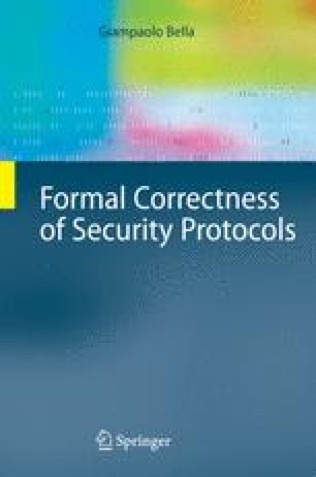
Formal Correctness of Security Protocols
The author investigates proofs of correctness of realistic security protocols in a formal, intuitive setting. The protocols examined include Kerberos versions, smartcard protocols, non-repudiation protocols, and certified email protocols. This research advances significant extensions to the method of analysis, while the findings on the protocols analysed are novel and illuminating.

Emerging Trends in Information and Communication Security ; International Conference, ETRICS 2006, Freiburg, Germany, June 6-9, 2006. Proceedings
This book constitutes the refereed proceedings of the International Conference on Emerging Trends in Information and Communication Security, ETRICS 2006, held in Freiburg, Germany, in June 2006. The book presents 36 revised full papers, organized in topical sections on multilateral security; security in service-oriented computing, secure mobile applications; enterprise privacy; privacy, identity, and anonymity; security engineering; security policies; security protocols; intrusion detection; and cryptographic security.
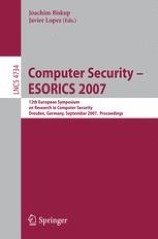
Computer Security – ESORICS 2007 ; 12th European Symposium On Research In Computer Security, Dresden, Germany, September 24 - 26, 2007, Proceedings
This book address issues such as data protection; security protocols; systems; web and network security; privacy; threat modeling and detection; information flow; and security in emerging applications such as cryptocurrencies, the Internet of Things and automotive.

Computer Security - ESORICS 2005
These proceedings contain the papers selected for presentation at the 10th - ropean Symposium on Research in Computer Security (ESORICS), held S- tember 12–14, 2005 in Milan, Italy. In response to the call for papers 159 papers were submitted to the conf- ence. These paperswere evaluated on the basis of their signi?cance, novelty,and technical quality. Each paper was reviewed by at least three members of the program committee. The program committee meeting was held electronically,
