



الصفحة 1
الصفحة 1

Imaging Beyond the Pinhole Camera
The world's first photograph was taken in 1826 using a pinhole camera called camera obscura. Cameras used since then are basically following the pinhole camera principle. This book looks at the development as well as the applications of alternative camera architectures.

Human motion : Understanding, modeling, capture and animation ; 2nd Workshop, HumanMotion 2007, Rio de Janeiro, Brazil, October 20, 2007, Proceedings
This LNCS volume contains the papers presented at the second Workshop on Human Motion Understanding, Modeling, Capture and Animation. The accepted papers re?ect the state of the art in the ?eld and cover various topicsrelatedto humanmotiontrackingandanalysis.Thepapersinthisvolume have been classi?ed into three categories based on the topics they cover: human motion capture and pose estimation, body and limb tracking and segmentation, and activity recognition.
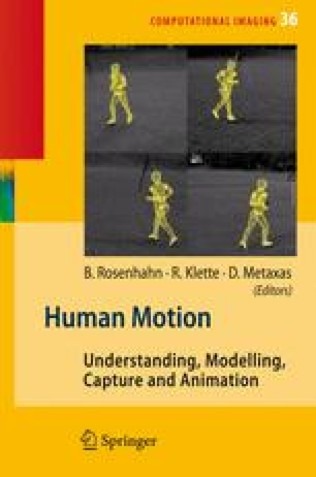
Human motion : Understanding, modeling, capture and animation
Edward Muybridge (1830–1904) is known as the pioneer in motion capt- ing with his famous experiments in 1887 called “Animal Locomotion”. Since then, the feld of animal or human motion analysis has grown in many dir- tions. However, research and results that involve human-like animation and the recovery of motion is still far from being satisfactory. Progress in human motion analysis depends on empirically anchored and grounded research in computer vision, computer graphics, and biomechanics. This book is based on a June 2006 workshop held in Dagstuhl, Germany. This workshop brought together for the frst time researchers from the afo- mentioned disciplines.

Geometric Properties for Incomplete Data
Computer vision and image analysis require interdisciplinary collaboration between mathematics and engineering. This book addresses the area of high-accuracy measurements of length, curvature, motion parameters and other geometrical quantities from acquired image data. It is a common problem that these measurements are incomplete or noisy, such that considerable efforts are necessary to regularise the data, to fill in missing information, and to judge the accuracy and reliability of these results. This monograph brings together contributions from researchers in computer vision, engineering and mathematics who are working in this area.

Combinatorial image analysis ; 10th International Workshop, IWCIA 2004, Auckland, New Zealand, December 1-3, 2004, Proceedings
This volume presents the proceedings of the 10th International Workshop on Combinatorial Image Analysis,held 2004, in Auckland, New Zealand. For this workshop we received 86 submitted papers from 23 countries. We selected 55 papers for the conference. completed the program. Conference papers are presented in this volume under the following topical part titles: discrete tomography (3 papers), combinatorics and computational models (6), combinatorial algorithms (6), combinatorial mathematics (4), d- ital topology (7), digital geometry (7), approximation of digital sets by curves and surfaces (5), algebraic approaches (5), fuzzy image analysis (2), image s- mentation (6), and matching and recognition (7). These subjects are dealt with in the context of digital image analysis or computer vision.
