



الصفحة 1
الصفحة 1

Object-Oriented Data Structures Using Java ; 4th ed.
an essential resource for students learning data structures using the Java programming language. It presents both the traditional and modern data structure topics with an emphasis on problem-solving and object-oriented software design. Beginning early and continuing throughout the text, it introduces and expands upon the use of many Java features such as classes, objects, generics, polymorphism, packages, interfaces, library classes, inheritance, exceptions, and threads.

Object-Oriented ActionScript for Flash 8
Object-Oriented ActionScript For Flash 8 teaches the theory and practice of OOP with ActionScript. You do not need any extensive prior programming experience, you just need to want to go beyond the usual Flash interfaces. Authors and working Flash developers Peter Elst and Todd Yard take you through the complete development cycle of a series of related applications, using numerous step-by-step instructions. You'll be able to develop highly reusable applications and services that leverage the dynamic features in Flash. This book demonstrates professional OOP skills and techniques that are completely transferable to other programming languages and technologies, including Inheritance, Polymorphism, managing classes, component development, consuming web services, and much more. It also includes some cutting edge ActionScript programming techniques, and animation and effects classes.
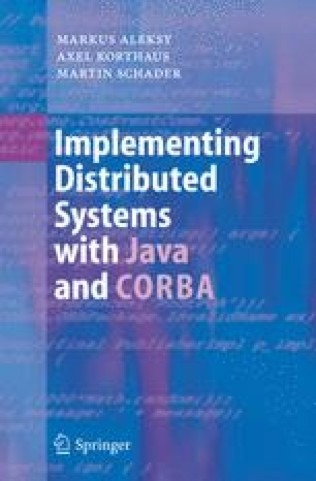
Implementing distributed systems with Java and CORBA
This book provides graduate students and practitioners with knowledge of the CORBA standard and practical experience of implementing distributed systems with CORBA's Java mapping. With tested code examples that will run immediately.
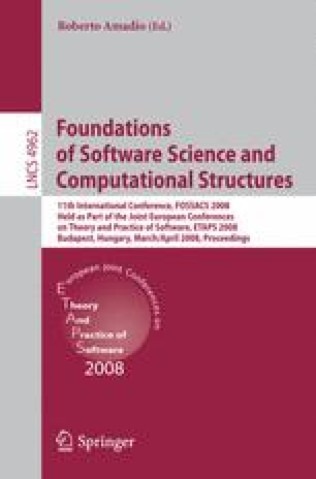
Foundations of software science and computation structures ; 11th International conference, FOSSACS 2008, Held as part of the joint European conferences on theory and practice of software, ETAPS 2008, Budapest, Hungary, March 29 - April 6, 2008. proceedings
The fve main conferences received 571 submissions, 147 of which were accepted, giving an overall acceptance rate of less than 26%, with each conference below 27%.Congratulations there foretoall the authorswhomadeittothe fnalprogramme! I hope that most of the other authors will still have found a way of participating in this exciting event, and that you will all continue submitting to ETAPS and contributing to make of it the best conference in the area. The events that comprise ETAPS address various aspects of the system velopment process, including specifcation, design, implementation, analysis and improvement

Datatype-Generic Programming ; International Spring School, SSDGP 2006, Nottingham, UK, April 24-27, 2006, Revised Lectures
A leitmotif in the evolution of programming paradigms has been the level and extent of parametrisation that is facilitated — the so-called genericity of the paradigm. The sorts of parameters that can be envisaged in a programming language range from simple values, like integers and fioating-point numbers, through structured values, types and classes, to kinds (the type of types and/or classes).Datatype-generic programming is about parametrising programsby the structure of the data that they manipulate. To appreciate the importance of data type genericity,one need look no further than the internet. The internet is a massive repository of structured data, but the structure is rarely exploited. For example, compression of data can be much more efiective if its structure is known, but most compression algorithms regard the input data as simply a string of bits, and take no account of its internal organisation. Datatype-generic programming is about exploiting the structure of data when it is relevant and ignoring it when it is not. Programming languages most c- monly used at the present time do not provide efiective mechanisms for do- menting and implementing datatype genericity.

Java : how to program. Late objects : Introducing Jshell
Introduction to Computers, the Internet and Java / Introduction to Java Applications; Input/Output and Operators / Control Statements: Part 1; Assignment, ++ and Operators / Control Statements: Part 2; Logical Operators / Methods / Arrays and ArrayLists / Introduction to Classes and Objects / Classes and Objects: A Deeper Look / Object-Oriented Programming: Inheritance / Object-Oriented Programming: Polymorphism and Interfaces / Exception Handling: A Deeper Look / JavaFX Graphical User Interfaces / JavaFX GUI / Strings, Characters and Regular Expressions / Files, Input/Output Streams, NIO and XML Serialization / Generic Collections / Lambdas and Streams / Recursion / Searching, Sorting and Big O / Generic Classes and Methods: A Deeper Look / Custom Generic Data Structures / JavaFX Graphics and Multimedia / Concurrency / Accessing Databases with JDBC / Introduction to JShell: Java 9's REPL for Interactive Java

Bioinformatics research and development ; 1st International Conference, BIRD 2007, Berlin, Germany, March 12-14, 2007, Proceedings
This volume covers a wide range of topics related to bioinformatics like microarray data, genomics, single nucleotide polymorphism, sequence analysis, systems biology, medical applications, proteomics, information systems.
Binary Rare Earth Oxides
The book begins with a brief introduction to binary rare earth oxides, their physical and chemical stabilities, polymorphism, crystal structures and phase transformation and the association with current applications. The book goes on to present the band structure of the oxides using several quantum chemical calculations, which belong to a newly developed area in the binary rare earth oxides. Central to this chapter are the characterizations of electrical, magnetic and optical properties, as well as details of single crystal growth and particle preparation methods that have progressed in recent years. Later chapters concentrate on thermo-chemical properties and trace determination techniques. The final chapter contains a variety of useful applications in various fields such as phosphors, glass abrasives, automotive catalysts, fuel cells, solid electrolytes, sunscreens, iron steels, and biological materials.
Automated deduction – CADE-21 ; 21st International Conference on automated deduction, Bremen, Germany, July 17-20, 2007, Proceedings
All current aspects of automated deduction are addressed, ranging from theoretical and methodological issues to presentation and evaluation of theorem provers and logical reasoning systems. The papers are organized in topical sections on higher-order logic, description logic, intuitionistic logic, satisfiability modulo theories, induction, rewriting, and polymorphism, first-order logic, model checking and verification, termination, as well as tableaux and first-order systems.
