



الصفحة 1
الصفحة 1

Interconnect-Centric Design for Advanced SoC and NoC
In Interconnect-centric Design for Advanced SoC and NoC, we have tried to create a comprehensive understanding about on-chip interconnect characteristics, design methodologies, layered views on different abstraction levels and finally about applying the interconnect-centric design in system-on-chip design.

Embedded System Design : Topics, Techniques and Trends; IFIP TC10 Working Conference: International Embedded Systems Symposium (IESS), May 30 - June 1, 2007, Irvine (CA), USA
Embedded systems have gained an enormous amount of processing power and functionality. Many of the formerly external components can now be integrated into a single System-on-Chip. This tendency has resulted in a dramatic reduction in the size and cost of embedded systems. As a unique technology, the design of embedded systems is an essential element of many innovations. This book including design methodology, specification and modeling, embedded software and hardware synthesis, networks-on-chip, distributed and networked systems, and system verification and validation. Particular emphaisis is paid to automotive and medical applications. A set of actual case studies and special aspects in embedded system design are included as well.
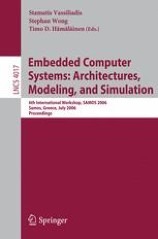
Embedded Computer Systems : Architectures, Modeling, and Simulation ; Vol. 4017 ; 6th International Workshop, SAMOS 2006, Samos, Greece, July 17-20, 2006, Proceedings
This book constitutes the refereed proceedings of the 6th International Workshop on Systems, Architectures, Modeling, and Simulation, SAMOS 2006, held in Samos, Greece on July 2006.The 47 revised full papers presented together with 2 keynote talks were thoroughly reviewed and selected from 130 submissions.

Embedded computer systems : Architectures, modeling, and simulation ; Vol. 3553 ; 5th International Workshop, SAMOS 2005, Samos, Greece, July 18-20, Proceedings
The SAMOS workshop is an international gathering of highly quali?ed researchers from academia and industry, sharing in a 3-day lively discussion on the quiet and - spiring northern mountainside of the Mediterranean island of Samos. As a tradition, the workshop features workshop presentations in the morning, while after lunch all kinds of informal discussions and nut-cracking gatherings take place. The workshop is unique in the sense that not only solved research problems are presented and discussed but also (partly) unsolved problems and in-depth topical reviews can be unleashed in the sci- ti?c arena. Consequently, the workshop provides the participants with an environment where collaboration rather than competition is fostered. The earlier workshops, SAMOS I–IV (2001–2004), were composed only of invited presentations. Due to increasing expressions of interest in the workshop, the Program Committee of SAMOS V decided to open the workshop for all submissions. As a result the SAMOS workshop gained an immediate popularity; a total of 114 submitted papers were received for evaluation. The papers came from 24 countries and regions: Austria (1), Belgium (2), Brazil (5), Canada (4), China (12), Cyprus (2), Czech Republic (1), Finland (15), France (6), Germany (8), Greece (5), Hong Kong (2), India (2), Iran (1), Korea (24), The Netherlands (7), Pakistan (1), Poland (2), Spain (2), Sweden (2), T- wan (1), Turkey (2), UK (2), and USA (5). We are grateful to all of the authors who submitted papers to the workshop.
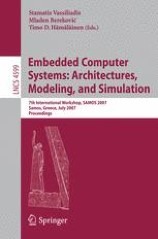
Embedded Computer Systems : Architectures, Modeling, and Simulation ; 7th International Workshop, SAMOS 2007, Samos, Greece, July 16-19, 2007, Proceedings
The book is unique in the sense that not only solved research problems are presented and discussed but also (partly) unsolved pr- lems and in-depth topical reviews can be unleashed in the scientific arena. C- sequently, it provides the participants with an environment where collaboration rather than competition is fostered.

Dynamic and robust streaming in and between connected consumer-electronic devices
This book provides a comprehensive overview of the challenges that face us. The book shows that there are many similarities between traditional networking and networks in the chip. However, there are some different operational conditions that lead to original solutions.
