



الصفحة 1
الصفحة 1

Intrusion Detection Systems
Sٍheds new light on defense alert systems against computer and network intrusions. It also covers integrating intrusion alerts within security policy framework for intrusion response, related case studies and much more. This volume is presented in an easy-to-follow style while including a rigorous treatment of the issues, solutions, and technologies tied to the field.
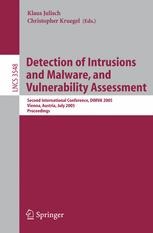
Intrusion and Malware Detection and Vulnerability Assessment 2nd International Conference, DIMVA 2005, Vienna, Austria, July 7-8, 2005, Proceedings
Represents an increase of approximately 25% compared with the n- ber of submissions last year. All submissions were carefully reviewed by at least three Program Committee members or external experts according to the cri- ria of scienti?c novelty, importance to the ?eld, and technical quality. The ?nal selection took place at a meeting held on March 18, 2005, in Zurich, Switz- land. Fourteen full papers were selected for presentation and publication in the conference proceedings. In addition, three papers were selected for presentation in the industry track of the conference. The program featured both theoretical and practical research results, which were grouped into six sessions. Philip Att?eld from the Northwest Security Institute gave the opening keynote speech. The slides presented by the authors are available on the DIMVA 2005 Web site at http://www.dimva.org/dimva2005 We sincerely thank all those who submitted papers as well as the Program Committee members and the external reviewers for their valuable contributions.
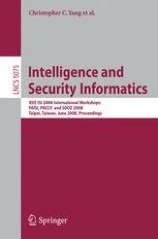
Intelligence and security informatics ; IEEE ISI 2008 International Workshops : PAISI, PACCF, and SOCO 2008, Taipei, Taiwan, June 17, 2008. Proceedings
This book constitutes the refereed proceedings of the three international workshops PAISI 2008, PACCF 2008, and SOCO 2008, held as satellite events of the IEEE International Conference on Intelligence and Security Informatics, ISI 2008, in Taipei, Taiwan, in June 2008.The 55 revised full papers presented were carefully reviewed and selected from the presentations at the workshops. The 21 papers of the Pacific Asia Workshop on Intelligence and Security Informatics (PAISI 2008) cover topics such as information retrieval and event detection, internet security and cybercrime, currency and data protection, cryptography, image and video analysis, privacy issues, social networks, modeling and visualization, and network intrusion detection.

Detection of intrusions and malware, and vulnerability assessment ; 4th International Conference, DIMVA 2007 Lucerne, Switzerland, July 12-13, 2007 Proceedings
This book presented malware; network security, Web security; attacks; Security-Intrusion; Detection and Response
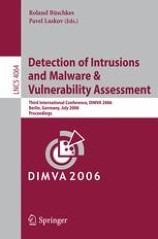
Detection of intrusions and malware, and vulnerability assessment ; 3rd International Conference, DIMVA 2006, Berlin, Germany, July 13-14, 2006, Proceedings
This book constitutes the refereed proceedings of the Third International Conference on Detection of Intrusions and Malware, and Vulnerability Assessment, DIMVA 2006, held in Berlin, Germany in July 2006.The 11 revised full papers presented were carefully reviewed and selected from 41 submissions.

Certification and security in inter-organizational E-services ; IFIP 18th World Computer Congress, August 22-27, 2004, Toulouse, France
This collection of papers offers real-life application experiences, research results and methodological proposals of direct interest to systems experts and users in governmental, industrial and academic communities. This book also documents several important developments. The uptake of distributed computational infrastructure oriented to service provision, like Web-Services and Grid, is making C&S even more important. E-services based on legacy systems managed by autonomous and independent organizations, a common situation in the public administration sector, increase overall complexity. The increased presence and use of e-service IT-infrastructures depends on the critical ability required for all security issues, from the basic (availability, authentication, integrity, confidentiality) to the more complex (e.g. authorization, non-repudiation).
