



الصفحة 1
الصفحة 1

Numerical Methods and Applications ; 6th International Conference, NMA 2006, Borovets, Bulgaria, August 20-24, 2006, Revised Papers
This book constitutes the thoroughly refereed post-proceedings of the 6th International Conference on Numerical Methods and Applications, NMA 2006. The papers are organized in topical sections on numerical methods for hyperbolic problems, robust preconditioning solution methods, Monte Carlo and quasi-Monte Carlo for diverse applications, metaheuristics for optimization problems, uncertain/control systems and reliable numerics, interpolation and quadrature processes, large-scale computations in environmental modelling, and contributed talks.

New Algorithms for Macromolecular Simulation
Molecular simulation is a widely used tool in biology, chemistry, physics and engineering. This book contains a collection of articles by leading researchers who are developing new methods for molecular modelling and simulation. Topics addressed here include: multiscale formulations for biomolecular modelling, such as quantum-classical methods and advanced solvation techniques; protein folding methods and schemes for sampling complex landscapes; membrane simulations; free energy calculation; and techniques for improving ergodicity. The book is meant to be useful for practitioners in the simulation community and for those new to molecular simulation who require a broad introduction to the state of the art.
Implementing machine learning for finance : A systematic approach to predictive risk and performance analysis for investment portfolios
Introduces pattern recognition and future price forecasting that exerts effects on time series analysis models, such as the Autoregressive Integrated Moving Average (ARIMA) model, Seasonal ARIMA (SARIMA) model, and Additive model, and it covers the Least Squares model and the Long Short-Term Memory (LSTM) model. It presents hidden pattern recognition and market regime prediction applying the Gaussian Hidden Markov Model. The book covers the practical application of the K-Means model in stock clustering. It establishes the practical application of the Variance-Covariance method and Simulation method (using Monte Carlo Simulation) for value at risk estimation. It also includes market direction classification using both the Logistic classifier and the Multilayer Perceptron classifier. Finally, the book presents performance and risk analysis for investment portfolios. You will: Understand the fundamentals of the financial market and algorithmic trading, as well as supervised and unsupervised learning models that are appropriate for systematic investment portfolio management / Know the concepts of feature engineering, data visualization, and hyperparameter optimization / Design, build, and test supervised and unsupervised ML and DL models / Discover seasonality, trends, and market regimes, simulating a change in the market and investment strategy problems and predicting market direction and prices / Structure and optimize an investment portfolio with preeminent asset classes and measure the / underlying risk

Computers and Games ; 6th International Conference, CG 2008, Beijing, China, September 29 - October 1, 2008. Proceedings
This book constitutes the refereed proceedings of the 6th International Conference on Computers and Games, CG 2008, held in Beijing, China, in September/October 2008 co-located with the 13th Computer Olympiad and the 16th World Computer-Chess Championship.

Computational Science – ICCS 2007; 7th International Conference, Beijing China, May 27-30, 2007, Proceedings, Part I
This book contiants sections on efficient data management, parallel monte carlo algorithms, simulation of multiphysics multiscale systems, dynamic data driven application systems, computer graphics and geometric modeling, computer algebra systems, computational chemistry, computational approaches and techniques in bioinformatics, computational finance and business intelligence, geocomputation, high-level parallel programming, networks theory and applications, collective intelligence for semantic and knowledge grid, collaborative and cooperative environments, tools for program development and analysis in CS, intelligent agents in computing systems, CS in software engineering, computational linguistics in HCI, internet computing in science and engineering, workflow systems in e-science, graph theoretic algorithms and applications in cs, teaching CS, high performance data mining, mining text, semi-structured, Web, or multimedia data,
Computational Science – ICCS 2007 ; 7th International Conference, Beijing China, May 27-30, 2007, Proceedings, Part IV
This book covers computational science and related areas, from multiscale physics to wireless networks, and from graph theory to tools for program development.
Computational Science – ICCS 2007 ; 7th International Conference, Beijing China, May 27-30, 2007, Proceedings, Part III
This book covers computational science and related areas, from multiscale physics to wireless networks, and from graph theory to tools for program development.

Computational Science – ICCS 2007 ; 7th International Conference, Beijing China, May 27-30, 2007, Proceedings, Part II
This book covers computational science and related areas, from multiscale physics to wireless networks, and from graph theory to tools for program development.

Large-Scale Scientific Computing ; 6th International Conference, LSSC 2007, Sozopol, Bulgaria, June 5-9, 2007. Revised Papers
The 6th International Conference on Large-Scale Scienti?c Computations (LSSC 2007) was held in Sozopol, Bulgaria, June 5–9, 2007. The conference was organized by the Institute for Parallel Processing at the Bulgarian Academy of Sciences in cooperation with SIAM (Society for Industrial and Applied Ma- ematics). Partial support was also provided from project BIS-21++ funded by the European Commission in FP6 INCO via grant 016639/2005. The conference was devoted to the 60th anniversary of Richard E. Professor Ewing is internati- ally well known with his contributions in applied mathematics, mathematical modeling, and large-scale scientific computations.
Bayesian reliability
Bayesian Reliability presents modern methods and techniques for analyzing reliability data from a Bayesian perspective. The adoption and application of Bayesian methods in virtually all branches of science and engineering have significantly increased over the past few decades. This increase is largely due to advances in simulation-based computational tools for implementing Bayesian methods. The authors extensively use such tools throughout this book, focusing on assessing the reliability of components and systems with particular attention to hierarchical models and models incorporating explanatory variables. Such models include failure time regression models, accelerated testing models, and degradation models. The authors pay special attention to Bayesian goodness-of-fit testing, model validation, reliability test design, and assurance test planning. Throughout the book, the authors use Markov chain Monte Carlo (MCMC) algorithms for implementing Bayesian analyses--algorithms that make the Bayesian approach to reliability computationally feasible and conceptually straightforward.
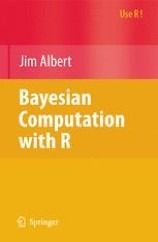
Bayesian computation with R : Introduces Bayesian modeling by use of computation using the R language
R's open source nature, free availability, and large number of contributor packages have made R the software of choice for many statisticians in education and industry. Bayesian Computation with R introduces Bayesian modeling by the use of computation using the R language.
