



الصفحة 1
الصفحة 1
Modern IoT onboarding platforms for advanced applications: a practitioner’s guide to KIS.ME
There is no doubt that digitalization solutions from Industry 4.0 and the Internet of Things (IoT) can be perceived as excellent candidate strategies capable of handling the above-stated issues concerning measurements and transparency. However, IoT tools themselves can provide appropriate data only, while their efficient integration and application are possible using a dedicated onboarding platform only. To settle this issue, the book undertakes the problem of modern IoT onboarding platforms for the advanced applications pertaining to manufacturing and logistics. In particular, instead of deliberating about a possible hypothetic platforms, an existing and efficient one is employed, which is called KIS.ME. KIS.ME (Keep It Simple. Manage Everything) is a complete IoT solution for a simple integration in manufacturing and logistics.

Models, Methods and Tools for Product Service Design : The Manutelligence Project
This book summarizes research being pursued within the Manutelligence project, the goal of which is to help enterprises develop smart, social and flexible products with high value added services. Manutelligence has improved Product and Service Design by developing suitable models and methods, and connecting them through a modular, collaborative and secure ICT Platform. The use of real data collected in real time by Internet of Things (IoT) technologies underpins the design of product-service systems and makes it possible to monitor them throughout their life cycle. Available data allows costs and sustainability issues to be more accurately measured and simulated in the form of Life Cycle Cost (LCC) and Life Cycle Assessment (LCA). Analysing data from IoT systems and sharing LCC and LCA information via the ICT Platform can help to accelerate the design of product-service systems, reduce costs and better understand customer needs. Industrial partners involved in Manutelligence provide a clear overview of the project's outcomes, and demonstrate how its technological solutions can be used to improve the design of product-service systems and the management of product-service life cycles.

IOT glass tempering controller
The Internet of things (IoT) subject speaks to a thought for the electronic-mechanical arrangement of devices to detect and gather data from the encompassing environmental factors and a short time later share that data over the Internet where it will, in general, be arranged and utilized for various purposes. This project will show the use of Iot in the process of Harding glass to accomplish a well-tempered glass and solving the problem of arching glass which is caused because of the difference of the temperature in the upper and lower heat, Iot will help in monitoring and controlling the temperature through blynk program.

IOT control and surveillance system
An automated system is a combination of both software and hardware which is designed and programmed to work automatically without the need of any human operator to provide inputs and instructions for each operation. The Internet of Things (IoT) is a network of connected things. These ‘things’ (devices) communicate with each other using machine to machine communication (M2M). Information is traversed between devices so that processes can be automated, without the need for human intervention. By reducing the number of people involved in a business process, several advantages arise, including improved accuracy and up-time. We will build an IoT automated system to control access of humans and vehicles to a warehouse based on biometrics and image recognition techniques.

Internet of things. information processing in an increasingly connected world ; First IFIP International Cross-Domain Conference, IFIPIoT 2018, Held at the 24th IFIP World Computer Congress, WCC 2018, Poznan, Poland, September 18-19, 2018, Revised Selected Papers
This book cover a wide range of topics from a technology to a business perspective and include among others hardware, software and management aspects, process innovation, privacy, power consumption, architecture, applications.

Internet of Things and Machine Learning in Agriculture
Machine Learning (ML) and the Internet of Things (IoT) can play a very promising role in the agricultural industry. Some examples include: an AI-powered drone to monitor the field, an IoT-designed automated crop watering system, sensors embedded in the field to monitor temperature and humidity, etc. The agriculture industry is the largest in the world, but when it comes to innovation there is a lot more to explore. IoT devices can be used to analyze the status of crops. For instance, with soil sensors, farmers can detect any irregular conditions such as high acidity and efficiently tackle these issues to improve their yield. In this book, we will point out the challenges facing the agro-industry that can be addressed by ML and IoT and explore the impacts of these technologies in the agriculture sector.

Intelligent connectivity : AI, IoT, and 5G
Explores the economics and technology of AI, IOT, and 5G integration. Delivers a comprehensive technological and economic analysis of intelligent connectivity and the integration of artificial intelligence, Internet of Things (IoT), and 5G. It covers a broad range of topics, including Machine-to-Machine (M2M) architectures, edge computing, cybersecurity, privacy, risk management, IoT architectures, and more. Will also get access to: A thorough introduction to technology adoption and emerging trends in technology, including business trends and disruptive new applications / Comprehensive explorations of telecommunications transformation and intelligent connectivity, including learning algorithms, machine learning, and deep learning / Practical discussions of the Internet of Things, including its potential for disruption and future trends for technological development / In-depth examinations of 5G wireless technology, including discussions of the first five generations of wireless tech
Evaluation of text summaries based on linear optimization of content metrics
Covers both theoretical contributions and practical applications in security system design by applying the Internet of Things (IoT) and CI. It further explains the application of IoT in the design of modern security systems and how IoT blended with computational intel- ligence can make any security system improved and realizable. Key features: Focuses on the computational intelligence techniques of security system design Covers applications and algorithms of discussed computational intelligence techniques Includes convergence-based and enterprise integrated security systems with their applications Explains emerging laws, policies, and tools affecting the landscape of cyber security Discusses application of sensors toward the design of security systems This book will be useful for graduate students and researchers in electrical, computer engineering, security system design and engineering

Enabling things to talk : Designing IoT solutions with the IoT architectural reference model
The Internet of Things (IoT) is an emerging network superstructure that will connect physical resources and actual users. It will support an ecosystem of smart applications and services bringing hyper-connectivity to our society by using augmented and rich interfaces. Whereas in the beginning IoT referred to the advent of barcodes and Radio Frequency Identification (RFID), which helped to automate inventory, tracking and basic identification, today IoT is characterized by a dynamic trend toward connecting smart sensors, objects, devices, data and applications. The next step will be “cognitive IoT,” facilitating object and data re-use across application domains and leveraging hyper-connectivity, interoperability solutions and semantically enriched information distribution.

E-Learning Methodologies : Fundamentals, technologies and applications
Covers state of the art topics including user modeling for e-learning systems and cloud, IOT, and mobile-based frameworks. It also considers security challenges and ethical conduct using Blockchain technology. E-learning has become an important part of our educational life with the development of e-learning systems and platforms and the need for online and remote learning. ICT and computational intelligence techniques are being used to design more intelligent and adaptive systems. However, the art of designing good real-time e-learning systems is difficult as different aspects of learning need to be considered including challenges such as learning rates, involvement, knowledge, qualifications, as well as networking and security issues. The earlier concepts of standalone integrated virtual e-learning systems have been greatly enhanced with emerging technologies such as cloud computing, mobile computing, big data, Internet of Things (IoT), AI and machine learning, and AR/VT technologies.

eIoT : The Development of the Energy Internet of Things in Energy Infrastructure
This book explores the collision between the sustainable energy transition and the Internet of Things (IoT). In that regard, this book’s arrival is timely. Not only is the Internet of Things for energy applications, herein called the energy Internet of Things (eIoT), rapidly developing but also the transition towards sustainable energy to abate global climate is very much at the forefront of public discourse. It is within the context of these two dynamic thrusts, digitization and global climate change, that the energy industry sees itself undergoing significant change in how it is operated and managed. The goal of this book is to provide a single integrated picture of how eIoT can come to transform our energy infrastructure. This book links the energy management change drivers mentioned above to the need for a technical energy management solution. It, then, describes how eIoT meets many of the criteria required for such a technical solution.

Cyber-physical systems : Foundations and techniques
Covers the various aspects associated with Cyber-Physical Systems (CPS) such as algorithms, application areas, and the improvement of existing technology such as machine learning, big data and robotics. The scope of CPS is tremendous. In CPS, one sees the applications of various emerging technologies such as artificial intelligence (AI), Internet of Things (IoT), machine learning (ML), deep learning (DL), big data (BD), robotics, quantum technology, etc. In almost all sectors, whether it is education, health, human resource development, skill improvement, startup strategy, etc., one sees an enhancement in the quality of output because of the emergence of CPS into the field.

Computer Vision and Internet of Things : Technologies and Applications
Explores the utilization of Internet of Things (IoT) with computer vision and its underlying technologies in different applications areas. Using a series of present and future applications – including business insights, indoor-outdoor securities, smart grids, human detection and tracking, intelligent traffic monitoring, e-health departments, and medical imaging – this book focuses on providing a detailed description of the utilization of IoT with computer vision and its underlying technologies in critical application areas, such as smart grids, emergency departments, intelligent traffic cams, insurance, and the automotive industry.

Cloud Computing Enabled Big-Data Analytics in Wireless Ad-hoc Networks
Discusses intelligent computing through the Internet of Things (IoT) and Big-Data in vehicular environments in a single volume. It covers important topics, such as topology-based routing protocols, heterogeneous wireless networks, security risks, software-defined vehicular ad-hoc networks, vehicular delay tolerant networks, and energy harvesting for WSNs using rectenna.
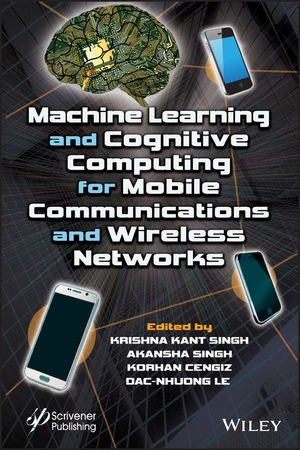
Machine Learning and Cognitive Computing for Mobile Communications and Wireless Networks
Communication and network technology has witnessed recent rapid development and numerous information services and applications have been developed globally. These technologies have high impact on society and the way people are leading their lives. The advancement in technology has undoubtedly improved the quality of service and user experience yet a lot needs to be still done. Some areas that still need improvement include seamless wide-area coverage, high-capacity hot-spots, low-power massive-connections, low-latency and high-reliability and so on. Thus, it is highly desirable to develop smart technologies for communication to improve the overall services and management of wireless communication. Machine learning and cognitive computing have converged to give some groundbreaking solutions for smart machines. With these two technologies coming together, the machines can acquire the ability to reason similar to the human brain. The research area of machine learning and cognitive computing cover many fields like psychology, biology, signal processing, physics, information theory, mathematics, and statistics that can be used effectively for topology management. Therefore, the utilization of machine learning techniques like data analytics and cognitive power will lead to better performance of communication and wireless systems.

Blockchains For Network Security : Principles, technologies and applications
Blockchain technology is a powerful, cost-effective method for network security. Essentially, it is a decentralized ledger for storing all committed transactions in trustless environments by integrating several core technologies such as cryptographic hash, digital signature and distributed consensus mechanisms. Over the past few years, blockchain technology has been used in a variety of network interaction systems such as smart contracts, public services, Internet of Things (IoT), social networks, reputation systems and security and financial services. With its widespread adoption, there has been increased focus on utilizing blockchain technologies to address network security concerns and vulnerabilities as well as understanding real-world security implications.
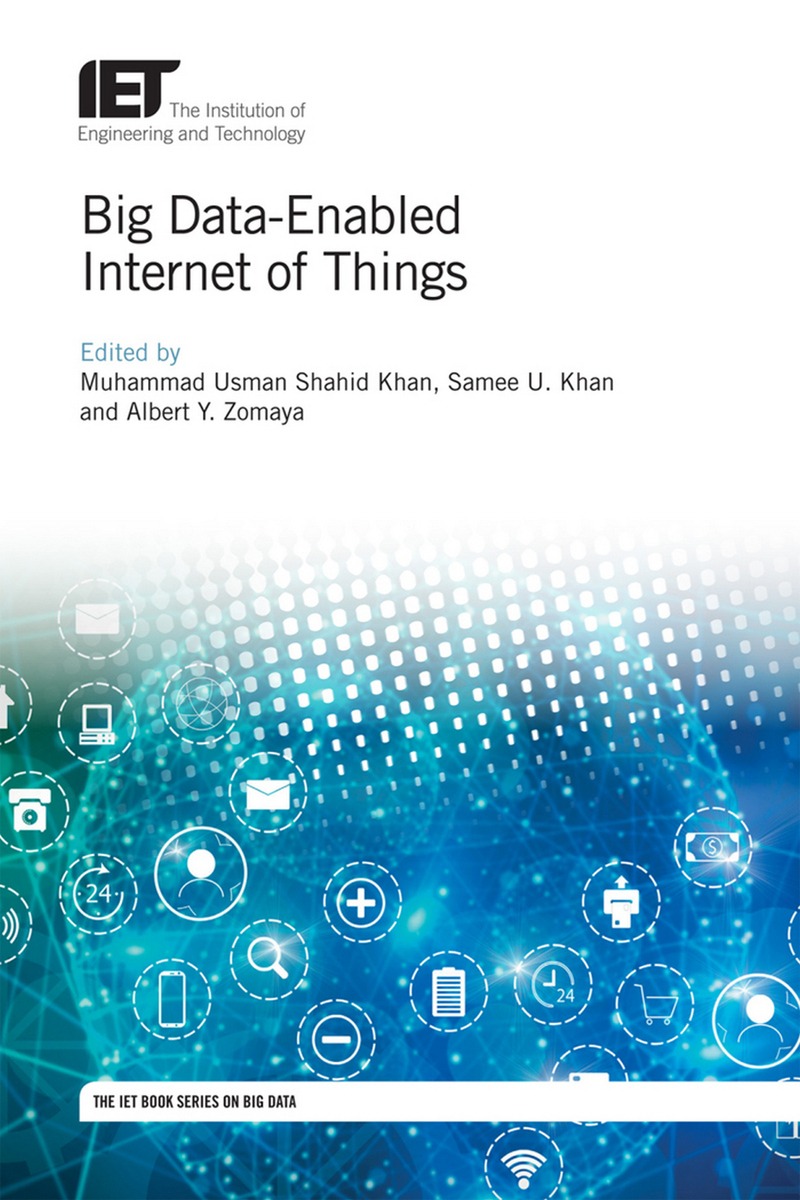
Big data-enabled internet of things
Covers analytical techniques for handling the huge amount of data generated by the Internet of Things, from architectures and platforms to security and privacy issues, applications, and challenges as well as future directions. The fields of Big Data and the Internet of Things (IoT) have seen tremendous advances, developments, and growth in recent years. The IoT is the inter-networking of connected smart devices, buildings, vehicles and other items which are embedded with electronics, software, sensors and actuators, and network connectivity that enable these objects to collect and exchange data. The IoT produces a lot of data. Big data describes very large and complex data sets that traditional data processing application software is inadequate to deal with, and the use of analytical methods to extract value from data. This edited book covers analytical techniques for handling the huge amount of data generated by the Internet of Things, from architectures and platforms to security and privacy issues, applications, and challenges as well as future directions.
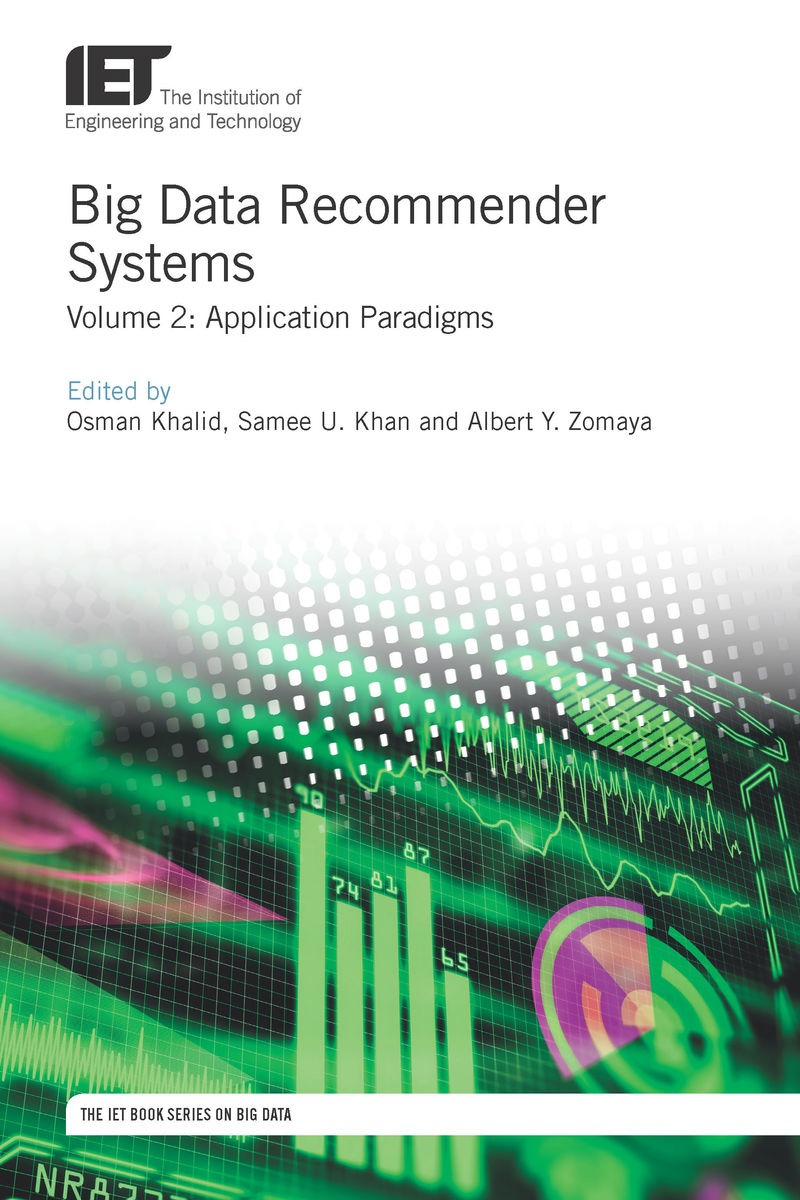
Big Data Recommender Systems ; Vol.2 : Application Paradigms
Combines experimental and theoretical research on big data recommender systems to help computer scientists develop new concepts and methodologies for complex applications. It includes original scientific contributions in the form of theoretical foundations, comparative analysis, surveys, case studies, techniques and tools. First designed to generate personalized recommendations to users in the 90s, recommender systems apply knowledge discovery techniques to users’ data to suggest information, products, and services that best match their preferences. In recent decades, we have seen an exponential increase in the volumes of data, which has introduced many new challenges. recommender systems. Volume 2 covers a broad range of application paradigms for recommender systems over 22 chapters
Big Data Recommender Systems ; Vol.1 : Algorithms, Architectures, Big Data, Security and Trust
Combines experimental and theoretical research on big data recommender systems to help computer scientists develop new concepts and methodologies for complex applications. It includes original scientific contributions in the form of theoretical foundations, comparative analysis, surveys, case studies, techniques and tools.
Big data analytics and machine intelligence in biomedical and health informatics : Concepts, methodologies, tools and applications
Provides coverage of developments and state-of-the-art methods in the broad and diversified data analytics field and applicable areas such as big data analytics, data mining, and machine intelligence in biomedical and health informatics. Covers the latest advances and developments in health informatics, data mining, machine learning, and artificial intelligence. They have been organized with respect to the similarity of topics addressed, ranging from issues pertaining to the Internet of Things (IoT) for biomedical engineering and health informatics, computational intelligence for medical data processing, and Internet of Medical Things??(IoMT).
