



الصفحة 1
الصفحة 1

Network-Centric Service-Oriented Enterprise
Network-Centric Service-Oriented Enterprise (NSCOE) is seen as heralding the next generation of mainstream Enterprise-business information collaboration solution that can enforce information and decision superiority in the decentralized, loosely-coupled, and highly interoperable service environments. Network-Centric Service Oriented Enterprise establishes a system-of-systems (SoS) view of information technologies, offering a synergistic combination of data and information-processing capacity upon an innovative networked-management framework.

Modeling and Management of Fuzzy Semantic RDF Data
Presents the latest research findings in fuzzy RDF data modeling and management. Fuzziness widely exist in many data and knowledge intensive applications. With the increasing amount of metadata available, efficient and scalable management of massive semantic data with uncertainty is of crucial importance. This book goes to great depth concerning the fast-growing topic of technologies and approaches of modeling and managing fuzzy metadata with Resource Description Framework (RDF) format. Its major topics include representation of fuzzy RDF data, fuzzy RDF graph matching, query of fuzzy RDF data, and persistence of fuzzy RDF data in diverse databases. The objective of the book is to provide the state-of-the-art information to researchers, practitioners, and postgraduates students who work on the area of big data intelligence and at the same time serve as the uncertain data and knowledge engineering professional as a valuable real-world reference.

Intelligent data engineering and automated Learning - IDEAL 2008 ; 9th International Conference Daejeon, South Korea, November 2-5, 2008 Proceedings
This book constitutes the refereed proceedings of the 9th International Conference on Intelligent Data Engineering and Automated Learning, IDEAL 2008, held in Daejeon, Korea, in November 2008.The 56 revised full papers presented together with 10 invited papers were carefully reviewed and selected from numerous submissions for inclusion in the book. The papers are organized in topical sections on learning and information processing, data mining and information management, bioinformatics and neuroinformatics, agents and distributed systems, as well as financial engineering and modeling.

Intelligent data engineering and automated Learning - IDEAL 2007 ; 8th International Conference, Birmingham, UK, December 16-19, 2007, Proceedings
This book constitutes the refereed proceedings of the 8th International Conference on Intelligent Data Engineering and Automated Learning, IDEAL 2007. The papers are organized in topical sections on learning and information processing, data mining and information management, bioinformatics and neuroinformatics, agents and distributed systems, financial engineering and modeling, agent-based approach to service sciences, as well as neural-evolutionary fusion algorithms and their applications.

Intelligence and Security Informatics for International Security : Information Sharing and Data Mining
Reflects a decade of leading-edge research on intelligence and security informatics from the Artificial Intelligence Laboratory and the NSF COPLINK Center for Homeland Security Information Technology Research, as well as the application in real-world community situations by the center’s director and the book’s author, Dr. Hsinchun Chen.

Information systems management
Intended for the technical reader who works with large volumes of data. Written by experts in information systems management, the book includes chapters on software development, cloud implementation, networking, and handling large datasets, among other topics. Blockchain and artificial intelligence (AI) are the foundations of automated systems and the authors provide their viewpoints on information management by using these fundamental domains of information technology.

Information Storage : A Multidisciplinary Perspective
Examines some of the underlying processes behind different forms of information management, including how we store information in our brains, the impact of new technologies such as computers and robots on our efficiency in storing information, and how information is stored in families and in society.

Information Management and Big Data ; 7th Annual International Conference, SIMBig 2020, Lima, Peru, October 1–3, 2020, Proceedings
This book constitutes the refereed proceedings of the 7th International Conference on Information Management and Big Data, SIMBig 2020, held in Lima, Peru, in October 2020.* The 32 revised full papers and 7 revised short papers presented were carefully reviewed and selected from 122 submissions. The papers address topics such as natural language processing and text mining; machine learning; image processing; social networks; data-driven software engineering; graph mining; and Semantic Web, repositories, and visualization.

Information Access through Search Engines and Digital Libraries
he Information Management Systems group at the University of Padua, led by Maristella Agosti, has been a major contributor to information retrieval (IR) and digital libraries for nearly twenty years. This group has gained an excellent reputation in the IR community and has produced some of the best-known IR researchers, whose work spans a broad range of topics.The papers in this book deal with e.g. automated text categorizations, web link analysis algorithms, retrieval in multimedia digital libraries, and multilingual information retrieval. The presentation of original research results built on the past work of the group which at the same time summarizes past .

From integrated publication and information systems to information and knowledge environments : Essays dedicated to Erich J. Neuhold on the Occasion of His 65th Birthday
This book constitutes a commemorative volume devoted to Erich J. Neuhold on the occasion of his 65th birthday. The 32 invited reviewed papers presented are written by students and colleagues of Erich Neuhold throughout all periods of his scientific career. The papers are organized in the following topical sections: Database management enabling information systems Semantic Web drivers for advanced information management Securing dynamic media content integration From digital libraries to intelligent knowledge environments Visualization – key to external cognition in virtual information environments From human-computer interaction to human-artefact interaction Domains for virtual information and knowledge environments.

Expert Oracle Database Architecture : 9i and 10g Programming Techniques and Solutions
This is a defining book on the Oracle database for any developer or database administrator who works with Oracle-driven database applications. Tom Kyte has a simple philosophy: you can treat Oracle as a black box and just stick data into it or you can understand how it works and exploit it as a powerful computing environment. If you choose the latter, then you will find that there are few information management problems that you cannot solve quickly and elegantly. Expert Oracle Database Architecture is the first of a three-book series that completely explores and defines the Oracle database. It covers all of the most important Oracle architecture features, including: Files, memory structures and processes / Locking and latching / Transactions, concurrency and multi-versioning / Tables and Indexes / Datatypes / Partitioning and parallelism Each feature is taught in a proof-by-example manner, not only discussing what it is, but also how it works, how to implement software using it, and the common pitfalls associated with it.

Expert Oracle
Thomas Kyte has a simple philosophy: You can treat Oracle as a black box and shove data inside of it, or you can learn how Oracle works and exploit it as a powerful computing environment. If you choose the latter, you will see there are few information management problems you cannot solve quickly and elegantly. Kyte has selected the most important features and techniques to discuss in Expert One-on-One Oracle, which he teaches in a proof-by-example manner. He discusses available features, implementing software using these features, and avoiding potential pitfalls.

Databases, Information Systems, and Peer-to-Peer Computing ; International Workshops, DBISP2P 2005/2006, Trondheim, Norway, August 28-29, 2006, Revised Selected Papers
The P2P paradigm lends itself to constructing large-scale, complex, adaptive, autonomous and heterogeneous database and information systems, endowed with clearly specified and difierential capabilities to negotiate, bargain, coordinate and self-organize the information exchanges in large-scale networks. This vision will have a radical impact on the structure of complex organizations (business, sci- tific or otherwise) and on the emergence and the formation of social communities, and on how the information is organized and processed. The P2P information paradigm naturally encompasses static and wireless connectivity and static and mobile architectures. Wireless connectivity combined with the increasingly small and powerful mobile devices and sensors poses new challenges as well as opp- tunities to the database community. Information becomes ubiquitous, highly distributed and accessible anywhere and at any time over highly dynamic, - stable networks with very severe constraints on the information management and processing capabilities.

Databases, information systems, and peer-to-peer computing ; 2nd international workshop, DBISP2P 2004, Toronto, Canada, August 29-30, 2004, revised selected papers
Peer-to-peer (P2P) paradigm lends itself to constructing large-scale complex, adaptive, - tonomous and heterogeneous database and information systems, endowed with clearly speci?ed and di?erential capabilities to negotiate, bargain, coordinate, and self-organize the information exchanges in large-scale networks. This vision will have a radical impact on the structure of complex organizations (business, scienti?c, or otherwise) and on the emergence and the formation of social c- munities, and on how the information is organized and processed. The P2P information paradigm naturally encompasses static and wireless connectivity, and static and mobile architectures. Wireless connectivity c- bined with the increasingly small and powerful mobile devices and sensors pose new challenges to as well as opportunities for the database community. Inf- mation becomes ubiquitous, highly distributed and accessible anywhere and at any time over highly dynamic, unstable networks with very severe constraints on the information management and processing capabilities.

Databases in networked information systems; 4th international workshop, DNIS 2005, Aizu-Wakamatsu, Japan, March 28-30, 2005, Proceedings
This book constitutes the refereed proceedings of the 4th International Workshop on Databases in Networked Information Systems, DNIS 2005, held in Aizu-Wakamatsu, Japan in March 2005. The 17 revised full papers presented together with 8 invited papers were carefully reviewed and selected for inclusion in the book. The papers are organized in topical sections on information interchange and management systems, Web data management systems, networked information systems applications, and networked information systems implementations.

Databases in Networked Information Systems ; 5th International Workshop, DNIS 2007, Aizu-Wakamatsu, Japan, October 17-19, 2007, Proceedings
This book Is focusing on data semantics and infrastructure for information management and interchange, the papers are organized in topical sections on geospatial decision-making, Web data management systems, infrastructure of networked information systems, and Web query and web mining systems.

Databases and information systems ; 14th International Baltic Conference, DB&IS 2020, Tallinn, Estonia, June 16–19, 2020, Proceedings
This book constitutes the refereed proceedings of the 14th International Baltic Conference on Databases and Information Systems, DB&IS 2020, held in Tallinn, Estonia, in June 2020.* The 22 revised papers presented were carefully reviewed and selected from 52 submissions. The papers are centered around topics like architectures and quality of information systems, artificial intelligence in information systems, data and knowledge engineering, enterprise and information systems engineering, security of information systems.
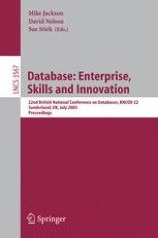
Database : Enterprise, skills and innovation; 22nd British national conference on databases, BNCOD 22, Sunderland, UK, July 5-7, 2005, Proceedings
The British National Conference on Databases (BNCOD) was established in 1980 as a forum for research into the theory and practice of databases. The original conference in the series took place at the University of Aberdeen. To be precise, this conference was in fact entitled ICOD which stood for International Conference on Databases. It was the intention, when the series began, that an ICOD would take place every two years, whilst a BNCOD would run in the years in between. As the record shows ICOD was only held in 1980 and 1983. The more junior conference has managed to acquire a lifetime much longer than that of its senior relative! If truth wereknown,however,BNCOD has,overthe years,growninto ICOD and although the conference is still titled “British National,” it is, in fact, an international conference that takes place on a yearly basis. Proof of this can be obtained simply by looking at the table of contents of these proceeding which clearlyshowthatthe majorityofpaperspresentedatthis year’sconferencecame from contributors whose a?liations are outside the UK. Despitetherangeofpapersono?er,BNCODstillretainsitsuniquelyBritish ?avor. The Programme Committee is drawn from UK academics and the c- ference is always held at a British university (or in earlier years a polytechnic!).

Current trends in database technology - EDBT 2004 Workshops ; EDBT 2004 Workshops PhD, DataX, PIM, P2P&DB, and ClustWeb, Heraklion, Crete, Greece, March 14-18, 2004, Revised Selected Papers
This volume comprises papers from the following ?ve workshops that were part of the complete program for the International Conference on Extending Database Technology (EDBT) held in Heraklion, Greece, March 2004: • ICDE/EDBT Joint Ph. D. Workshop (PhD) • Database Technologies for Handling XML-information on the Web (DataX) • Pervasive Information Management (PIM) • Peer-to-Peer Computing and Databases (P2P&DB) • Clustering Information Over the Web (ClustWeb) Together, the ?ve workshops featured 61 high-quality papers selected from appr- imately 180 submissions.

Computer Network Security
As society becomes increasingly dependent on computers and computer networks, computer problems continue to rise in number. Yet despite the proliferation of expert remedies, a viable solution to these security issues remains elusive, and society continues to suffer at the hands of cyber vandalism and computer viruses. This comprehensive text outlines and discusses today’s most important issues and concerns in computer network and information safety and security, and promises to ignite debate and participation in the ongoing global security dialog Computer Network Security is foremost an educational tool that aims to explore computer network infrastructure and protocol design security flaws and discusses current security solutions and best practices. It explores the security threats and vulnerabilities in the current network infrastructure and protocols and outlines current efforts including: Access Control and Authorization, Cryptography, Firewalls and VPNs, Web Security and Content Filtering, among others. The text further discusses various security proposals This text is an invaluable instructional and research tool for courses in computer and information security. Students or practitioners in computer science, information science, technology studies, library sciences, and information management studies will find this text particularly useful for their purposes. In addition, it is a rich resource for those looking to gain an understanding of computer infrastructures and network security threats.
