



الصفحة 1
الصفحة 1

Next generation information technologies and systems ; 6th International Conference, NGITS 2006, Kebbutz Sehfayim, Israel, July 4-6, 2006, Proceedings
The selected papers may be classified roughly in ten broad areas: ? Information systems development ? Distributed systems ? Semi-structured data ? Data mining and agent-oriented computing ? User-oriented design ? Frameworks, models and taxonomies ? Simulation and incremental computing ? Information integration ? Security and privacy ? Next-generation applications This event is the culmination of efforts by many talented and dedicated individuals.

New horizons for a data-driven economy : A roadmap for usage and exploitation of big data in Europe
The book is structured in four parts: Part I “The Big Data Opportunity” explores the value potential of big data with a particular focus on the European context. It also describes the legal, business and social dimensions that need to be addressed, and briefly introduces the European Commission’s BIG project. Part II “The Big Data Value Chain” details the complete big data lifecycle from a technical point of view, ranging from data acquisition, analysis, curation and storage, to data usage and exploitation. Next, Part III “Usage and Exploitation of Big Data” illustrates the value creation possibilities of big data applications in various sectors, including industry, healthcare, finance, energy, media and public services. Finally, Part IV “A Roadmap for Big Data Research” identifies and prioritizes the cross-sectorial requirements for big data research, and outlines the most urgent and challenging technological, economic, political and societal issues for big data in Europe.
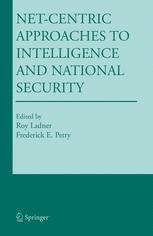
Net-Centric Approaches to Intelligence and National Security
Net-Centric Approaches to Intelligence and National Security considers the web architectures and recent developments that make net-centric approaches for intelligence and national security possible. The development of net-centric approaches for intelligence, national & homeland security applications has become a major concern in many areas such as defense intelligence and national and international law enforcement agencies, especially since the terrorist attacks of 9/11. Net-Centric Approaches to Intelligence and National Security presents developments in information integration and recent advances in web services including the concept of the semantic web. Discovery analysis and management of web-available data pose a number of interesting challenges for research in web-based management systems. Intelligent agents and data mining are among the techniques employed. A number of specific systems that are net-centric based in various areas of military applications, intelligence and law enforcements are presented utlilizing one or more of such techniques Net-Centric Approaches to Intelligence and National Security is designed for a professional audience of researchers and practitioners in industry. This volume is also suitable for graduate-level students in computer science.
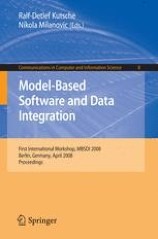
Model-Based Software and Data Integration ; 1st International Workshop, MBSDI 2008, Berlin, Germany, April 1-3, 2008. Proceedings
The First International Workshop on Model-Based Software and Data Integ- tion (MBSDI 2008), was ourfrst event of this kind in a forthcoming series of activities at TU Berlin, where a scientifc discussion and exchange forum was provided for both academic and industrial researchers. We aimed at researchers, engineersand practitionerswho focus onadvanced, model-basedsolutions inthe area of software and information integration and interoperability. As withevery beginning, the resonanceonour callsin today's overfoodingof workshops was somewhat unpredictable, and we did not really know how many paper submissions to expect. We were nicely surprised, considering the rather short lead time to organize the meeting and the very specialized and focused topic.
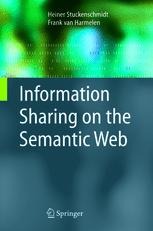
Information Sharing on the Semantic Web
The more information is available, the harder it is to locate any particular piece of it. And even when it has been successfully found, it is even harder still to usefully combine it with other information we may already possess. It is commonly understood that this problem of information sharing can only be solved by giving computers better access to the semantics of the information. While it has been recognized that ontologies play a crucial role in solving the open problems, most approaches rely on the existence of well-established data structures. To overcome these shortcomings, Stuckenschmidt and van Harmelen describe ontology-based approaches for resolving semantic heterogeneity in weakly structured environments, in particular the World Wide Web. Addressing problems like missing conceptual models, unclear system boundaries, and heterogeneous representations, they design a framework for ontology-based information sharing in weakly structured environments like the Semantic Web. For researchers and students in areas related to the Semantic Web, the authors provide not only a comprehensive overview of the State of the art, but also present in detail recent research in areas like ontology design for information integration, metadata generation and management, and representation and management of distributed ontologies. For professionals in areas such as e-commerce and knowledge management, the book provides decision support on the use of novel technologies, information about potential problems, and guidelines for the successful application of existing technologies.

Database Theory – ICDT 2007 ; 11th International Conference, Barcelona, Spain, January 10-12, 2007, Proceedings
The papers are organized in topical sections on information integration and peer to peer, axiomatizations for XML, expressive power of query languages, incompleteness, inconsistency, and uncertainty, XML schemas and typechecking, stream processing and sequential query processing, ranking, XML update and query, as well as query containment.
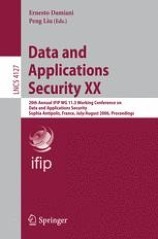
Data and applications security XX ; 20th Annual IFIP WG 11.3 Working Conference on data and applications security, Sophia Antipolis, France, July 31-August 2, 2006, Proceedings
For 20 years, the IFIP WG 11. 3 Working Conference on Data and Appli- tions Security (DBSEC) has been a major forum for presenting originalresearch results, practical experiences, and innovative ideas in data and applications - curity.Like the previous conference, the 20th DBSEC has proved to be up to this challenge. DBSEC 2006 received 56 submissions, out of which the program committee selected22 high-qualitypaperscoveringanumber of diverseresearchtopicssuch as access control, privacy, and identity management.

Data and applications security XIX ; 19th Annual IFIP WG 11.3 working conference on data and applications security, Storrs, CT, USA, August 7-10, 2005, Proceedings
Constitutes the refereed proceedings of the 19th Annual Working Conference on Data and Applications Security held in Storrs, CT, USA, in August 2005. The papers present theory, technique, applications, and practical experience of data and application security with topics like cryptography, privacy, security planning and administration, and more.

Charting the Topic Maps Research and Applications Landscape ; 1st International Workshop on Topic Map Research and Applications, TMRA 2005, Leipzig, Germany, October 6-7, 2005, Revised Selected Papers
The papers in this volume were presented at the workshop “Topic Map Research and Applications 2005” held on October 6-7, 2005, in Leipzig. TMRA 2005 was the first workshop of an annual series of international workshops dedicated to topic maps in research and industry. As the motto “Charting the Topic Maps Research and Applications Landscape” suggests, the aim of TMRA 2005 was to identify the primary open issues in research, learn about who is working on what, bring together researchers and application pioneers, stimulate the systematic tackling of such issues, and foster the exchange of ideas in a stimulating setting.
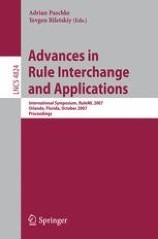
Advances in Rule Interchange and Applications ; International Symposium, RuleML 2007, Orlando, Florida, October 25-26, 2007, Proceedings
The goal of RuleM is to develop an open, general, XML-based family of rule languages as intermediaries between various ‘specialized’ rule vendors, applications, industrial and academic research groups, as well as standardization efforts such as OMG’s PRR or W3C’s RIF. A general advantage of using declarative rules is that they can be easily represented in a machine-readable and platform-independent manner, often governed by an XML schema. This fits well into today’s distributed, heterogeneous Web-based system environments. Rules represented in standardized Web formats can be discovered, interchanged and invoked at runtime within and across Web systems, and can be interpreted and executed on any platform.
