



الصفحة 1
الصفحة 1

Geometric Algebra for Computer Graphics
The first five chapters review the algebras of real numbers, complex numbers, vectors, and quaternions and their associated axioms, together with the geometric conventions employed in analytical geometry. As well as putting geometric algebra into its historical context, John Vince provides chapters on Grassmann’s outer product and Clifford’s geometric product, followed by the application of geometric algebra to reflections, rotations, lines, planes and their intersection. The conformal model is also covered, where a 5D Minkowski space provides an unusual platform for unifying the transforms associated with 3D Euclidean space.

Computer Algebra in Scientific Computing ; Vol. 4194 ; 9th International Workshop, CASC 2006, Chisinau, Moldova, September 11-15, 2006, Proceedings
This volume contains revised versions of the papers submitted to the workshop by the participants and accepted by the program committee after a thorough reviewing process. The collection of papers included in the proceedings covers not only various expanding applications of computer algebra to scienti?c computing but also the computer algebra systems themselves and the CA algorithms.

Computer Algebra in Scientific Computing ; 10th International Workshop, CASC 2007, Bonn, Germany, September 16-20, 2007, Proceedings
The book covers not only various expanding applications of computer algebra to scientific computing but also the computer algebra systems themselves and the CA algorithms. Topics addressed are studies in polynomial and matrix algebra, quantifier elimination, and Gröbner bases, as well as stability investigation of both differential equations and difference methods for them. Several papers are devoted to the application of computer algebra methods and algorithms to the derivation of new mathematical models in biology and in mathematical physics.
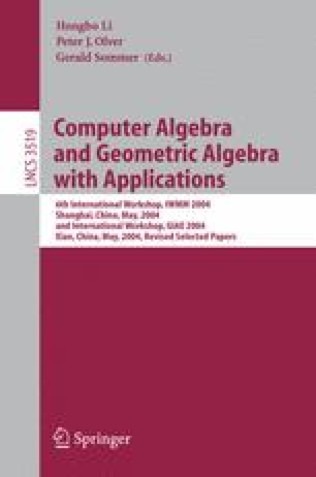
Computer algebra and geometric algebra with applications ; 6th International Workshop, IWMM 2004, Shanghai, China, May 19-21, 2004 and International Workshop, GIAE 2004, Xian, China, May 24-28, 2004.Revised Selected Papers
MathematicsMechanization consistsoftheory,softwareandapplicationofc- puterized mathematical activities such as computing, reasoning and discovering. ItsuniquefeaturecanbesuccinctlydescribedasAAA(Algebraization,Algori- mization, Application). The name “Mathematics Mechanization” has its origin in the work of Hao Wang (1960s), one of the pioneers in using computers to do research in mathematics, particularly in automated theorem proving. Since the 1970s, this research direction has been actively pursued and extensively dev- oped by Prof. Wen-tsun Wu and his followers. It di?ers from the closely related disciplines like Computer Mathematics, Symbolic Computation and Automated Reasoning in that its goal is to make algorithmic studies and applications of mathematics the major trend of mathematics development in the information age.
