



الصفحة 1
الصفحة 1
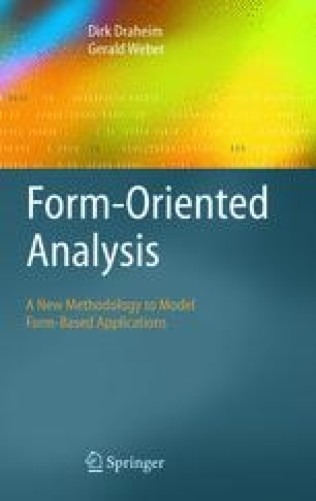
Form-oriented analysis : A new methodology to model form-based applications
Form-based applications range from simple web shops to complex enterprise resource planning systems. Draheim and Weber adapt well-established basic modeling techniques in a novel way to achieve a modeling framework optimized for this broad application domain. They introduce new modeling artifacts, such as page diagrams and form storyboards, and separate dialogue patterns to allow for reuse. In their implementation they have developed new constructs such as typed server pages, and tools for forward and reverse engineering of presentation layers. The methodology is explained using an online bookshop as a running example in which the user can experience the modeling concepts in action. The combination of theoretical achievements and hands-on practical advice and tools makes this book a reference work for both researchers in the areas of software architectures and submit-response style user interfaces, and professionals designing and developing such applications. More information and additional material is also available online.

Enterprise Applications and Services in the Finance Industry ; 3rd International Workshop, FinanceCom 2007, Montreal, Canada, December 8, 2007. Revised Papers
This book constitutes the proceedings of the 4th International Workshop on Enterprise Applications and Services in the Finance Industry, FinanceCom2008, held in Paris, France, on December 13, 2008. The workshop spans multiple disciplines, including technical, economic, sociological and behavioral sciences. The guiding theme of this workshop was concerned with innovations in the financial services industry, driven by either new business models or changed regulations.
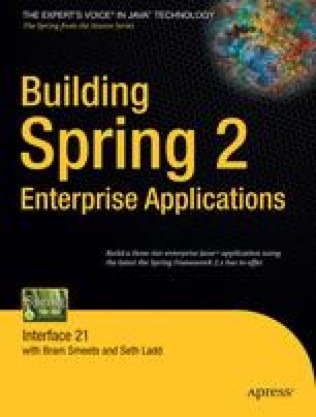
Building Spring 2 Enterprise Applications
This book covers the first steps of using Spring while discussing the relevant technologies that Spring can be integrated with, what to be aware of, and how working with Spring makes them easier to use. Focuses on the most useful features of Spring, including persistence and transaction management as well as the complete Spring web tools portfolio. Introduces three-tier application design and how to test these designs.
Beginning Java EE 5 : From novice to professional
Sun's new lightweight Java Enterprise Edition (EE) 5 is an extremely powerful platform for developing enterprise-level Java-based applications, primarily for the server. This book shows you how to harness that power, examining how the pieces of the new Java EE 5 platform fit together, including the redesigned annotations-driven EJB 3 spec as well as JavaServer Faces (JSF), integrated into the platform for the first time. Hands-on tutorials are also included, along with clear explanations and working code examples. You will grow to take the next step—from writing client-side desktop applications to writing enterprise applications. You will also learn how to use the individual APIs and tools in the Java EE 5 platform, and how to merge these to create your own enterprise applications.
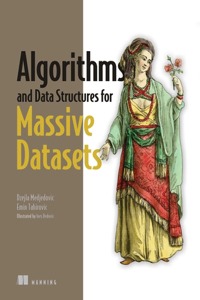
Algorithms and data structures for massive datasets
Learn: Probabilistic sketching data structures for practical problems Choosing the right database engine for your application Evaluating and designing efficient on-disk data structures and algorithms Understanding the algorithmic trade-offs involved in massive-scale systems Deriving basic statistics from streaming data Correctly sampling streaming data Computing percentiles with limited space resources Algorithms and Data Structures for Massive Datasets reveals a toolbox of new methods that are perfect for handling modern big data applications. You'll explore the novel data structures and algorithms that underpin Google, Facebook, and other enterprise applications that work with truly massive amounts of data. These effective techniques can be applied to any discipline, from finance to text analysis. Graphics, illustrations, and hands-on industry examples make complex ideas practical to implement in your projects--and there's no mathematical proofs to puzzle over. Work through this one-of-a-kind guide, and you'll find the sweet spot of saving space without sacrificing your data's accuracy. About the Technology Standard algorithms and data structures may become slow--or fail altogether--when applied to large distributed datasets. Choosing algorithms designed for big data saves time, increases accuracy, and reduces processing cost.
