



الصفحة 1
الصفحة 1
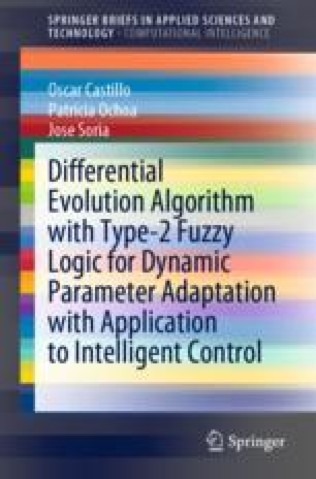
Differential Evolution Algorithm with Type-2 Fuzzy Logic for Dynamic Parameter Adaptation with Application to Intelligent Control
This book focuses on the fields of fuzzy logic, bio-inspired algorithm, especially the differential evolution algorithm and also considering the fuzzy control area. The main idea is that these two areas together can help solve various control problems and to find better results. In this book, the authors test the proposed method using five benchmark control problems. First, the water tank, temperature, mobile robot, and inverted pendulum controllers are considered. For these 4 problems, experimentation was carried out using a Type-1 fuzzy system and an Interval Type-2 system. The last control problem was the D.C. motor, for which the experiments were performed with Type-1, Interval Type-2, and Generalized Type-2 fuzzy systems. When we use fuzzy systems combined with the differential evolution algorithm, we can notice that the results obtained in each of the controllers are better and with increasing uncertainty, the results are even better. For this reason, the authors consider in this book the proposed method using fuzzy systems and the differential evolution algorithm to improve the fuzzy controllers’ behavior in complex control problems.

AI based Robot Safe Learning and Control
This book mainly focuses on the safe control of robot manipulators. The control schemes are mainly developed based on dynamic neural network, which is an important theoretical branch of deep reinforcement learning.
Adaptive-robust control with limited knowledge on systems dynamics : An artificial input delay approach and beyond
investigates the role of artificial input delay in approximating unknown system dynamics, referred to as time-delayed control (TDC), and provides novel solutions to current design issues in TDC. Its central focus is on designing adaptive-switching gain-based robust control (ARC) for a class of Euler–Lagrange (EL) systems with minimal or no knowledge of the system dynamics parameters. The newly proposed TDC-based ARC tackles the commonly observed over- and under-estimation issues in switching gain. The consideration of EL systems lends a practical perspective on the proposed methods, and each chapter is supplemented by relevant experimental data
