



الصفحة 1
الصفحة 1

Model Checking Software ; Vol. 3639 : 12th International SPIN Workshop, San Francisco, CA, USA, August 22-24, 2005, Proceedings
Constitutes the refereed proceedings of the 12th International SPIN workshop on Model Checking Software, SPIN 2005, held in San Francisco, USA in August 2005. The papers are organized in topical sections on state representation and abstraction, dealing with concurrency, dealing with complex data, checking temporal properties, and more.

Mining Complex Data ; ECML/PKDD 2007 Third International Workshop, MCD 2007, Warsaw, Poland, September 17-21, 2007, Revised Selected Papers
This book constitutes the refereed proceedings of the Third International Workshop on Mining Complex Data, MCD 2007, held in Warsaw, Poland, in September 2007, co-located with ECML and PKDD 2007.The 20 revised full papers presented were carefully reviewed and selected; they present original results on knowledge discovery from complex data. In contrast to the typical tabular data, complex data can consist of heterogenous data types, can come from different sources, or live in high dimensional spaces. All these specificities call for new data mining strategies.

Earth Observation Open Science and Innovation
The digital transformation is revolutionizing our ability to monitor our planet and transforming the way we access, process and exploit Earth Observation data from satellites.This book reviews these megatrends and their implications for the Earth Observation community as well as the wider data economy. It provides insight into new paradigms of Open Science and Innovation applied to space data, which are characterized by openness, access to large volume of complex data, wide availability of new community tools, new techniques for big data analytics such as Artificial Intelligence, unprecedented level of computing power, and new types of collaboration among researchers, innovators, entrepreneurs and citizen scientists. In addition, this book aims to provide readers with some reflections on the future of Earth Observation, highlighting through a series of use cases not just the new opportunities created by the New Space revolution, but also the new challenges that must be addressed in order to make the most of the large volume of complex and diverse data delivered by the new generation of satellites.

Data Warehousing and Knowledge Discovery ; 9th International Conference, DaWaK 2007, Regensburg, Germany, September 3-7, 2007, Proceedings
Data Warehousing and Knowledge Discovery have been widely accepted as key te- nologies for enterprises and organizations to improve their abilities in data analysis, decision support, and the automatic extraction of knowledge from data. With the exponentially growing amount of information to be included in the decision-making process, the data to be processed become more and more complex in both structure and semantics. Consequently, the process of retrieval and knowledge discovery from this huge amount of heterogeneous complex data constitutes the reality check for research in the area.

Data science in theory and practice : Techniques for big data analytics and complex data sets
Delivers a comprehensive treatment of the mathematical and statistical models useful for analyzing data sets arising in various disciplines, like banking, finance, health care, bioinformatics, security, education, and social services. Written in five parts, the book examines some of the most commonly used and fundamental mathematical and statistical concepts that form the basis of data science. The authors go on to analyze various data transformation techniques useful for extracting information from raw data, long memory behavior, and predictive modeling. Readers will also learn from topics like: Analyses of foundational theoretical subjects, including the history of data science, matrix algebra and random vectors, and multivariate analysis A comprehensive examination of time series forecasting, including the different components of time series and transformations to achieve stationarity Introductions to both the R and Python programming languages, including basic data types and sample manipulations for both languages An exploration of algorithms, including how to write one and how to perform an asymptotic analysis A comprehensive discussion of several techniques for analyzing and predicting complex data sets
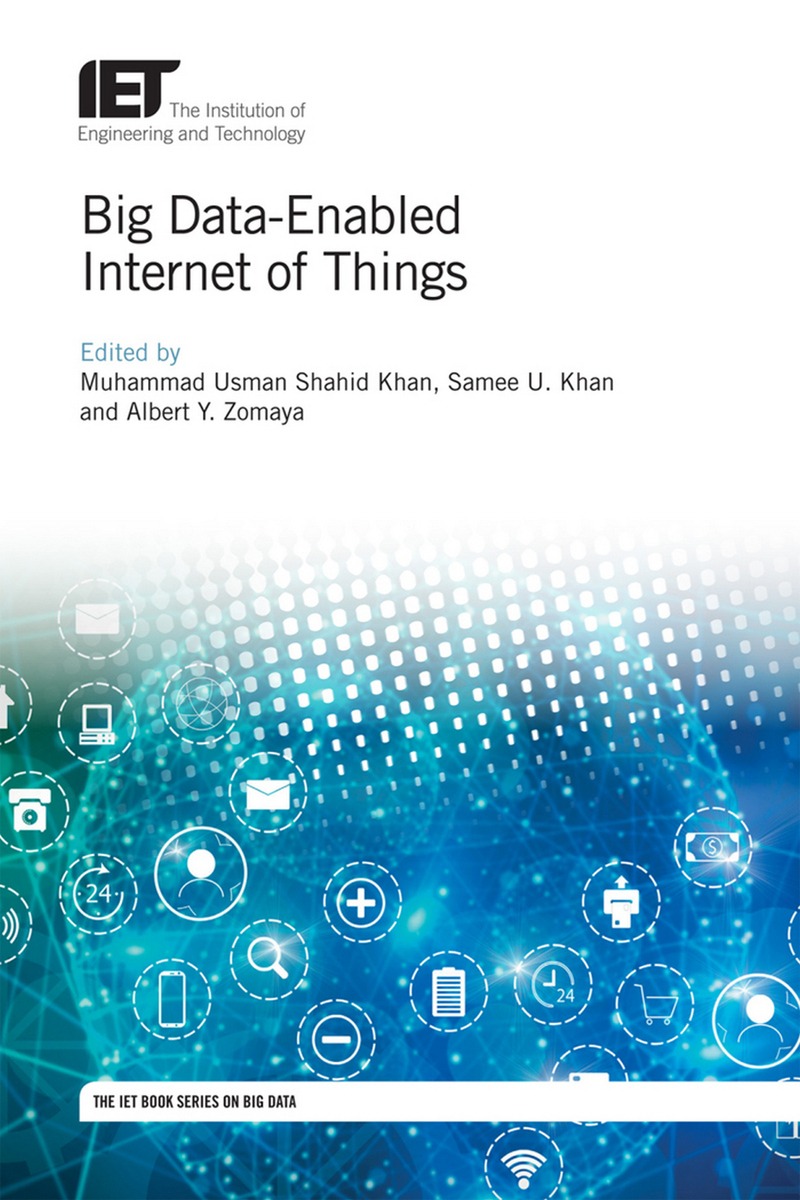
Big data-enabled internet of things
Covers analytical techniques for handling the huge amount of data generated by the Internet of Things, from architectures and platforms to security and privacy issues, applications, and challenges as well as future directions. The fields of Big Data and the Internet of Things (IoT) have seen tremendous advances, developments, and growth in recent years. The IoT is the inter-networking of connected smart devices, buildings, vehicles and other items which are embedded with electronics, software, sensors and actuators, and network connectivity that enable these objects to collect and exchange data. The IoT produces a lot of data. Big data describes very large and complex data sets that traditional data processing application software is inadequate to deal with, and the use of analytical methods to extract value from data. This edited book covers analytical techniques for handling the huge amount of data generated by the Internet of Things, from architectures and platforms to security and privacy issues, applications, and challenges as well as future directions.
Advanced methods for knowledge discovery from complex data
An overview of the field, looking at the issues and challenges involved is followed by coverage of recent trends in data mining, including descriptions of some currently popular tools like genetic algorithms, neural networks and case-based reasoning. This provides the context for the subsequent chapters on methods and applications. Part I is devoted to the foundations of mining different types of complex data like trees, graphs, links and sequences. A knowledge discovery approach based on problem decomposition is also described. Part II presents important applications of advanced mining techniques to data in unconventional and complex domains, such as life sciences, world-wide web, image databases, cyber security and sensor networks. With a good balance of introductory material on the knowledge discovery process, advanced issues and state-of-the-art tools and techniques, as well as recent working applications this book provides a representative selection of the available methods and their evaluation in real domains. It will be useful to students at Masters and PhD level in Computer Science, as well as practitioners in the field.
