



الصفحة 1
الصفحة 1

New trends in computational vision and bio-inspired computing : Selected works presented at the ICCVBIC 2018, Coimbatore, India
Gathers selected, peer-reviewed original contributions presented at the International Conference on Computational Vision and Bio-inspired Computing (ICCVBIC) conference which was held in Coimbatore, India, on November 29-30, 2018. The works included here offer a rich and diverse sampling of recent developments in the fields of Computational Vision, Fuzzy, Image Processing and Bio-inspired Computing. The topics covered include computer vision; cryptography and digital privacy; machine learning and artificial neural networks; genetic algorithms and computational intelligence; the Internet of Things; and biometric systems, to name but a few. The applications discussed range from security, healthcare and epidemic control to urban computing, agriculture and robotics.

Intelligent glasses store
Technology has been found to facilitate humankind's life. Hence, there is a new technique almost every day. One of the most common is E-commerce. This is the first project in Syria. about online glasses Shop, which displays sets of glasses on a website. The website allows the shopkeeper (the admin) to add their collections of glasses. Set prices and show reservations. Users can view glasses on the website and try whatever he wants by real-time or by recording video, then they add the preferred ones to the cart to reserve the sample they like the most for a specific time. This project aims to allow busy traders to make their own business online, in addition, it saves time and effort for them and users as they can make shopping and compare goods whatever the situation is especially in quarantine.

Human-centered visualization environments : GI-Dagstuhl Research Seminar, Dagstuhl Castle, Germany, March 5-8, 2006, Revised Papers
This tutorial book features an augmented selection of the material presented at the GI-Dagstuhl Research Seminar on Human-Centered Visualization Environments, HCVE 2006, held in Dagstuhl Castle, Germany in March 2006. It presents eight tutorial lectures that are the thoroughly cross-reviewed and revised versions of the summaries and findings presented and discussed at the seminar.

Human motion : Understanding, modeling, capture and animation ; 2nd Workshop, HumanMotion 2007, Rio de Janeiro, Brazil, October 20, 2007, Proceedings
This LNCS volume contains the papers presented at the second Workshop on Human Motion Understanding, Modeling, Capture and Animation. The accepted papers re?ect the state of the art in the ?eld and cover various topicsrelatedto humanmotiontrackingandanalysis.Thepapersinthisvolume have been classi?ed into three categories based on the topics they cover: human motion capture and pose estimation, body and limb tracking and segmentation, and activity recognition.

Fundamental approaches to software engineering ; Vol. 3442 ; 8th International Conference, FASE 2005, Held as Part of the Joint European conferences on theory and practice of software, ETAPS 2005, Edinburgh, UK, April 4-8, 2005, Proceedings
ETAPS 2005 was the eighth instance of the European Joint Conferences on Theory and Practice of Software. ETAPS is an annual federated conference that was established in 1998 by combining a number of existing and new conf- ences. This year it comprised ?ve conferences (CC, ESOP, FASE, FOSSACS, TACAS), 17 satellite workshops (AVIS, BYTECODE, CEES, CLASE, CMSB, COCV, FAC, FESCA, FINCO, GCW-DSE, GLPL, LDTA, QAPL, SC, SLAP, TGC, UITP), seven invited lectures (not including those that were speci?c to the satellite events), and several tutorials. We received over 550 submissions to the ?ve conferences this year, giving acceptance rates below 30% for each one. The events that comprise ETAPS address various aspects of the system - velopment process, including speci?cation, design, implementation, analysis and improvement. The languages, methodologies and tools which support these - tivities are all well within its scope. Di?erent blends of theory and practice are represented, with an inclination towards theory with a practical motivation on the one hand and soundly based practice on the other. Many of the issues involved in software design apply to systems in general, including hardware s- tems,andtheemphasisonsoftwareisnotintendedtobeexclusive.

Foundations of software science and computational structures ; Vol.3441 : 8th International Conference, FOSSACS 2005, Held as part of the joint European conferences on theory and practice of software, ETAPS 2005
ETAPS 2005 was the eighth instance of the European Joint Conferences on Theory and Practice of Software. ETAPS is an annual federated conference that was est- lished in 1998 by combining a number of existing and new conferences. This year it comprised ?ve conferences (CC, ESOP, FASE, FOSSACS, TACAS), 17 satellite wo- shops (AVIS, BYTECODE, CEES, CLASE, CMSB, COCV, FAC, FESCA, FINCO, GCW-DSE, GLPL, LDTA, QAPL, SC, SLAP, TGC, UITP), seven invited lectures (not including those that were speci?c to the satellite events), and several tutorials. We - ceived over 550 submissions to the ?ve conferences this year, giving acceptance rates below 30% for each one. Congratulations to all the authors who made it to the ?nal program! I hope that most of the other authors still found a way of participating in this exciting event and I hope you will continue submitting. The events that comprise ETAPS address various aspects of the system devel- ment process, including speci?cation, design, implementation, analysis and impro- ment. The languages, methodologies and tools which support these activities are all well within its scope.

Energy minimization methods in computer vision and pattern recognition ; 6th International Conference, EMMCVPR 2007, Ezhou, China, August 27-29, 2007, Proceedings
Contains critical issues of representation, learning, and inference. Important new themes include pr- abilistic grammars, image parsing, and the use of datasets with ground-truth to act as benchmarks for evaluating algorithms and as a way to train learning algorithms. Other themes include the development of efficient inference algorithms using advanced techniques from statistics, computer science, and applied mathematics. This book makes no distinction between oral and poster papers. It also contiants sections on al- rithms, applications, image parsing, image processing, motion, shape, and thr- dimensional processing.

Energy minimization methods in computer vision and pattern recognition ; 5th International Workshop, EMMCVPR 2005, St. Augustine, FL, USA, November 9-11, 2005, Proceedings
Constitutes the refereed proceedings of the 5th International Workshop on Energy Minimization Methods in Computer Vision and Pattern Recognition, EMMCVPR 2005, in St Augustine, FL, USA, in November 2005. This book consists of 24 papers and 18 poster papers organized in topical sections on different approaches.

Dynamical Vision ; ICCV 2005 and ECCV 2006 Workshops, WDV 2005 and WDV 2006, Beijing, China, October 21, 2005, Graz, Austria, May 13, 2006, Revised Papers
Classical multiple-view geometry studies the reconstruction of a static scene - served by a rigidly moving camera. However, in many real-world applications the scene may undergo much more complex dynamical changes. For instance, the scene may consist of multiple moving objects (e.g., a trafic scene) or arti- lated motions (e.g., a walking human) or even non-rigid dynamics (e.g., smoke, fire, or a waterfall). In addition, some applications may require interaction with the scene through a dynamical system (e.g., vision-guided robot navigation and coordination). To study the problem of reconstructing dynamical scenes, many new al- braic, geometric, statistical, and computational tools have recently emerged in computer vision, computer graphics, image processing, and vision-based c- trol.

Deepfake detection
The rise of large language models (LLMs) and the increasing sophistication of deepfake images have made detecting synthetic content a pressing challenge. Several approaches have been proposed to tackle this problem, including statistical analysis, and machine learning algorithms. In this project, A novel zero-shot approach is proposed that utilizes the power of LLMs to detect fake text. The pre-trained LLM is fine-tuned to enhance its ability to differentiate real and fake text. The approach uses the LLM to detect text by analyzing the log probabilities of the text. For detecting fake images, computer vision algorithms and neural networks are used to analyze facial features. The facial region is cropped and preprocessed and the neural network identifies patterns indicative of synthetic content.

Deep structure, singularities, and computer vision ; 1st international workshop, DSSCV 2005, Maastricht, The Netherlands, June 9-10, 2005, revised selected papers
Constitutes the refereed post-proceedings of the First International Workshop on Deep Structure, Singularities, and Computer Vision, DSSCV 2005, held in Maastricht. This book represents in understanding the relation between structural, topological information represented by singularities and metric information of signals, shapes, and colors.

Deep learning and computer vision in remote sensing-II
Computer vision (CV) have seen a massive rise in popularity in the remote sensing field over the last few years. This success is mostly due to the effectiveness of deep learning (DL) algorithms. However, remote sensing data acquisition and annotation, as well as information extraction from massive remote sensing data, are still challenging. This reprint collected novel developments in the field of deep learning and computer vision methods for remote sensing. Papers dealing with fundamental theoretical analyses, as well as those demonstrating their application to real-world problems, have been published. With practical examples and real-world case studies, this reprint provides a valuable resource for researchers, professionals, and students seeking to harness the power of deep learning in the field of remote sensing.

Computer Vision, Graphics and Image Processing ; 5th Indian Conference, ICVGIP 2006, Madurai, India, December 13-16, 2006, Proceedings
The Indian Conference on Computer Vision, Graphics and Image Processing (ICVGIP) is a forum bringing together researchers and practitioners in these related areas, coming from national and international academic institutes, from government research and development laboratories, and from industry. The proceedings of ICVGIP 2006, published in Springer's series Lecture Notes in Computer Science, comprise 85 papers that were selected for presentation from 284 papers, which were submitted from all over the world.

Computer vision systems ; 6th International conference, ICVS 2008 Santorini, Greece, May 12-15, 2008 Proceedings
This book constitutes the refereed proceedings of the 6th International Conference on Computer Vision Systems, ICVS 2008, held in Santorini, Greece, May 12-15, 2008.

Computer Vision Systems ; 2nd International Workshop, ICVS 2001 Vancouver, Canada, July 7-8, 2001 Proceedings
Computer Vision has reached a level of maturity that allows us not only to p- form research on individual methods and system components but also to build fully integrated computer vision systems of signi cant complexity. This opens a number of new problems related to system architecture, methods for system synthesis and veri cation, active vision systems, control of perception and - tion, knowledge and system representation, context modeling, cue integration, etc. By focusing on methods and concepts for the construction of fully integrated vision systems, ICVS aims to bring together researchers interested in computer vision systems. Similar to the previous event in Las Palmas, ICVS 2001 was organized as a single-track workshop consisting of high-quality.

Computer Vision in Human-Computer Interaction ; Vol.3979 ; ECCV 2006 Workshop on HCI, Graz, Austria, May 13, 2006, Proceedings
This volume presents the proceedings of the HCI 2006 Workshop, held in conjunction with ECCV 2006 (European Conference on Computer Vision) in Graz, Austria. The goal of this workshop was to bring together researchers from the field of computer vision whose work is related to human–computer interaction.

Computer vision for biomedical image applications
The purpose of this book is to submit the workshop, “Computer Vision for Biomedical Image Applications: Current Techniques and Future Trends” (CVBIA), is to examine the diverse applications of computer vision to biomedical image applications, considering both current methods and promising new trends. An additional goal is to provide the opportunity for direct interactions between (1) prominent senior researchers and young scientists, including students, postdoctoral associates and junior faculty; (2) local researchers and international leaders in biomedical image analysis; and (3) computer scientists and medical practitioners. Our CVBIA workshop had two novel characteristics: each contributed paper was authored primarily by a young scientist, and the workshop attracted an unusually large number of well-respected invited speakers (and their papers).

Computer vision approaches to medical image analysis ; 2nd International ECCV Workshop, CVAMIA 2006, Graz, Austria, May 12, 2006, Revised Papers
This was the second time that a satellite workshop,solely devoted to medical image analysis issues, was held in conjunction with the European Conference on Computer Vision (ECCV). We received 38 full-length paper submissions to the second Computer Vision Approaches to Medical Image Analysis (CVAMIA) Workshop, out of which 10 were accepted for oral and 11 for poster presentation after a rigorous peer-review process. In addition, the workshop included three invited talks.

Computer vision and graphics ; International Conference, ICCVG 2020, Warsaw, Poland, September 14–16, 2020, Proceedings
This book constitutes the refereed proceedings of the International Conference on Computer Vision and Graphics, ICCVG 2020, held in Warsaw, Poland, in September 2020. The 20 full papers were selected from 49 submissions. The contributions cover topics such as: modelling of human visual perception; computational geometry; geometrical models of objects and scenes; illumination and reflection models and methods; image formation; image and video coding; image filtering and enhancement; biomedical image processing; biomedical graphics; colour image processing; multispectral image processing; pattern recognition in image processing
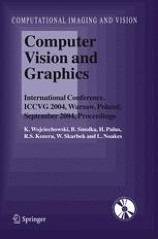
Computer vision and graphics ; International Conference, ICCVG 2004, Warsaw, Poland, September 2004, Proceedings
The objectives of the ICCVG are: presentation of current research topics and d- cussions leading to the integration of the community engaged in machine vision and computer graphics, carrying out and supporting research in the ?eld and ?nally pro- tion of new applications. The ICCVG is a continuation of the former International Conference on Computer Graphics and Image Processing called GKPO, held in Poland every second year in May since 1990, organized by the Institute of Computer Science of the Polish Academy of Sciences, Warsaw.
