



الصفحة 1
الصفحة 1

Innovations in robot mobility and control
The most important aspects of this book is that the principles and models introduced in the text are all field-tested, and thus can readily be used in solving real world problems, such as factory automation, disposal of nuclear wastes, landmine clearing and computerized surgery.

Hybrid Estimation of Complex Systems
This monograph provides a tool-set for hybrid estimation that can successfully monitor the behavior of complex artifacts with a large number of possible operational and failure modes such as production plants, automotive or aeronautic systems, and autonomous robots.
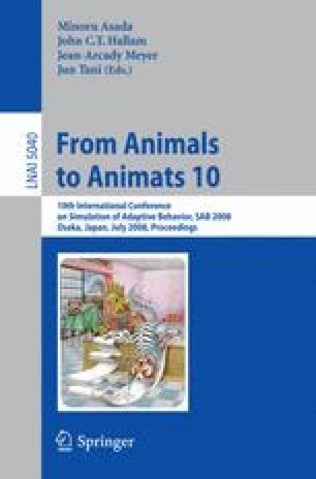
From Animals to Animats 10 ; 10th International Conference on Simulation of Adaptive Behavior, SAB 2008, Osaka, Japan, July 7-12, 2008. Proceedings
This book constitutes the refereed proceedings of the 10th International Conference on Simulation of Adaptive Behavior, SAB 2008, held in Osaka, Japan in July 2008.The 30 revised full papers and 21 revised poster papers presented were carefully reviewed and selected from 110 submissions. The papers are organized in topical sections on the animat approach to adaptive behaviour, evolution, navigation and internal world models, perception and control, learning and adaptation, cognition, emotion and behaviour, collective and social behaviours, adaptive behaviour in language and communication, and applied adaptive behaviour.
Entertainment Computing - ICEC 2005 ; 4th International Conference, Sanda, Japan, September 19-21, 2005, Proceedings
First of all, we appreciate the hard work of all the authors who contributed to ICEC 2005 by submitting their papers. ICEC 2005 attracted 95 technical paper submissions, 8 poster submissions and 7 demo submissions, in total 110. This number is nearly equal to ICEC 2004. Based on a thorough review and selection process carried out by 76 international experts from academia and industry as members of the senior and international program committees, a high-quality program was compiled. The program committee consisted of experts from all over the world: 1 from Austria, 3 from Bulgaria, 2 from Canada, 4 from China, 1 from Finland, 4 from France, 10 from Germany, 1 from Greece, 1 from Ireland, 1 from Israel, 1 from Italy, 26 from Japan, 1 from Korea, 4 from The Netherlands, 1 from New Zealand, 1 from Norway, 1 from Singapore, 1 from Thailand, 4 from the UK, and 8 from the USA. In this number, reviewers are included. The final decision was made at the senior program committee meeting based on three reviewers' feedback, available online via the conference management tool. Through earnest and fair discussion at the meeting, 25 technical papers were accepted as long papers and 32 technical papers were accepted as short papers from 95 submitted technical papers. Moreover, 3 poster papers and 5 demo papers were accepted.
Distributed Computing ; 22nd International Symposium, DISC 2008, Arcachon, France, September 22-24, 2008. Proceedings
This book constitutes the refereed proceedings of the 22nd International Symposium on Distributed Computing, DISC 2008, held in Arcachon, France, in September 2008.

Cooperative Control : A Post-Workshop Vol., 2003 Block Island Workshop on Cooperative Control
This carefully edited book presents how natural groupings such as fish schools, bird flocks, deer herds etc. coordinate themselves and move so flawlessly, often without an apparent leader or any form of centralized control. It shows how the underlying principles of cooperative control may be used for groups of mobile autonomous agents to help enable a large group of autonomous robotic vehicles in the air, on land or sea or underwater, to collectively accomplish useful tasks such as distributed, adaptive scientific data gathering, search and rescue, or reconnaissance.
Biomimetic neural learning for intelligent robots : Intelligent systems, cognitive robotics, and neuroscience
This book presents research performed as part of the EU project on biomimeticmultimodal learning in a mirror neuron-based robot (MirrorBot) and contribu-tions presented at the International AI-Workshop on NeuroBotics. The over-all aim of the book is to present a broad spectrum of current research intobiomimetic neural learning for intelligent autonomous robots. In this book we show the development of newtechniques using cell assemblies, associative neural networks, and Hebbian-typelearning in order to associate vision, language and motor concepts. We havedeveloped biomimetic multimodal learning and language instruction in a robotto investigate the task of searching for objects. As well as the research performedin this area for the MirrorBot project, the second part of this book incorporatessignificant contributions from other research in the field of biomimetic robotics.This second part of the book concentrates on the progress made in neuroscienceinspired robotic learning approaches (in short: NeuroBotics). We hope that this book stimulates and encourages new research in this in-teresting and dynamic area.
Autonomous Robots and Agents
This book deals with the theoretical and methodological aspects of incorporating intelligence in Autonomous Robots and Agents. Challenges faced in the real world to accomplish complex tasks, which require collaborative efforts, and methods to overcome them, are detailed. Several informative articles deal with navigation, localization and mapping of mobile robots, a problem that engineers and researchers are grappling with all the time.This edited volume is targeted to present the latest state-of-the-art methodologies in Robotics. It is a compilation of the extended versions of the very best papers selected from the many that were presented at the 3rd International Conference on Autonomous Robots and Agents (ICARA 2006) which was held at Palmerston North, New Zealand from 11-14 December, 2006. Scientists and engineers who work with mobile robots will find this book very useful and stimulating.
Attention in Cognitive Systems : Theories and Systems from an Interdisciplinary Viewpoint ; 4th International Workshop on Attention in Cognitive Systems, WAPCV 2007 Hyderabad, India, January 8, 2007 Revised Selected Papers
The embodied nature of sensory-motor intelligence requires a continuous and focused interplay between the control of motor activities and the interpretation of feedback from perceptual modalities. Decision making about the selection of information from the incoming sensory stream – in tune with contextual processing on a current task and an agent’s global objectives – becomes a further challenging issue in attentional control. Attention must operate at interfaces between bottom-up driven world int- pretation and top-down driven information selection, thus acting at the core of arti?cial cognitive systems. These insights have already induced changes in AI-related disciplines, such as the design of behavior-based robot control and the computational modeling of animats. Today, the development of enabling technologiessuch as autonomous robotic systems,miniaturizedmobile–evenwearable–sensors,andambientintelligence systems involves the real-time analysis of enormous quantities of data. These data have to be processed in an intelligent way to provide “on time delivery” of the required relevant information. Knowledge has to be applied about what needs to be attended to, and when, and what to do in a meaningful sequence, in correspondence with visual feedback.

Artificial intelligence : Methodology, systems, and applications ; 10th International Conference, AIMSA 2002, Varna, Bulgaria, September 4-6, 2002. Proceedings
The AIMSA conference series was frst conceived in 1984 as a gathering of AI researchers and students from Eastern and Central Europe.Sincethenthecon- rence has followed a biennial schedule of meetings in Bulgaria, attracting parti- pantsfrom awidergeographicalarea.The AIMSA organizers are delighted to present you with another exciting program, coveringmostareasof Artifcial Intelligence.Inkeepingwithitsm- sion to inform the research community and excite the commercial sector, AIMSA presents this year two invited contributions from world-leading European rese- chersworkingoncutting-edgeAIresearch: Prof.CaroleGoble, ontheSemantic Web.
