



الصفحة 1
الصفحة 1

Numerical Methods Using Java : For Data Science, Analysis, and Engineering
Covers a wide range of topics, including chapters on linear algebra, root finding, curve fitting, differentiation and integration, solving differential equations, random numbers and simulation, a whole suite of unconstrained and constrained optimization algorithms, statistics, regression and time series analysis. The mathematical concepts behind the algorithms are clearly explained, with plenty of code examples and illustrations to help even beginners get started. You will: Program in Java using a high-performance numerical library / Learn the mathematics for a wide range of numerical computing algorithms / Convert ideas and equations into code / Put together algorithms/ and classes to build your own engineering solution / Build solvers for industrial optimization problems / Do data analysis using basic and advanced statistics

Numerical Mathematics and Advanced Applications ENUMATH 2019 ; European Conference, Egmond aan Zee, The Netherlands, September 30 - October 4
It contians basic aspects and new trends in numerical mathematics and scientific and industrial applications, all examined at the highest level of international expertise.

Nuclear Principles in Engineering
Nuclear Principles in Engineering is written for students, engineers, physicians and scientists who need up-to-date information in basic nuclear concepts and calculation methods using numerous examples and illustrative computer application areas.

Nonlinear dynamics of a wheeled vehicle
This book provides an overview of the theory of stability analysis and its applications. It is focused on various methods devoted to analyzing wheeled vehicle behavior. The authors provide both basic and advanced knowledge of the subject.

New Computational Paradigms ; 1st Conference on Computability in Europe, CiE 2005, Amsterdam, The Netherlands, June 8-12, 2005, Proceedings
This book constitutes the refereed proceedings of the first International Conference on Computability in Europe, CiE 2005, held in Amsterdam, The Netherlands in June 2005. The 68 revised full papers presented were carefully reviewed and selected from 144 submissions. Among them are papers corresponding to two tutorials, six plenary talks and papers of six special sessions involving mathematical logic and computer science at the same time as offering the methodological foundations for models of computation. The papers address many aspects of computability in Europe with a special focus on new computational paradigms. These include first of all connections between computation and physical systems (e.g., quantum and analog computation, neural nets, molecular computation), but also cover new perspectives on models of computation arising from basic research in mathematical logic and theoretical computer science.

Networked RFID : Systems, Software and Services
Begins with a quick introduction to RFID basics and then discusses the various elements of the topic, using applications such as e-passports, ticketing and supply-chain management throughout. The text explores RFID technology fundamentals, including operating principles, core system components and performance trade-offs involved in the selection of specific RFID platforms. The emphasis is on a practical approach, developing an arsenal of techniques and designs that can be mixed and matched to fit the needs of new systems and applications.

Network Security, Firewalls, and VPNs ; 3rd ed.
Provides a unique, in-depth look at the major business challenges and threats that are introduced when an organization’s network is connected to the public Internet. Written by industry experts, this book provides a comprehensive explanation of network security basics, including how hackers access online networks and the use of Firewalls and VPNs to provide security countermeasures. Using examples and exercises, this book incorporates hands-on activities to prepare the reader to disarm threats and prepare for emerging technologies and future attacks.

Network Control and Engineering for QOS, Security and Mobility, III ; IFIP TC6 / WG6.2, 6.6, 6.7 and 6.8. Third International Conference on Network Control and Engineering for QoS, Security and Mobility, NetCon 2004 on November 2-5, 2004, Palma de Mallorca, Spain
This volume contains the proceedings of the Third International Conference on Network Control and Engineering for Quality of Service, Security and Mobility (Net-Con'2004), celebrated in Palma de Mallorca (Illes Balears, Spain) during November 2-5, 2004. This IFIP TC6 Conference was organized by the Universitat de les Illes Balears and sponsored by the following Working Groups: WG6.2 (Network and Internetwork Architectures), WG6.6 (Management of Networks and Distributed Systems), WG6.7 (Smart Networks) and WG6.8 (Mobile and Wireless Communications). The rapid evolution of the networking industry introduces new exciting challenges that need to be explored by the research community. The adoption of Internet as the global network infrastructure places the issue of quality of service among one of the hot topics nowadays: a huge diversity of applications with quite different service requirements must be supported over a basic core of protocols. Also, the open and uncontrolled nature of Internet enforces the need to guarantee secure transactions among users, thus placing security as another hot topic. Finally, the explosion of mobility and its integration as part of the global infrastructure are probably now the most challenging issues in the networking field.

Nearest Neighbor Search : A Database Perspective
Modern applications are both data and computationally intensive and require the storage and manipulation of voluminous traditional (alphanumeric) and nontraditional data sets (images, text, geometric objects, time-series). Examples of such emerging application domains are: Geographical Information Systems (GIS), Multimedia Information Systems, CAD/CAM, Time-Series Analysis, Medical Information Sstems, On-Line Analytical Processing (OLAP), and Data Mining. These applications pose diverse requirements with respect to the information and the operations that need to be supported. From the database perspective, new techniques and tools therefore need to be developed towards increased processing efficiency. This monograph explores the way spatial database management systems aim at supporting queries that involve the space characteristics of the underlying data, and discusses query processing techniques for nearest neighbor queries. It provides both basic concepts and state-of-the-art results in spatial databases and parallel processing research, and studies numerous applications of nearest neighbor queries.

Multiobjective Evolutionary Algorithms and Applications
Multiobjective Evolutionary Algorithms and Applications provides comprehensive treatment on the design of multiobjective evolutionary algorithms and their applications in domains covering areas such as control and scheduling. Emphasizing both the theoretical developments and the practical implementation of multiobjective evolutionary algorithms, a profound mathematical knowledge is not required. Written for a wide readership, engineers, researchers, senior undergraduates and graduate students interested in the field of evolutionary algorithms and multiobjective optimization with some basic knowledge of evolutionary computation will find this book a useful addition to their book case.

Modern Control Theory
This book presents a unified, systematic description of basic and advanced problems, methods and algorithms of the modern control theory treated as a foundation for the design of computer control and management systems.

Modern Control Systems ; 14th ed.
Written to be equally useful for all engineering disciplines, this text is organized around the concepts of control systems theory in the context of frequency and time domains. It provides coverage of both classical and modern methods of control engineering to give students a strong foundation in basic principles that they can utilize to explore advanced topics in later chapters. Emphasis is placed on real-world complex control systems and practical design applications as well as evolving design strategies like green engineering and human-centered design. Problem solving is strongly emphasized, with an abundance of problems of increasing complexity that help students learn to apply theory to computer-aided design and analysis concepts using MATLAB® and LabVIEW MathScript.
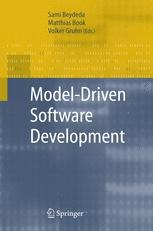
Model-Driven Software Development
Abstraction is the most basic principle of software engineering. Abstractions are provided by models. Modeling and model transformation constitute the core of model-driven development. Models can be refined and finally be transformed into a technical implementation, i.e., a software system. The aim of this book is to give an overview of the state of the art in model-driven software development. Achievements are considered from a conceptual point of view in the first part, while the second part describes technical advances and infrastructures. Finally, the third part summarizes experiences gained in actual projects employing model-driven development. Beydeda, Book and Gruhn put together the results from leading researchers in this area, both from industry and academia. The result is a collection of papers which gives both researchers and graduate students a comprehensive overview of current research issues and industrial forefront practice, as promoted by OMG’s MDA initiative.

Model-Based Testing of Reactive Systems : Advanced Lectures
This book is based on a seminar held in Dagstuhl Castle, Germany, in January 2004. It presents 19 carefully reviewed and revised lectures given at the seminar in a well-balanced way ensuring competent complementary coverage of all relevant aspects. An appendix provides a glossary for model-based testing and basics on finite state machines and on labelled transition systems. The lectures are presented in topical sections on testing of finite state machines, testing of labelled transition systems, model-based test case generation, tools and case studies, standardized test notation and execution architectures, and beyond testing.

Model and Design of Improved Current Mode Logic Gates : Differential and Single-ended
This book presents MOSFET-based current mode logic (CML) topologies, which increase the speed, and lower the transistor count, supply voltage and power consumption. The improved topologies modify the conventional PDN, load, and the current source sections of the basic CML gates.
Mobile Edge Computing
It offers comprehensive, self-contained knowledge on Mobile Edge Computing (MEC), which is a very promising technology for achieving intelligence in the next-generation wireless communications and computing networks. The book starts with the basic concepts, key techniques and network architectures of MEC. Then, we present the wide applications of MEC, including edge caching, 6G networks, Internet of Vehicles, and UAVs. In the last part, we present new opportunities when MEC meets blockchain, Artificial Intelligence, and distributed machine learning (e.g., federated learning). We also identify the emerging applications of MEC in pandemic, industrial Internet of Things and disaster management.
Mobile 3D Graphics
Historically, not enough was understood about how to deliver a high quality playing experience on handheld, small screen, small memory devices, plus there has been considerable confusion about the hardware’s abilities and restrictions. By addressing these issues this book provides: • A comprehensive explanation of 3D mobile graphics programming • Includes an extensive range of code samples in both C and Java • Combines 3D and 2D mobile graphics methods • Covers recent advances in mobile computer graphics techniques and applications. The book teaches fundamental 3D mobile graphics programming with standard APIs, and covers the basic and advanced application programme interfaces behind the major wireless and mobile devices supporting 3D graphics applications. Advanced undergraduates and postgraduates, as well as mobile application and games developers, will find this an excellent reference source.

Microsoft .NET framework 2.0 web-based client development : MCTS self-paced training Kit (Exam 70-528)
Designed to help you make the most of your study time. Maximize your performance on the exam by learning to: * Create, trace, configure, and deploy Web applications * Integrate data into your application using Microsoft ADO.NET, XML, and data-bound controls * Implement forms authentication, impersonation, and login controls * Configure server controls and create custom Web controls * Use themes, user profiles, and Web parts for customizable, personalized Web sites * Manage server-side and client-side application state PRACTICE TESTS Assess your skills with practice tests on CD. You can work through hundreds of questions using multiple testing modes to meet your specific learning needs. You get detailed explanations for right and wrong answers?including a customized learning path that describes how and where to focus your studies. Your kit includes: * Official self-paced study guide. * Practice tests with multiple, customizable testing options and a learning plan based on your results. *400+ practice and review questions. * Case scenarios and lab exercises. * Microsoft Visual Basic and Visual C# code samples on CD.
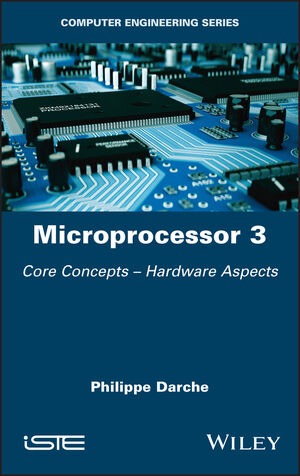
Microprocessor 3 : Core concepts - hardware aspects
Calculation is the main function of a computer. The central unit is responsible for executing the programs. The microprocessor is its integrated form. This component, since the announcement of its marketing in 1971, has not stopped breaking records in terms of computing power, price reduction and integration of functions (calculation of basic functions, storage with integrated controllers). It is present today in most electronic devices. Knowing its internal mechanisms and programming is essential for the electronics engineer and computer scientist to understand and master the operation of a computer and advanced concepts of programming.

Microelectronic Circuits
Devices and basic circuits -- Signals, amplifiers and semiconductors -- Operational amplifiers -- Diodes -- Bipolar junction transistors (BJTS) -- Mos field-effect transistors (MOSFETS) -- Transistor amplifiers -- Analog integrated circuits -- Building blocks of integrated-circuit amplifiers -- Differential and multistage amplifiers -- Frequency response -- Feedback -- Output stages and power amplifiers -- Operational-amplifier circuits -- Filters and oscillators -- Digital integrated circuits -- CMOS digital logic circuits -- Digital Design: Power, Speed, and Area -- Memory and Clocking Circuits
