



الصفحة 1
الصفحة 1

Network Security, Firewalls, and VPNs ; 3rd ed.
Provides a unique, in-depth look at the major business challenges and threats that are introduced when an organization’s network is connected to the public Internet. Written by industry experts, this book provides a comprehensive explanation of network security basics, including how hackers access online networks and the use of Firewalls and VPNs to provide security countermeasures. Using examples and exercises, this book incorporates hands-on activities to prepare the reader to disarm threats and prepare for emerging technologies and future attacks.
Net-Centric Approaches to Intelligence and National Security
Net-Centric Approaches to Intelligence and National Security considers the web architectures and recent developments that make net-centric approaches for intelligence and national security possible. The development of net-centric approaches for intelligence, national & homeland security applications has become a major concern in many areas such as defense intelligence and national and international law enforcement agencies, especially since the terrorist attacks of 9/11. Net-Centric Approaches to Intelligence and National Security presents developments in information integration and recent advances in web services including the concept of the semantic web. Discovery analysis and management of web-available data pose a number of interesting challenges for research in web-based management systems. Intelligent agents and data mining are among the techniques employed. A number of specific systems that are net-centric based in various areas of military applications, intelligence and law enforcements are presented utlilizing one or more of such techniques Net-Centric Approaches to Intelligence and National Security is designed for a professional audience of researchers and practitioners in industry. This volume is also suitable for graduate-level students in computer science.

Multimedia Forensics
Media forensics has never been more relevant to societal life. Not only media content represents an ever-increasing share of the data traveling on the net and the preferred communications means for most users, it has also become integral part of most innovative applications in the digital information ecosystem that serves various sectors of society, from the entertainment, to journalism, to politics. Undoubtedly, the advances in deep learning and computational imaging contributed significantly to this outcome. The underlying technologies that drive this trend, however, also pose a profound challenge in establishing trust in what we see, hear, and read, and make media content the preferred target of malicious attacks.

Mobile and Wireless Communications Networks ; IFIP TC6 / WG6.8 Conference on Mobile and Wireless Communication Networks (MWCN 2004) October 25-27, 2004 Paris, France
Mobile Ad hoc NETworks (MANETs) has attracted great research interest in recent years. A Mobile Ad Hoc Network is a self-organizing multi-hop wireless network where all hosts (often called nodes) participate in the routing and data forwarding process. The dependence on nodes to relay data packets for others makes mobile ad hoc networks extremely susceptible to various malicious and selfish behaviors. This point is largely overlooked during the early stage of MANET research. Many works simply assume nodes are inherently cooperative and benign. However, experiences from the wired world manifest that the reverse is usually true; and many works [3] [10] [9] [8] [12] [19] have pointed out that the impact of malicious and selfish users must be carefully investigated. The goal of this research is to address the cooperation problem and related security issues in wireless ad hoc networks. As a rule of thumb, it is more desirable to include security mechanisms in the design phase rather than continually patching the system for security breaches. As pointed out in [2] [1], there can be both selfish and malicious nodes in a mobile ad hoc network. Selfish nodes are most concerned about their energy consumption and intentionally drop packets to save power. The purpose of malicious nodes, on the other hand, is to attack the network using various intrusive techniques. In general, nodes in an ad hoc network can exhibit Byzantine behaviors.

MDATA : A New Knowledge Representation Model: Theory, Methods and Applications
This book introduces a new knowledge representation model called MDATA (Multi-dimensional Data Association and inTelligent Analysis). By modifying the representation of entities and relations in knowledge graphs, dynamic knowledge can be efficiently described with temporal and spatial characteristics. The MDATA model can be regarded as a high-level temporal and spatial knowledge graph model, which has strong capabilities for knowledge representation. This book introduces some key technologies in the MDATA model, such as entity recognition, relation extraction, entity alignment, and knowledge reasoning with spatiotemporal factors. The MDATA model can be applied in many critical applications and this book introduces some typical examples, such as network attack detection, social network analysis, and epidemic assessment.

MCITP self-paced training Kit (Exam 70-444) : Optimizing and maintaining a database administration solution microsoft SQL server 2005
Designed to help you make the most of your study time. Maximize your performance on the exam by learning to: * Monitor and troubleshoot queries, databases, and servers * Help defend against injection attacks, denial of service attacks, worms, and viruses * Manage security strategies and perform audits * Detect and resolve data conflicts * Diagnose faults and recover from database failures and disasters * Optimize database availability with failover clustering, database mirroring, log shipping, and replication * Customize a maintenance strategy and automate routine tasks * Build, debug, and deploy SQL Server Integration Services packages PRACTICE TESTS Assess your skills with practice tests on CD. You can work through hundreds of questions using multiple testing modes to meet your specific learning needs. You get detailed explanations for right and wrong answers-including a customized learning path that describes how and where to focus your studies. Your training kit includes: Details inside. * Official self-paced study guide. * Practice tests with multiple, customizable testing options and a learning plan based on your results. *400+ practice and review questions. * Case scenarios, practice exercises, and best practices. *180-day evaluation version of Microsoft SQL Server 2005 Enterprise Edition. * Fully searchable eBook of this guide.
Intrusion and Malware Detection and Vulnerability Assessment 2nd International Conference, DIMVA 2005, Vienna, Austria, July 7-8, 2005, Proceedings
Represents an increase of approximately 25% compared with the n- ber of submissions last year. All submissions were carefully reviewed by at least three Program Committee members or external experts according to the cri- ria of scienti?c novelty, importance to the ?eld, and technical quality. The ?nal selection took place at a meeting held on March 18, 2005, in Zurich, Switz- land. Fourteen full papers were selected for presentation and publication in the conference proceedings. In addition, three papers were selected for presentation in the industry track of the conference. The program featured both theoretical and practical research results, which were grouped into six sessions. Philip Att?eld from the Northwest Security Institute gave the opening keynote speech. The slides presented by the authors are available on the DIMVA 2005 Web site at http://www.dimva.org/dimva2005 We sincerely thank all those who submitted papers as well as the Program Committee members and the external reviewers for their valuable contributions.

Internet of things from hype to reality : The road to digitization
Presents updated material on its core content: an end-to-end IoT architecture that is comprised of devices, network, compute, storage, platform, applications along with management and security components. As with the second edition, it is organized into six main parts: an IoT reference model; fog computing and the drivers; IoT management and applications; smart services in IoT; IoT standards; and case studies. This edition’s features include overhaul of the IoT Protocols (Chapter 5) to include an expanded treatment of low-power wide area networks including narrow band IoT (NB-IoT) protocol, updated IoT platforms and capabilities (Chapter 7) to include comparison of commercially available platforms (e.g. AWS IoT Platform, Google Cloud IoT Platform, Microsoft Azure IoT Platform, and PTC ThinkWorx), updated security (Chapter 8) to include approaches for securing IoT devices with examples of IoT devices used in security attacks and associated solutions including MUD and DICE, and finally new Appendix B to include six IoT project detailed for students.

Insider attack and cyber security : Beyond the hacker
This book sets an agenda for an ongoing research initiative to solve one of the most vexing problems encountered in computer security, and includes the following topics: critical IT infrastructure protection, insider threats, awareness and dealing with nefarious human activities in a manner that respects individual liberties and privacy policies of organizations while providing the best protection of critical resources and services. In some sense, the insider problem is the ultimate security problem. This volume concludes with technical and legal challenges facing researchers who study and propose solutions to mitigate insider attacks.

Information theoretic security ; 3rd International Conference, ICITS 2008, Calgary, Canada, August 10-13, 2008. Proceedings
This book constitutes the proceedings of the Third International Conference on Information Theoretic Security, held in Calgary, Canada, in August 2008.The 14 papers presented in this volume were carefully reviewed and selected from 43 submissions. There were nine invited speeches to the conference. The topics covered are secure and reliable communication; quantum information and communication; networks and devices; multiparty computation; information hiding and tracing; coding theory and security; quantum computation; foundation; and encryption.
Information Systems Security and Privacy ; 5th International Conference, ICISSP 2019, Prague, Czech Republic, February 23-25, 2019, Revised Selected Papers
This book constitutes the revised selected papers of the 5th International Conference on Information Systems Security and Privacy, ICISSP 2019, held in Prague, Czech Republic, in February 2019. The 19 full papers presented were carefully reviewed and selected from a total of 100 submissions. The papers presented in this volume address various topical research, including new approaches for attack modelling andprevention, incident management and response, and user authentication andaccess control, as well as business and human-oriented aspects such as data pro-tection and privacy, and security awareness.
Information security theory and practices : Smart devices, Convergence and Next Generation Networks ; 2nd IFIP WG 11.2 International Workshop, WISTP 2008, Seville, Spain, May 13-16, 2008. Proceedings
This volume constitutes the refereed proceedings of the Second IFIP WG 11.2 International Workshop on Information Security Theory and Practices: Smart Devices, Convergence and Next Generation Networks, WISTP 2008, held in Seville, Spain, in May 2008.The 10 revised full papers presented were carefully reviewed and selected from numerous submissions for inclusion in the book; they examine the rapid development of information technologies and the transition to next generation networks.

Information security applications ; Vol. 3786 ; 6th International Workshop, WISA 2005, Jeju Island, Korea, August 22-24, 2005, Revised Selected Papers
Constitutes the refereed proceedings of the 6th International Workshop on Information Security Applications, held in 2005. The papers are organized in topical sections on security analysis and attacks, systems security, network security, DRM/software security, efficient HW implementation, side-channel attacks, and privacy/anonymity

Information security applications ; 21st International Conference, WISA 2020, Jeju Island, South Korea, August 26–28, 2020, Revised Selected Papers
This book constitutes the thoroughly refereed proceedings of the 21st International Conference on Information Security Applications, WISA 2020, held in Jeju Island, South Korea, in August 2020. The 30 full research papers included in this book were carefully reviewed and selected from 89 submissions. They are organized in the following topical sections: AI Security and Intrusion Detection; Steganography and Malware; Application, System, and Hardware Security; Cryptography; Advances in Network Security and Attack Defense; and Cyber Security.
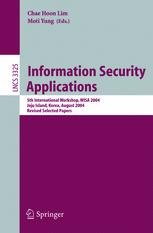
Information security applications : Vol. 3325 : 5th International Workshop, WISA 2004, Jeju Island, Korea, August 23-25, 2004, Revised Selected Papers
The 5th International Workshop on Information Security Applications (WISA 2004) was held in Jeju Island, Korea during August 23-25, 2004. The workshop was sponsored by the Korea Institute of Information Security and Cryptology (KIISC), the Electronics and Telecommunications Research Institute (ETRI) and the Ministry of Information and Communication (MIC). The aim of the workshop is to serve as a forum for new conceptual and - perimental research results in the area of information security applications from the academic community as well as from the industry. The workshop program covers a wide range of security aspects including cryptography, cryptanalysis, network/system security and implementation aspects. The programcommittee received169 papersfrom 22 countries,andaccepted 37 papers for a full presentation track and 30 papers for a short presentation track. Each paper was carefully evaluated through peer-review by at least three members of the programcommittee. This volume contains revised versions of 36 papers accepted and presented in the full presentation track. Short papers were only published in the WISA 2004 pre-proceedings as preliminary versions and are allowed to be published elsewhere as extended versions. In addition to the contributed papers, Professors Gene Tsudik and Ross Andersongaveinvitedtalks,entitledSecurityinOutsourcedDatabasesandWhat does ‘Security’ mean for Ubiquitous Applications?, respectively.

Information security and privacy ; Vol. 4058 ; 11th Australasian Conference, ACISP 2006, Melbourne, Australia, July 3-5, 2006, Proceedings
The 11th Australasian Conference on Information Security and Privacy (ACISP 2006) was held in Melbourne, 3–5 July, 2006. The conference was sponsored by Deakin University, the Research Network for a Secure Australia, and was organized in cooperation with the University of Wollongong. The conference brought together researchers,practitioners and a wide range of other users from academia, industries and government organizations. The program included 35 papers covering important aspects of information security technologies. The papers were selected from 133 submissions through a two-stage anonymous review process. Each paper received at least three reviews by members of the Program Committee, and was then scrutinized by the whole committee during a two-week discussion.

Information security and privacy ; Vol. 3574 : 10th Australasian Conference, ACISP 2005, Brisbane, Australia, July 4-6, 2005, Proceedings
Constitutes the refereed proceedings of the 10th Australasian Conference on Information Security and Privacy, ACISP 2005, held in Brisbane, Australia in July 2005. The papers are organized in topical sections on network security, cryptanalysis, group communication, elliptic curve cryptography, mobile security, side channel attacks, and more.

Information security and privacy ; 6th Australasian Conference, ACISP 2001, Sydney, Australia, July 11-13, 2001. Proceedings
A Few Thoughts on E-Commerce.- New CBC-MAC Forgery Attacks.- Cryptanalysis of a Public Key Cryptosystem Proposed at ACISP 2000.- Improved Cryptanalysis of the Self-Shrinking Generator.- Attacks Based on Small Factors in Various Group Structures.- On Classifying Conference Key Distribution Protocols.- Pseudorandomness of MISTY-Type Transformations and the Block Cipher KASUMI.- New Public-Key Cryptosystem Using Divisor Class Groups.- First Implementation of Cryptographic Protocols Based on Algebraic Number Fields.- Practical Key Recovery Schemes.- Non-deterministic Processors.- Personal Secure Booting.- Evaluation of Tamper-Resistant Software Deviating from Structured Programming Rules.- A Strategy for MLS Workflow.- Condition-Driven Integration of Security Services.- SKETHIC: Secure Kernel Extension against Trojan Horses with Informat ion-Carrying Codes.- Secure and Private Distribution of Online Video and Some Related Cryptographic Issues.- Private Information Retrieval Based on the Subgroup Membership Problem.

Information security and privacy ; 12th Australasian Conference, ACISP 2007, Townsville, Australia, July 2-4, 2007, Proceedings
The book covers a wide array of key aspects in information security. The papers are organized in topical sections on stream ciphers, hashing, biometrics, secret sharing, cryptanalysis, public key cryptography, authentication, e-commerce, and security.

Information security and cryptology ; Vol. 4318 ; 2nd SKLOIS Conference, Inscrypt 2006, Beijing, China, November 29 - December 1, 2006, Proceedings
The second SKLOIS Conference on Information Security and Cryptology 2006 (Inscrypt, formerly CISC) was organized by the State Key Laboratory of Inf- mation Security of the Chinese Academy of Sciences. This international conf- ence was held in Beijing, China and was sponsored by the Institute of Software, the Chinese Academy of Sciences, the Graduate University of Chinese Academy of Sciences and the National Natural Science Foundations of China. The c- ference proceedings, with contributed papers, are published by Springer in this volume of Lecture Notes in Computer Science (LNCS).
