



الصفحة 9
الصفحة 9

Advances in UAV detection, classification and tracking
Explores the latest techniques and advancements in unmanned aerial vehicle (UAV) detection, classification, and tracking. As UAV technology continues to evolve and become more accessible, there is a growing need for effective methods to detect, identify, and track these devices in various scenarios. This reprint provides a thorough overview of the state-of-the-art approaches for UAV detection, classification, and tracking, covering both theoretical and practical aspects.The reprint begins by introducing the basics of UAVs and their various applications, followed by a detailed overview of the challenges associated with UAV detection, classification, and tracking. The authors then present the latest techniques and algorithms used in the field, including machine-learning-based approaches, computer vision techniques, and sensor fusion techniques. The reprint also covers the challenges of real-world applications, such as dealing with occlusions, sensor noise, and environmental factors.

Advances in Swarm Intelligence ; 11th International Conference, ICSI 2020, Belgrade, Serbia, July 14–20, 2020, Proceedings
Constitutes the proceedings of the 11th International Conference on Advances in Swarm Intelligence, ICSI 2020, held in July 2020 in Belgrade, Serbia. Due to the COVID-19 pandemic the conference was held virtually. The 63 papers included in this volume were carefully reviewed and selected from 127 submissions. The papers are organized in 12 cohesive topical sections as follows: Swarm intelligence and nature-inspired computing; swarm-based computing algorithms for optimization; particle swarm optimization; ant colony optimization; brain storm optimization algorithm; bacterial foraging optimization; genetic algorithm and evolutionary computation; multi-objective optimization; machine learning; data mining; multi-agent system and robotic swarm, and other applications.

Advances in neural networks -- ISNN 2007 ; 4th International symposium on neutral networks, ISNN 2007 Nanjing, China, June 3-7, 2007. Proceedings, Part II
An eural network is an information processing structure inspired by biological nervous systems, such as the brain. It consists of a large number of highly int- connected processing elements, called neurons. It has the capability of learning from example.

Advances in Neural Networks -- ISNN 2007 ; 4th International Symposium on Neutral Networks, ISNN 2007 Nanjing, China, June 3-7, 2007. Proceedings, Part I
An eural network is an information processing structure inspired by biological nervous systems, such as the brain. It consists of a large number of highly int- connected processing elements, called neurons. It has the capability of learning from example.

Advances in Neural Networks -- ISNN 2007 ; 4th International symposium on neural networks, ISNN 2007 Nanjing, China, June 3-7, 2007. Proceedings, Part III
An eural network is an information processing structure inspired by biological nervous systems, such as the brain. It consists of a large number of highly int- connected processing elements, called neurons. It has the capability of learning from example.

Advances in neural networks - ISNN 2005 ; Vol. 3498 ; 2nd International Symposium on Neural Networks, Chongqing, China, May 30 - June 1, 2005, Proceedings, Part III
The three volume set LNCS 3496/3497/3498 constitutes the refereed proceedings of the Second International Symposium on Neural Networks, ISNN 2005, held in Chongqing, China in May/June 2005. The 483 revised papers presented were carefully reviewed and selected from 1.425 submissions. The papers are organized in topical sections on theoretical analysis, model design, learning methods, optimization methods, kernel methods, component analysis, pattern analysis, systems modeling, signal processing, image processing, financial analysis, control systems, robotic systems, telecommunication networks, incidence detection, fault diagnosis, power systems, biomedical applications, industrial applications, and other applications.

Advances in neural networks - ISNN 2005 ; Vol. 3496 ; 2nd International symposium on neural networks, Chongqing, China, May 30 - June 1, 2005, Proceedings, Part I
The three volume set LNCS 3496/3497/3498 constitutes the refereed proceedings of the Second International Symposium on Neural Networks, ISNN 2005, held in Chongqing, China in May/June 2005. The 483 revised papers presented were carefully reviewed and selected from 1.425 submissions. The papers are organized in topical sections on theoretical analysis, model design, learning methods, optimization methods, kernel methods, component analysis, pattern analysis, systems modeling, signal processing, image processing, financial analysis, control systems, robotic systems, telecommunication networks, incidence detection, fault diagnosis, power systems, biomedical applications, industrial applications, and other applications.

Advances in natural computation ; Vol. 3612 ; 1st International conference, ICNC 2005, Changsha, China, August 27-29, 2005, Proceedings, Part III
Includes 313 full papers and 189 short papers the refereed proceedings of the First International Conference on Natural Computation, ICNC 2005, held in Changsha, China, in August 2005 as a joint event with the Second International Conference on Fuzzy Systems and Knowledge Discovery FSKD 2005. includ Topics : Artificial Intelligence / Theory of Computation / Computation by Abstract Devices / Algorithm Analysis and Problem Complexity / Image Processing and Computer Vision / Pattern Recognition

Advances in natural computation ; Vol. 3611 ; 1st International conference, ICNC 2005, Changsha, China, August 27-29, 2005, proceedings, Part II
Featured the most up-to-date research results in com-putational algorithms inspired from nature, including biological, ecological, andphysical systems. It is an exciting and emerging interdisciplinary area in whicha wide range of techniques and methods are being studied for dealing with large,complex, and dynamic problems. The joint conferences also promoted cross-fertilization over these exciting and yet closely-related areas, "

Advances in natural computation ; Vol. 3610 ; 1st International conference, ICNC 2005, Changsha, China, August 27-29, 2005, Proceedings, Part I
Featured the most up-to-date research results in computational algorithms inspired from nature, including biological, ecological, andphysical systems. It is an exciting and emerging interdisciplinary area in which a wide range of techniques and methods are being studied for dealing with large, complex, and dynamic problems. The joint conferences also promoted cross-fertilization over these exciting and yet closely-related areas, which had a sig-nificant impact on the advancement of these important technologies. Specificareas included neural computation, quantum computation, evolutionary com-putation, DNA computation, chemical computation, information processing incells and tissues, molecular computation, computation with words, fuzzy com-putation, granular computation, artificial life, swarm intelligence, ants colonies

Advances in Artificial Reality and Tele-Existence ; 16th International Conference on Artificial Reality and Telexistence, ICAT 2006, Hangzhou, China, November 28 - December 1, 2006, Proceedings
ICAT is the oldest international conference on virtual reality and tele-existence. ICAT 2006 not only looked for innovations in the technology itself, but also explored novel ways to transfer and express information and creative ideas to the society and people. The 16th International Conference on Artificial Reality and Telexistence was held at the Zhejiang University of Technology, Hangzhou, P. R. China from November 29 to December 1, 2006. The main purpose of the conference is to provide opportunities for researchers and practitioners to present their research findings and exchange opinions on the development and use of such systems.

Advances in Artificial Life ; 9th European Conference, ECAL 2007, Lisbon, Portugal, September 10-14, 2007, Proceedings
This book is organized in topical sections on conceptual articles, morphogenesis and development, robotics and autonomous agents, evolutionary computation and theory, cellular automata, models of biological systems and their applications, ant colony and swarm systems, evolution of communication, simulation of social interactions, self-replication, artificial chemistry, and posters.

Advances in artificial life ; 8th European Conference, ECAL 2005 , Canterbury, UK, September 5-9, 2005, Proceedings
The Artificial Life term appeared more than 20 years ago . Since then the area has developed dramatically, many researchersjoining enthusiastically and research groups sprouting everywhere.a conceptual track, where papers were judged on criteria like importance and/or novelty of the concepts proposed rather than the experimental / theoretical results, has been introduced this year. A conference on a theme as broad as Artificial Life is bound to be very di-verse, but a few tendencies emerged. First, fields like ‘Robotics and Autonomous Agents’ or ‘Evolutionary Computation’are still extremely active and keep onbringing a wealth of results to the A-Life community. Even there, however, new tendencies appear, like collective robotics, and more specifically self-assembling robotics, which represent now a large subsection. Second, new areas appear.‘Morphogenesis and Development’ which used to be the subject of only a fewpapers, is now one of the largest subsections, and seems to be on the brinkof becoming a field of its own. Finally, most classical themes of A-Life re-search like ‘Artificial Chemistry’, ‘Ant-Inspired Systems’, ‘Cellular Automata’,‘Self-Replication’, ‘Social Simulations’ or ‘Bio-realist Simulations’ are still goingstrong and are well represented within this volume.
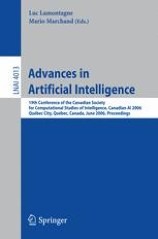
Advances in Artificial Intelligence ; Vol. 4013 : 19th Conference of the Canadian Society for Computational Studies of Intelligence, Canadian AI 2006, Quebec City, Quebec, Canada, June 7-9, Proceedings
Constitutes the refereed proceedings of the 4th Hellenic Conference on Artificial Intelligence, SETN 2006, held at Heraklion, Crete, Greece in May 2006. The 43 revised full papers and extended abstracts of 34 revised short papers presented together with 2 invited contributions were carefully reviewed and selected from 125 submissions. The papers address any area of artificial intelligence; particular fields of interest include; logic programming, knowledge-based systems, intelligent information retrieval, machine learning, neural nets, genetic algorithms, data mining and knowledge discovery, hybrid intelligent systems and methods, intelligent agents, multi-agent systems, intelligent distributed systems, intelligent/natural interactivity, intelligent virtual environments, planning, scheduling, and robotics.

Advances in Artificial Intelligence ; Vol. 3955 : 4th Helenic Conference on AI, SETN 2006, Heraklion, Crete, Greece, May 18-20, 2006, Proceedings
Constitutes the refereed proceedings of the 4th Hellenic Conference on Artificial Intelligence, SETN 2006, held at Heraklion, Crete, Greece in May 2006. The 43 revised full papers and extended abstracts of 34 revised short papers presented together with 2 invited contributions were carefully reviewed and selected from 125 submissions. The papers address any area of artificial intelligence; particular fields of interest include; logic programming, knowledge-based systems, intelligent information retrieval, machine learning, neural nets, genetic algorithms, data mining and knowledge discovery, hybrid intelligent systems and methods, intelligent agents, multi-agent systems, intelligent distributed systems, intelligent/natural interactivity, intelligent virtual environments, planning, scheduling, and robotics.

Advances in Artificial Intelligence ; 20th Conference of the Canadian Society for Computational Studies of Intelligence, Canadian AI 2007, Montreal, Canada, May 28-30, 2007, Proceedings
This book cover agents, bioinformatics, classification, constraint satisfaction, data mining, knowledge representation and reasoning, learning, natural language, and planning.
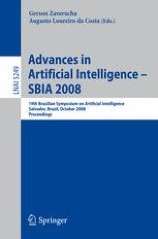
Advances in Artificial Intelligence - SBIA 2008 ; 19th Brazilian Symposium on Artificial Intelligence Savador, Brazil, October 26-30, 2008. Proceedings
Constitutes the refereed proceedings of the 19th Brazilian Symposium on Artificial Intelligence, SBIA 2008, held in Salvador, Brazil, in October 2008.

Advances in Artificial Intelligence - IBERAMIA-SBIA 2006 ; 2nd International Joint Conference, 10th Ibero-American Conference on AI, 18th Brazilian AI Symposium, Ribeirao Preto, Brazil, October 23-27, 2006
This decision was a consequence of the successful event organized in 2000, when the First International Joint Conference IBERAMIA/ SBIA 2000 (7th Ibero- American Artifcial Intelligence Conference and 15th Brazilian Artifcial Intel- gence Symposium) occurred in Brazil. Moreover, in 2006 the artifcial intelligence community celebrated the golden anniversary of the 1956 Dartmouth Conference that marked the beginning of artifcial intelligence as a research feld. th SBIA 2006 was the 18 conference of the SBIA conference series, which is the leading Brazilian conference for the presentation of AI research and applications.
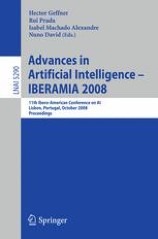
Advances in Artificial Intelligence - IBERAMIA 2008 ; 11th Ibero-American Conference on AI, Lisbon, Portugal, October 14-17, 2008. Proceedings
Constitutes the refereed proceedings of the 11th Ibero-American Conference on Artificial Intelligence, IBERAMIA 2008, held in Lisbon, Portugal, in October 2008.
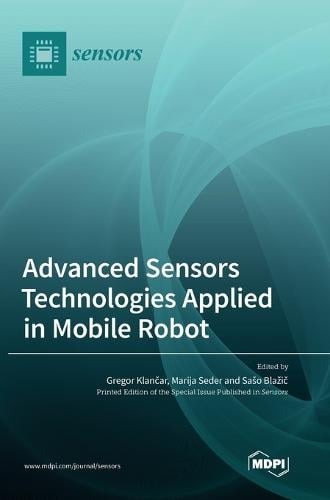
Advanced sensors technologies applied in mobile robot
Contains contributions on the latest developments in mobile robotic systems and related research. Various topics with different ideas and applications from mobile robotics have found their place. New ideas are presented for mobile robots that specialise in cleaning floors, power lines and HVAC systems. We also find innovative approaches for navigation path planning using local minima-free potential fields, novel path primitives and/or their parameterisation for minimum-time planning, and various control approaches ranging from visual serving to model predictive and adaptive trajectory tracking, applied to wheeled robots, humanoid manipulators and flying robots. Localisation approaches using LiDAR, motion capture systems, fingerprint-based and biomechanical gait systems are also discussed.
