



الصفحة 9
الصفحة 9

Computer-Aided Design of User Interfaces V ; Proceedings of the 6th International Conference on Computer-Aided Design of User Interfaces CADUI '06 (6-8 June 2006, Bucharest, Romania)
Today, the development life cycle of 3D User Interfaces (UIs) mostly remains an art more than a principled-based approach. Several methods [1,3,7,8,9,10,11,15,17,18,19] have been introduced to decompose this life cycle into steps and sub-steps, but these methods rarely provide the design knowledge that should be typically used for achieving each step. In addition, the development life cycle is more focusing directly on the programming - sues than on the design and analysis phases. This is sometimes reinforced by the fact that available tools for 3D UIs are toolkits, interface builders, r- dering engines, etc. When there is such a development life cycle defined, it is typically structured into the following set of activities: 1. The conceptual phase is characterized by the identification of the content and interaction requests. The meta-author discusses with the interface designer to take advantage of the current interaction technology. The int- face designer receives information about the content. The result of this phase is the production of UI schemes (e. g. , written sentences, visual schemes on paper) for defining classes of interactive experiences (e. g. , class Guided tour). Conceptual schemes are produced both for the final users and the authors. The meta-author has a deep knowledge of the c- tent domain and didactic skills too. He/she communicates with the final user too, in order to focus on didactic aspects of interaction. 2.

Computer science : Theory and applications ; 15th International computer science symposium in Russia, CSR 2020, Yekaterinburg, Russia, June 29 – July 3, 2020, Proceedings
This book constitutes the proceedings of the 15th International Computer Science Symposium in Russia, CSR 2020, held in Yekaterinburg, Russia, in June 2020. The 25 full papers and 6 invited papers were carefully reviewed and selected from 49 submissions. The papers cover a broad range of topics, such as: algorithms and data structures; computational complexity, including hardness of approximation and parameterized complexity; randomness in computing, approximation algorithms, fixed-parameter algorithms; combinatorial optimization, constraint satisfaction, operations research; computational geometry; string algorithms; formal languages and automata, including applications to computational linguistics; codes and cryptography; combinatorics in computer science; computational biology; applications of logic to computer science, proof complexity; database theory; distributed computing; fundamentals of machine learning, including learning theory, grammatical inference and neural computing; computational social choice; quantum computing and quantum cryptography; theoretical aspects of big data.

Computer Processing of Oriental Languages. Beyond the Orient : The Research Challenges Ahead ; 21st International Conference, ICCPOL 2006, Singapore, December 17-19, 2006, Proceedings
This book constitutes the thoroughly refereed proceedings of the 21st International Conference on Computer Processing of Oriental Languages, ICCPOL 2006.The papers are organized in topical sections on information retrieval, document classification, questions and answers, summarization, machine translation, word segmentation, chunking, abbreviation expansion, writing-system issues, parsing, semantics, and lexical resources.

Computer Aided Verification ; 32nd International Conference, CAV 2020, Los Angeles, CA, USA, July 21–24, 2020, Proceedings, Part II
The two-volume set LNCS 12224 and 12225 constitutes the refereed proceedings of the 32st International Conference on Computer Aided Verification, CAV 2020, held in Los Angeles, CA, USA, in July 2020.*

Computer Aided Verification ; 32nd International Conference, CAV 2020, Los Angeles, CA, USA, July 21–24, 2020, Proceedings, Part I
The two-volume set LNCS 12224 and 12225 constitutes the refereed proceedings of the 32st International Conference on Computer Aided Verification, CAV 2020, held in Los Angeles, CA, USA, in July 2020.*

Computational Science – ICCS 2007; 7th International Conference, Beijing China, May 27-30, 2007, Proceedings, Part I
This book contiants sections on efficient data management, parallel monte carlo algorithms, simulation of multiphysics multiscale systems, dynamic data driven application systems, computer graphics and geometric modeling, computer algebra systems, computational chemistry, computational approaches and techniques in bioinformatics, computational finance and business intelligence, geocomputation, high-level parallel programming, networks theory and applications, collective intelligence for semantic and knowledge grid, collaborative and cooperative environments, tools for program development and analysis in CS, intelligent agents in computing systems, CS in software engineering, computational linguistics in HCI, internet computing in science and engineering, workflow systems in e-science, graph theoretic algorithms and applications in cs, teaching CS, high performance data mining, mining text, semi-structured, Web, or multimedia data,
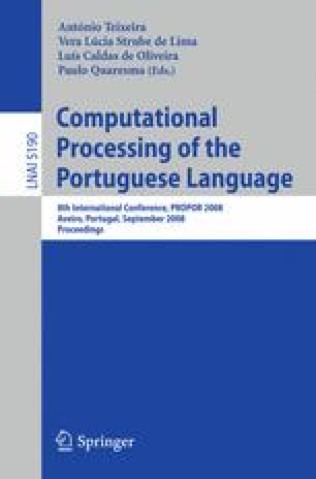
Computational Processing of the Portuguese Language ; 8th International Conference, PROPOR 2008 Aveiro, Portugal, September 8-10, 2008 Proceedings
This book constitutes the thoroughly refereed proceedings of the 8th International Workshop on Computational Processing of the Portuguese Language, PROPOR 2008, held in Aveiro, Portugal, in September 2008.

Computational Processing of the Portuguese Language ; 7th International Workshop, PROPOR 2006, Itatiaia, Brazil, May 13-17, 2006, Proceedings
Since 1993, PROPOR Workshops have become an important forum for - searchers involved in the Computational Processing of Portuguese,both written and spoken. The workshop and this book were structured around the following main t- ics, seven for full papers: (i) automatic summarization; (ii) resources; (iii) au- matic translation; (iv) named entity recognition; (v) tools and frameworks; (vi) systems and models; and another ?ve topics for short papers; (vii) information extraction; (viii) speech processing; (ix) lexicon; (x) morpho-syntactic studies; (xi) web, corpus and evaluation.

Computational linguistics and intelligent text processing ; Vol. 3878 ; 7th International Conference, CICLing 2006, Mexico City, Mexico, February 19-25, 2006, Proceedings
CICLing 2006 (www.CICLing.org) was the 7th Annual Conference on Intelligent Text Processing and Computational Linguistics. The CICLing conferences are intended to provide a wide-scope forum for discussion of the internal art and craft of natural language processing research and the best practices in its applications.
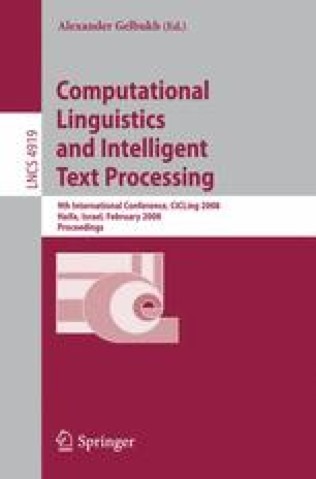
Computational linguistics and intelligent text processing ; 9th International Conference, CICLing 2008, Haifa, Israel, February 17-23, 2008. Proceedings
The CICLing conferences are intended to provide a wide-scope forum for the discussion of both the art and craft of natural language processing research and the best practices in its applications. This volume contains the papers accepted for oral presentation at the c- ference, as well as several of the best papers accepted for poster presentation.
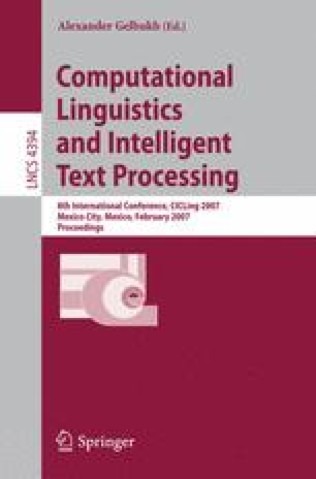
Computational linguistics and intelligent text processing ; 8th International Conference, CICLing 2007, Mexico City, Mexico, February 18-24, 2007, Proceedings
This book cover all current issues in computational linguistics research and present intelligent text processing applications. The papers are organized in topical sections on: lexical resources, corpus-based knowledge acquisition, morphology and part-of-speech tagging, named entity recognition, temporal expression treatment, word segmentation, sentence splitting, chunking, grammar formalisms and syntax, word sense disambiguation and discrimination and semantics.

Computational linguistics and intelligent text processing ; Vol. 3406 ; 6th International Conference, CICLing 2005, Mexico City, Mexico, February 13-19, 2005, Proceedings
This book constitutes the refereed proceedings of the 6th International Conference on Computational Linguistics and Intelligent Text Processing, CICLing 2005, held in Mexico City, Mexico in February 2005. An approach that involves natural language analysis techniques for the treatment of software system functional requirements is described in this book. This approach is used as the basis for a process developed to generate sequence diagrams automatically from the textual specification of use cases. This facility has been integrated in the Requirements Engineering Phase of OO-Method, an automatic production environment of software. For this purpose, a translator that is based on natural language parser is used. The translator provides grammatical information to each use case sentence and it identifies the corresponding interaction. The automatic transformation is conceived and specified following an orientation that is based on models and patterns. The results of the validation of the transformation patterns are presented.

Computational Forensic ; 2nd International Workshop, IWCF 2008, Washington, DC, USA, August 7-8, 2008. Proceedings
This book constitutes the refereed proceedings of the Second International Workshop, IWCF 2008, held in Washington, DC, USA, August 2008. The papers are organized in topical sections on trends and challenges; scanner, printer, and prints; human identification; shoeprints; linguistics;decision making and search; speech analysis; signatures and handwriting.

Command-Line Rust : A Project-Based Primer for Writing Rust CLIs
Rather than focusing on the language as a whole, this guide teaches Rust using a single small, complete, focused program in each chapter. Author Ken Youens-Clark shows you how to start, write, and test each of these programs to create a finished product. You'll learn how to handle errors in Rust, read and write files, and use regular expressions, Rust types, structs, and more.

Combinatorial Optimization in Communication Networks
Combinatorial optimization algorithms are used in many applications including the design, management, and operations of communication networks. The objective of this book is to advance and promote the theory and applications of combinatorial optimization in communication networks. The book collects a distinguished set of papers on subjects such as wireless communication systems, satellite networks, optical networks, and ad hoc networks. The topics covered range from topology control, routing optimization, and resource allocation to QoS provisioning. It is the first book that integrates rich theory from operations research with cutting-edge research in communication networks.

Collaboration Technologies and Social Computing ; 26th International Conference, CollabTech 2020, Tartu, Estonia, September 8–11, 2020, Proceedings
This book constitutes the proceedings of the 26th International Conference on Collaboration Technologies and Social Computing, CollabTech 2020. The conference was scheduled to take place in Tartu, Estonia, in September 2020. It was held virtually due to the COVID-19 pandemic. The 10 full and 5 work-in-progress papers presented in this volume were carefully reviewed and selected from 25 submissions.
Cognitive Systems ; Joint Chinese-German Workshop, Shanghai, China, March 7-11, 2005, Revised Selected Papers
This book organized in topical sections on multimodal human-computer interfaces, neuropsychology and neurocomputing, Chinese-German natural language processing and psycholinguistics, as well as information processing and retrieval from the semantic Web for intelligent applications.

Code : The Hidden Language of Computer Hardware and Software ; 2nd ed
The classic guide to how computers work, updated with new chapters and interactive graphics Computers are everywhere --- most obviously in our laptops and smartphones, but also our cars, televisions, microwave ovens, alarm clocks, robot vacuum cleaners, and other smart appliances. Have you ever wondered what goes on inside these devices to make our lives easier but occasionally more infuriating? Explores more deeply the bit-by-bit, gate-by-gate construction of the heart of every smart device ― the central processing unit that combines the simplest of basic operations to perform the most complex of feats. Along with new chapters, Petzold created a new website, CodeHiddenLanguage.com, that uses animated interactive graphics to make computers even easier to comprehend.
Mathematical Linguistics
Mathematical Linguistics introduces the mathematical foundations of linguistics to computer scientists, engineers, and mathematicians interested in natural language processing. The book presents linguistics as a cumulative body of knowledge from the ground up, with no prior knowledge of linguistics being assumed, covering more than the average two-semester introductory course in linguistics.This comprehensive, reader-friendly volume offers readers a high-level orientation, discussing the foundations of the field and presenting both the classical work and the most recent results. It covers an extremely rich array of topics including not only syntax and semantics but also phonology and morphology, probabilistic approaches, complexity, learnability, and the analysis of speech and handwriting.

Mastering VMware Horizon 8 : An Advanced Guide to Delivering Virtual Desktops and Virtual Apps
Learn all about designing, installing, configuring, and managing VMware Horizon, with a core focus on how to deliver virtual desktops using Horizon. This book allows you to follow the complete process for deploying VMware Horizon and covers the design, deployment, and management of solutions. You will: See the core components of VMware Horizon and their functionality / Design and install a Horizon environment / Deliver the best end-user experience / Manage the deployed solution / Use VMware reference architectures to create real-life scenario examples / Review the minimum requirements for designing a solution
