



الصفحة 9
الصفحة 9
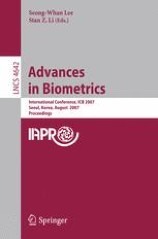
Advances in Biometrics ; International Conference, ICB 2007, Seoul, Korea, August 27-29, 2007, Proceedings
Biometrics technology continues to stride forward with its wider acceptance and its real need in various new security facets of modern society. From simply logging on to a laptop to crossing the border of a country, biometrics is being called upon to meet the growing challenges of identity management. This book presents a comprehensive treatment of biometrics and offers coverage of the entire gamut of topics in the field, including data acquisition, pattern-matching algorithms, and issues that impact at the system level, such as standards, security, networks, and databases. It has been organized under three sections: sensors, advances in biometric matching algorithms, and topics that deal with issues at the systems level.

Advances in biometrics ; International conference, ICB 2006, Hong Kong, China, January 5-7, 2006, Proceedings
Biometrics has emerged as a reliable person identification method that can over-come some of the limitations of the traditional automatic personal identificationmethods. With significant advances in biometric technology and a correspondingincrease in the number of applications incorporating biometrics, it is essentialthat we bring together researchers from academia and industry as well as practi-tioners to share ideas, problems and solutions for the development and successfuldeployment of state-of-the-art biometric systems.The International Conference on Biometrics (ICB 2006) followed the success-ful International Conference on Biometric Authentication (ICBA 2004) to facil-itate this interaction. ICB 2006 received a large number of high-quality researchpapers. After a careful review of 192 submissions, 104 papers were acceptedfor presentation.

Advances in biometric person authentication ; Vol. 3781 ; International workshop on biometric recognition systems, IWBRS 2005, Beijing, China, October 22 – 23, 2005, Proceedings
Constitutes the refereed proceedings of the 5th Chinese Conference on Biometric Recognition, SINOBIOMETRICS 2004, held in Guanzhou, China in December 2004. The 60 revised full papers presented together with 14 invited papers by internationally leading researchers were carefully reviewed and selected from 140 submissions. The papers are organized in topical sections on biometrics, best performing biometric engines, face localization, pose estimation, face recognition, 3D based methods, subspace and discriminant analysis, systems and applications, fingerprint preprocessing and minutiae extraction, fingerprint recognition and matching, fingerprint classificaiton, iris recognition, speaker recognition, and other biometric primitives.

Advances in biometric person authentication ; 5th Chinese conference on biometric recognition, SINOBIOMETRICS 2004, Guangzhou, China, December 13-14, 2004, Proceedings
Aimed at promoting the international exchange of ideas and providing an opportunity for keeping abreast of the latest developments in biometric algorithms, systems, and applications. The 1st Biometrics Verification Competition (BVC) on face, iris, and fingerprint recognition was also conducted in conjunction with the conference. This book is composed of 74 papers presented at Sinobiometrics 2004,
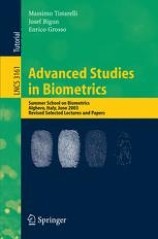
Advanced studies in biometrics : Summer School on biometrics, Alghero, Italy, June 2-6, 2003. Revised Selected Lectures and Papers
This book originates from an international summer school on biometrics, held in Alghero, Italy, in June 2003. The seven revised tutorial lectures by leading researchers introduce the reader to biometrics-based person authentication, fingerprint recognition, gait recognition, various aspects of face recognition and face detection, topologies for biometric recognition, and hand detection. Also included are the four best selected student papers, all dealing with face recognition.

Advanced Intelligent Computing Theories and Applications. With Aspects of Contemporary Intelligent Computing Techniques ; 4th International Conference on Intelligent Computing, ICIC 2008 Shanghai, China, September 15-18, 2008 Proceedings
Constitutes the refereed proceedings of the Fourth International Conference on Intelligent Computing, ICIC 2008, held in Shanghai, China in September 2008.

AdvancED Flex 3
Divided into three parts. The first part discusses the architectural and design aspects of Flex 3 application development. It explains the internals of a Flex 3 application and advocates a few best practices to fine-tune your application to ensure maximum performance. It includes tutorials on creating custom components, data binding, and creating AIR-powered desktop applications. The second part concentrates on effectively integrating Flex 3 with server- and client-side technologies. Techniques for integration with Java and PHP are covered in detail, and content covering interaction with client-side technologies is also included. After reading the chapter on JavaScript integration, you will be ready to create applications that can use Ajax and Flex 3 together. The third and final part of the book is a unique and eclectic mix of some advanced topics like mash-ups, collaborative applications, 3D rendering, highly interactive visualization, and audio and video streaming.
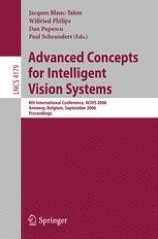
Advanced Concepts for Intelligent Vision Systems ; Vol. 4179 ; 8th International Conference, ACIVS 2006, Antwerp, Belgium, September 18-21, 2006, Proceedings
This book constitutes the refereed proceedings of the 8th International Conference on Advanced Concepts for Intelligent Vision Systems, ACIVS 2006, held in Antwerp, Belgium in September 2006. The 45 revised full papers and 65 revised poster papers presented were carefully reviewed and selected from around 242 submissions. The papers are organized in topical sections on noise reduction and restoration, segmentation, motion estimation and tracking, video processing and coding, camera calibration, image registration and stereo matching, biometrics and security, medical imaging, image retrieval and image understanding, as well as classification and recognition.

Adaptive Multimedia Retrieval : User, Context, and Feedback ; 4th International Workshop, AMR 2006, Geneva, Switzerland, July, 27-28, 2006, Revised Selected Papers
This book constitutes the thoroughly refereed post-proceedings of the 4th International Workshop on Adaptive Multimedia Retrieval, AMR 2006, held in Geneva, Switzerland in July 2006. this book provides a good and conclusive overview of the current research in the area of adaptive information retrieval.

3-D Shape Estimation and Image Restoration : Exploiting Defocus and Motion-Blur
Images contain information about the spatial properties of the scene they depict. When coupled with suitable assumptions, images can be used to infer three-dimensional information. This useful volume concentrates on motion blur and defocus, which can be exploited to infer the 3-D structure of a scene—as well as its radiance properties—and which in turn can be used to generate novel images with better quality. 3-D Shape Estimation and Image Restoration presents a coherent framework for the analysis and design of algorithms to estimate 3-D shape from defocused and motion blurred images, and to eliminate defocus and motion blur to yield "restored" images. It provides a collection of algorithms that are optimal with respect to the chosen model and estimation criterion.

3D Segmentation for medical images (OsteoVision) = التقطيع ثلاثي الأبعاد للصور الطبية
With the increasing integration of AI across various sectors, artificial intelligence (AI) is already playing a significant role in the healthcare industry, and its use is expected to grow further. AI systems used in image processing and computer vision algorithms have shown a significant ability to perform many operations such as segmentation, classification, and detection. This project presents the application of computer vision algorithms in the field of medical imaging for diagnostic, therapeutic, and interventional purposes. This thesis explores the use of several computer vision algorithms to address different pathologies, specifically brain tumors (glioma) (see Appendix A) and knee osteoarthritis (OA), as well as tracking the progression of knee osteoarthritis using the Kellgren and Lawrence (KL) grading system, a common method for classifying the severity of OA into five grades. To achieve the desired impact, the project employs various techniques, including 3D segmentation for brain tumors, 2D segmentation for knee joints, and multinomial classification for determining the severity of knee OA injuries. The primary aims of the project are to enhance diagnostic accuracy, assist in creating treatment plans, provide an assistive tool for healthcare providers to make more informed decisions, leverage AI's capabilities to detect abnormalities that might escape the human eye, and streamline workflow. To facilitate these goals, the project incorporates a user-friendly UI, a website, and a Flutter-based mobile application, enabling healthcare providers to efficiently integrate these tools into their practice and improve patient care.
3D Mesh processing and character animation : with examples using OpenGL, OpenMesh and Assimp
Focusses specifically on topics that are important in three-dimensional modelling, surface design and real-time character animation. It provides an in-depth coverage of data structures and popular methods used in geometry processing, keyframe and inverse kinematics animations and shader based processing of mesh objects. It also introduces two powerful and versatile libraries, OpenMesh and Assimp, and demonstrates their usefulness through implementations of a wide range of algorithms in mesh processing and character animation respectively. This Textbook is written for students at an advanced undergraduate or postgraduate level who are interested in the study and development of graphics algorithms for three-dimensional mesh modeling and analysis, and animations of rigged character models.
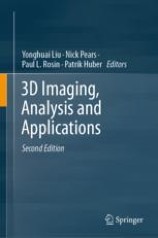
3D Imaging, Analysis and Applications
This textbook is designed for postgraduate studies in the field of 3D Computer Vision. It also provides a useful reference for industrial practitioners; for example, in the areas of 3D data capture, computer-aided geometric modelling and industrial quality assurance. This second edition is a significant upgrade of existing topics with novel findings. Additionally, it has new material covering consumer-grade RGB-D cameras, 3D morphable models, deep learning on 3D datasets, as well as new applications in the 3D digitization of cultural heritage and the 3D phenotyping of crops.
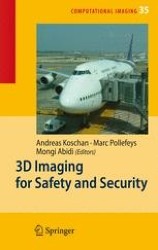
3D Imaging for Safety and Security
This book is so far the first that covers the current state of the art in 3D imaging for safety and security. Special attention was given to advanced 3D imaging technologies in the context of safety and security applications. Comparative evaluation studies showing advantages of 3D imaging over traditional 2D imaging for a given computer vision or pattern recognition task were emphasized. Moreover, additional experts in the field of 3D imaging for safety and security were invited by the editors for a contribution to this book.

3D design reconstruction
This report will talk about a way to design and rebuild a cheap, true-to-the-truth 3D system using reverse engineering. The system provides the service of reconstructing objects into 3D models by placing the object in a predetermined place facing a set of sensors and cameras at a certain distance and at precise angles, using the angle of rotation for each image and combining the points of triangulation we can build a form of 3D modeling types. These models can be used in digital animation or printed with 3D printers for a wide variety of applications.
