



الصفحة 84
الصفحة 84

Logic for Programming, Artificial Intelligence, and Reasoning ; Vol. 3452 : 11th International Workshop, LPAR 2004, Montevideo, Uruguay, March 14-18, 2005, Proceedings
Contains the papers presented at the 11th International Conference on Logic for Programming, Arti'cial Intelligence, and Reasoning (LPAR), held from March 14 to 18, 2005, in Montevideo, Uruguay, together with the 5th - ternational Workshop on the Implementation of Logics (organized by Stephan Schulz and Boris Konev) and the Workshop on Analytic Proof Systems (or- nized by Matthias Baaz). The call for papers attracted 77 paper submissions, each of which was - viewed by at least three expert reviewers. The ?nal decisions on the papers were taken during an electronic Program Committee meeting held on the Internet. The Internet-based submission, reviewing, and discussion software EasyChair, provided by the second PC co-chair, supported each stage of the reviewing p- cess.

Logic for Programming, Artificial Intelligence, and Reasoning ; 15th International Conference, LPAR 2008, Doha, Qatar, November 22-27, 2008. Proceedings
This book constitutes the refereed proceedings of the 15th International Conference on Logic for Programming, Artificial Intelligence, and Reasoning, LPAR 2008, which took place in Doha, Qatar, during November 22-27, 2008.The 45 revised full papers presented together with 3 invited talks were carefully revised and selected from 153 submissions. The papers address all current issues in automated reasoning, computational logic, programming languages and their applications and are organized in topical sections on automata, linear arithmetic, verification knowledge representation, proof theory, quantified constraints, as well as modal and temporal logics.

Logic for programming, artificial intelligence, and reasoning ; 14th International Conference, LPAR 2007, Yerevan, Armenia, October 15-19, 2007, Proceedings
This book constitutes the refereed proceedings of the 14th International Conference on Logic for Programming, Artificial Intelligence, and Reasoning, LPAR 2007, held in Yerevan, Armenia.

Logic for Programming, Aritficial Intelligence, and Reasoning ; 13th International Conference, LPAR 2006, Phnom Penh, Cambodia, November 13-17, 2006, Proceedings
This book constitutes the refereed proceedings of the 13th International Conference on Logic for Programming, Artificial Intelligence, and Reasoning, LPAR 2006, held in Phnom Penh, Cambodia in November 2006. The 38 revised full papers presented together with one invited talk were carefully reviewed and selected from 96 submissions.

Logic for Computer Scientists
This book introduces the notions and methods of formal logic from a computer science standpoint, covering propositional logic, predicate logic, and foundations of logic programming. It presents applications and themes of computer science research such as resolution, automated deduction, and logic programming in a rigorous but readable way.The style and scope of the work, rounded out by the inclusion of exercises, make this an excellent textbook for an advanced undergraduate course in logic for computer scientists.

Logic Based Program Synthesis and Transformation ; Vol. 3901 ; 15th International Symposium, LOPSTR 2005, London, UK, September 7-9, 2005, Revised Selected Papers
This book constitutes the thoroughly refereed post-proceedings of the 15th International Symposium on Logic Based Program Synthesis and Transformation, LOPSTR 2005, held in September 2005. The papers are organized in topical sections on tools for program development, program transformations, and software development and program analysis.

Logic Based Program Synthesis and Transformation ; Vol. 3573 : 14th International Symposium, LOPSTR 2004, Verona, Italy, August 26-28, 2004, Revised Selected Papers
In this work, we devise an analysis that searches for semantically equivalent code fragments within a given logic program. The presence of duplicated code (or functionality) is a primary indication that the design of the program can be improved by performing a so-called refactoring transformation. Within the framework of our analysis, we formally characterize three situations of duplicated functionality and their associated refactorings: the extraction of a duplicated goal into a new predicate, the removal of equivalent predicates and the generalization of two predicates into a higher-order predicate. The resulting analysis detects in a completely automatic way what program fragments are suitable candidates for the considered refactoring transformations.

Logic and Theory of Algorithms ; 4th Conference on Computability in Europe, CiE 2008, Athens, Greece, June 15-20, 2008 Proceedings
Constitutes the refereed proceedings of the 4th International Conference on Computability in Europe, CiE 2008, held in Athens, Greece, in June 2008.The 36 revised full papers presented together with 25 invited tutorials and lectures were carefully reviewed and selected from 108 submissions. Among them are papers of 6 special sessions entitled algorithms in the history of mathematics, formalising mathematics and extracting algorithms from proofs, higher-type recursion and applications, algorithmic game theory, quantum algorithms and complexity, and biology and computation.

Location- and Context-Awareness ; Vol. 3987 ; 2nd International Workshop, LoCA 2006, Dublin, Ireland, May 10-11, 2006, Proceedings
Contain the papers presented at the 2 International Workshop on Location- and Context-Awareness in May of 2006. As computing moves increasingly into the everyday world, the importance of location and context knowledge grows. The range of contexts encountered while sitting at a desk working on a computer is very limited compared to the large variety of situations experienced away from the desktop. For computing to be relevant and useful in these situations, the computers must have knowledge of the user’s activity, resources, state of mind, and goals, i.e., the user’s context, of which location is an important indicator. This workshop was intended to present research aimed at sensing, inferring, and using location and context data in ways that help the user.

Location- and Context-Awareness ; Vol. 3479 ; First International Workshop, LoCA 2005, Oberpfaffenhofen, Germany, May 12-13, 2005, Proceedings
The workshop was organized by the Institute of Communications and Navigation of the German Aerospace Center (DLR) in Oberpfa?enhofen, and the Mobile and Distributed Systems Group of the University of Munich. During the workshop, novel positioning algorithms and location sensing techniques were discussed, comprising not only enhancements of singular systems, like positioning in GSM or WLAN, but also hybrid technologies, such as the integration of global satellite systems with inertial positioning. Furthermore, improvements in sensor technology, as well as the integration and fusion of sensors, were addressed both on a theoretical and on an implementation level. Personal and confidential data, such as location data of users, have p- found implications for personal information privacy. Thus privacy protection, privacy-oriented location-aware systems, and how privacy aspects the feasibility and usefulness of systems were also addressed in the workshop.

Location- and context-awareness ; 3rd International Symposium, LoCA 2007, Oberpfaffenhofen, Germany, September 20-21, 2007, Proceedings
These proceedings contain the papers presented at the 3rd International S- posium on Location- and Context-Awareness in September of 2007. Computing has become mobile, wireless, and portable. The rangeof contexts encountered while sitting at a desk working on a computer is very limited c- pared to the large variety of situations experienced away from the desktop.

Local Pattern Detection ; International Seminar Dagstuhl Castle, Germany, April 12-16, 2004, Revised Selected Papers
Introduction The dramatic increase in available computer storage capacity over the last 10 years has led to the creation of very large databases of scienti?c and commercial information. The need to analyze these masses of data has led to the evolution of the new field knowledge discovery in databases (KDD) at the intersection of machine learning, statistics and database technology. Being interdisciplinary by nature, the field offers the opportunity to combine the expertise of different fields into a common objective. Moreover, within each field diverse methods have been developed and justified with respect to different quality criteria. We have to investigate how these methods can contributet o solving the problem of KDD. Traditionally, KDD was seeking to end global models for the data that - plain most of the instances of the database and describe the general structure of the data. Examples are statistical time series models, cluster models, logic programs with high coverageor classi?cation models like decision trees or linear decision functions. In practice, though, the use of these models often is very l- ited, because global models tend to end only the obvious patterns in the data, 1 which domain experts already are aware of . What is really of interest to the users are the local patterns that deviate from the already-known background knowledge. David Hand, who organized a workshop in 2002, proposed the new field of local patterns.

Literature-based Discovery
When Don Swanson hypothesized a connection between Raynaud’s phenomenon and dietary fish oil, the field of literature-based discovery (LBD) was born. During the subsequent two decades a steady stream of researchers have published articles about LBD and the field has made steady progress in laying foundations and creating an identity. LBD is an inherently multi-disciplinary enterprise where collaborations between the information and biomedical sciences are readily encountered. It is the hope and intention that this volume will plant a flag in the ground and inspire new researchers to the LBD challenge.
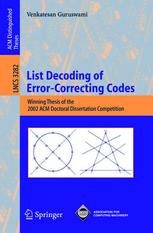
List decoding of error-correcting codes : Winning thesis of the 2002 ACM doctoral dissertation competition
Presents some spectacular new results in the area of decoding algorithms for error-correcting codes. Specifically, it shows how the notion of “list-decoding” can be applied to recover from far more errors, for a wide variety of err- correcting codes, than achievable before. A brief bit of background : error-correcting codes are combinatorial str- tures that show how to represent (or “encode”) information so that it is - silient to a moderate number of errors. Speci?cally, an error-correcting code takes a short binary string, called the message, and shows how to transform it into a longer binary string, called the codeword, so that if a small number of bits of the codewordare ?ipped, the resulting string does not look like any other codeword. The maximum number of errorsthat the code is guaranteed to detect, denoted d, is a central parameter in its design. A basic property of such a code is that if the number of errors that occur is known to be smaller than d/2, the message is determined uniquely. This poses a computational problem, called the decoding problem : compute the message from a corrupted codeword, when the number of errors is less than d/2.
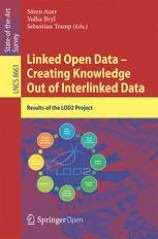
Linked Open Data -- Creating Knowledge Out of Interlinked Data : Results of the LOD2 Project
Linked Open Data (LOD) is a pragmatic approach for realizing the Semantic Web vision of making the Web a global, distributed, semantics-based information system. This book presents an overview on the results of the research project “LOD2 -- Creating Knowledge out of Interlinked Data”. LOD2 is a large-scale integrating project co-funded by the European Commission within the FP7 Information and Communication Technologies Work Program. Commencing in September 2010, this 4-year project comprised leading Linked Open Data research groups, companies, and service providers from across 11 European countries and South Korea.
Linguistics for the age of AI
One of the original goals of artificial intelligence research was to endow intelligent agents with human-level natural language capabilities. Recent AI research, however, has focused on applying statistical and machine learning approaches to big data rather than attempting to model what people do and how they do it. In this book, Marjorie McShane and Sergei Nirenburg return to the original goal of recreating human-level intelligence in a machine. They present a human-inspired, linguistically sophisticated model of language understanding for intelligent agent systems that emphasizes meaning—the deep, context-sensitive meaning that a person derives from spoken or written language.

Linear Genetic Programming
Linear Genetic Programming examines the evolution of imperative computer programs written as linear sequences of instructions. In contrast to functional expressions or syntax trees used in traditional Genetic Programming (GP), Linear Genetic Programming (LGP) employs a linear program structure as genetic material whose primary characteristics are exploited to achieve acceleration of both execution time and evolutionary progress.

Life System Modeling and Simulation; International Conference on Life System Modeling, and Simulation, LSMS 2007, Shanghai, China, September 14-17, 2007. Proceedings
The International Conference on Life System Modeling and Simulation (LSMS) was formed to bring together international researchers and practitioners in the field of life system modeling and simulation as well as life system-inspired theory and methodology. The arrival of the 21st century has been marked by a resurgence of research interest both in arriving at a systems-level und- standing of biology and in applying such knowledge in complex real-world appli- tions. Consequently, computational methods and intelligence in systems, biology, as well as bio-inspired computational intelligence, have emerged as key drivers for new computational methods. For this reason papers dealing with theory, techniques and real-world applications relating to these two themes were especially solicited.

Leveraging the Semantics of Topics Maps ; 2nd International Conference on Topic Maps Research and Applications, TMRA 2006, Leipzig, Germany, October 11-12, 2006, Revised Selected papers
The papers in this volume were presented at TMRA 2006, the International Conference on Topic Maps Research and Applications, held October 11–12, 2006, in Leipzig, Germany. TMRA 2006 was the second conference of an annual series of international conferences dedicated to Topic Maps in research and industry.

Leveraging Data Science for Global Health
Explores ways to leverage information technology and machine learning to combat disease and promote health, especially in resource-constrained settings. It focuses on digital disease surveillance through the application of machine learning to non-traditional data sources.
