



الصفحة 83
الصفحة 83

Computers helping people with special needs ; 17th International Conference, ICCHP 2020, Lecco, Italy, September 9–11, 2020, Proceedings, Part II
The two-volume set LNCS 12376 and 12377 constitutes the refereed proceedings of the 17th International Conference on Computers Helping People with Special Needs, ICCHP 2020, held in Lecco, Italy, in September 2020. The conference was held virtually due to the COVID-19 pandemic.

Computers helping people with special needs ; 17th International Conference, ICCHP 2020, Lecco, Italy, September 9–11, 2020, Proceedings, Part I
The two-volume set LNCS 12376 and 12377 constitutes the refereed proceedings of the 17th International Conference on Computers Helping People with Special Needs, ICCHP 2020, held in Lecco, Italy, in September 2020. The conference was held virtually due to the COVID-19 pandemic.

Computers Helping People with Special Needs ; 11th International Conference, ICCHP 2008, Linz, Austria, July 9-11, 2008. Proceedings
This book constitutes the refereed proceedings of the 11th International Conference on Computers Helping People with Special Needs, ICCHP 2008, held in Linz, Austria in July 2008.
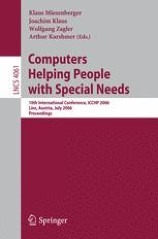
Computers Helping People with Special Needs ; 10th International Conference, ICCHP 2006, Linz, Austria, July 11-13, 2006, Proceedings
This book constitutes the refereed proceedings of the 10th International Conference on Computers Helping People with Special Needs, ICCHP 2006, held in Linz, Austria, in July 2006. The papers evaluate how various fields in computer science can contribute to helping people with various kinds of disabilities and impairment.

Computers and Games ; 6th International Conference, CG 2008, Beijing, China, September 29 - October 1, 2008. Proceedings
This book constitutes the refereed proceedings of the 6th International Conference on Computers and Games, CG 2008, held in Beijing, China, in September/October 2008 co-located with the 13th Computer Olympiad and the 16th World Computer-Chess Championship.

Computers and Games ; 5th International Conference, CG 2006, Turin, Italy, May 29-31, 2006, Revised Papers
This book covers all aspects of artificial intelligence in computer-game playing. Topics addressed are evaluation and learning, search, combinatorial games and theory opening and endgame databases, single-agent search and planning, and computer Go.

Computers and Games ; 4th International Conference, CG 2004, Ramat-Gan, Israel, July 5-7, 2004. Revised Papers
This book constitutes the thoroughly refereed post-proceedings of the 4th International Conference on Computers and Games, CG 2004, held in July 2004. Topics addressed include evaluation and learning, search, single-agent search and planning, and computer Go.

Computers and Education : Towards Educational Change and Innovation
This volume contains a selection of papers covering the latest research and experiences on the application of Information and Communication Technologies in the field of Education, especially in the Ibero-American space.
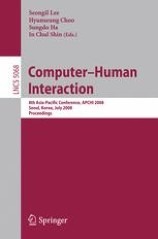
Computer-Human Interaction ; 8th Asia-Pacific Conference, APCHI 2008 Seoul, Korea, July 6-9, 2008 Proceedings
This book constitutes the refereed proceedings of the 8th Asia Pacific Conference on Computer Human Interaction, APCHI 2008, held in Seoul, Korea, in July 2008.

Computer-Aided Innovation (CAI) ; IFIP 20th World Computer Congress, Proceedings of the Second Topical Session on Computer-Aided Innovation, WG 5.4/TC 5 Computer-Aided Innovation, September 7-10, 2008, Milano, Italy
The IFIP series publishes state-of-the-art results in the sciences and technologies of information and communication. The principal aim of the IFIP series is to encourage education and the dissemination and exchange of information about all aspects of computing.

Computer-Aided Design of User Interfaces V ; Proceedings of the 6th International Conference on Computer-Aided Design of User Interfaces CADUI '06 (6-8 June 2006, Bucharest, Romania)
Today, the development life cycle of 3D User Interfaces (UIs) mostly remains an art more than a principled-based approach. Several methods [1,3,7,8,9,10,11,15,17,18,19] have been introduced to decompose this life cycle into steps and sub-steps, but these methods rarely provide the design knowledge that should be typically used for achieving each step. In addition, the development life cycle is more focusing directly on the programming - sues than on the design and analysis phases. This is sometimes reinforced by the fact that available tools for 3D UIs are toolkits, interface builders, r- dering engines, etc. When there is such a development life cycle defined, it is typically structured into the following set of activities: 1. The conceptual phase is characterized by the identification of the content and interaction requests. The meta-author discusses with the interface designer to take advantage of the current interaction technology. The int- face designer receives information about the content. The result of this phase is the production of UI schemes (e. g. , written sentences, visual schemes on paper) for defining classes of interactive experiences (e. g. , class Guided tour). Conceptual schemes are produced both for the final users and the authors. The meta-author has a deep knowledge of the c- tent domain and didactic skills too. He/she communicates with the final user too, in order to focus on didactic aspects of interaction. 2.
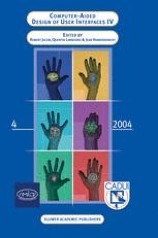
Computer-Aided Design of User Interfaces IV
Computer-Aided Design of User Interfaces IV gathers the latest research of experts, research teams and leading organisations involved in computer-aided design of user interactive applications supported by software, with specific attention for platform-independent user interfaces and context-sensitive or aware applications. This includes: innovative model-based and agent-based approaches, code-generators, model editors, task animators, translators, checkers, advice-giving systems and systems for graphical and multimodal user interfaces. It also addresses User Interface Description Languages. This books attempts to emphasize the software tool support for designing user interfaces and their underlying languages and methods, beyond traditional development environments offered by the market. It will be of interest to software development practitioners and researchers whose work involves human-computer interaction, design of user interfaces, frameworks for computer-aided design, formal and semi-formal methods, web services and multimedia systems, interactive applications, and graphical user and multi-user interfaces.

Computer Vision, Graphics and Image Processing ; 5th Indian Conference, ICVGIP 2006, Madurai, India, December 13-16, 2006, Proceedings
The Indian Conference on Computer Vision, Graphics and Image Processing (ICVGIP) is a forum bringing together researchers and practitioners in these related areas, coming from national and international academic institutes, from government research and development laboratories, and from industry. The proceedings of ICVGIP 2006, published in Springer's series Lecture Notes in Computer Science, comprise 85 papers that were selected for presentation from 284 papers, which were submitted from all over the world.
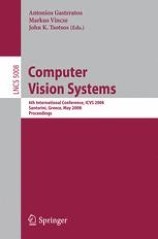
Computer vision systems ; 6th International conference, ICVS 2008 Santorini, Greece, May 12-15, 2008 Proceedings
This book constitutes the refereed proceedings of the 6th International Conference on Computer Vision Systems, ICVS 2008, held in Santorini, Greece, May 12-15, 2008.

Computer Vision Systems ; 2nd International Workshop, ICVS 2001 Vancouver, Canada, July 7-8, 2001 Proceedings
Computer Vision has reached a level of maturity that allows us not only to p- form research on individual methods and system components but also to build fully integrated computer vision systems of signi cant complexity. This opens a number of new problems related to system architecture, methods for system synthesis and veri cation, active vision systems, control of perception and - tion, knowledge and system representation, context modeling, cue integration, etc. By focusing on methods and concepts for the construction of fully integrated vision systems, ICVS aims to bring together researchers interested in computer vision systems. Similar to the previous event in Las Palmas, ICVS 2001 was organized as a single-track workshop consisting of high-quality.
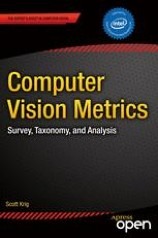
Computer Vision Metrics : Survey, Taxonomy, and Analysis
Computer Vision Metrics provides an extensive survey and analysis of over 100 current and historical feature description and machine vision methods, with a detailed taxonomy for local, regional and global features. This book provides necessary background to develop intuition about why interest point detectors and feature descriptors actually work, how they are designed, with observations about tuning the methods for achieving robustness and invariance targets for specific applications. The survey is broader than it is deep, with over 540 references provided to dig deeper. The taxonomy includes search methods, spectra components, descriptor representation, shape, distance functions, accuracy, efficiency, robustness and invariance attributes, and more.

Computer Vision in Human-Computer Interaction ; Vol.3979 ; ECCV 2006 Workshop on HCI, Graz, Austria, May 13, 2006, Proceedings
This volume presents the proceedings of the HCI 2006 Workshop, held in conjunction with ECCV 2006 (European Conference on Computer Vision) in Graz, Austria. The goal of this workshop was to bring together researchers from the field of computer vision whose work is related to human–computer interaction.

Computer vision in human-computer interaction ; Vol. 3766
Human-Computer Interaction (HCI) lies at the crossroads of many scienti?c areas including arti?cial intelligence, computer vision, face recognition, motion tracking, etc. In order for HCI systems to interact seamlessly with people, they need to understand their environment through vision and auditory input. Mo- over, HCI systems should learn how to adaptively respond depending on the situation. The goal of this workshop was to bring together researchers from the ?eld of computer vision whose work is related to human-computer interaction. The selected articles for this workshop address a wide range of theoretical and - plication issues in human-computer interaction ranging from human-robot - teraction, gesture recognition, and body tracking, to facial features analysis and human-computer interaction systems.

Computer vision for biomedical image applications
The purpose of this book is to submit the workshop, “Computer Vision for Biomedical Image Applications: Current Techniques and Future Trends” (CVBIA), is to examine the diverse applications of computer vision to biomedical image applications, considering both current methods and promising new trends. An additional goal is to provide the opportunity for direct interactions between (1) prominent senior researchers and young scientists, including students, postdoctoral associates and junior faculty; (2) local researchers and international leaders in biomedical image analysis; and (3) computer scientists and medical practitioners. Our CVBIA workshop had two novel characteristics: each contributed paper was authored primarily by a young scientist, and the workshop attracted an unusually large number of well-respected invited speakers (and their papers).

Computer Vision Beyond the Visible Spectrum
Recently, there has been a dramatic increase in the use of sensors in the non-visible bands. As a result, there is a need for existing computer vision methods and algorithms to be adapted for use with non-visible sensors, or for the development of completely new methods and systems. Computer Vision Beyond the Visible Spectrum is the first book to bring together state-of-the-art work in this area. It presents new & pioneering research across the electromagnetic spectrum in the military, commercial, and medical domains. By providing a detailed examination of each of these areas, it focuses on the development of state-of-the-art algorithms and looks at how they can be used to solve existing & new challenges within computer vision. Essential reading for academics & industrial researchers working in the area of computer vision, image processing, and medical imaging, it will also be useful background reading for advanced undergraduate & postgraduate students.
