



الصفحة 8
الصفحة 8

Embedded and Ubiquitous Computing ; International Conference, EUC 2006, Seoul, Korea, August 1-4, 2006, Proceedings
Embedded and ubiquitous computing is an exciting new paradigm that p- vides computing and communication services all the time, everywhere. Now we can attach computing and communication devices to human bodies to mo- tor our health, embed computing chips into brains to cure memory losses, or make smart fabrics so they can change colors or generate heat.

Embedded and Ubiquitous Computing - EUC 2005 Workshops ; EUC 2005 Workshops : UISW, NCUS, SecUbiq, USN, and TAUES, Nagasaki, Japan, December 8-9, 2005
This book constitutes the refereed proceedings of the EUC 2005 workshops held in conjunction with the IFIP International Conference on Embedded and Ubiquitous Computing, EUC 2005, in Nagasaki, Japan in December 2005.The 132 revised full papers presented were carefully reviewed and selected from 352 submissions. Topics covered by the five workshops are ubiquitous intelligence and smart worlds (UISW 2005), network-centric ubiquitous systems (NCUS 2005), security in ubiquitous computing systems (SecUbiq 2005), RFID and ubiquitous sensor networks (USN 2005), and trusted and autonomic ubiquitous and embedded systems (TAUES 2005).

Embedded and Ubiquitous Computing - EUC 2005 ; International Conference EUC 2005, Nagasaki, Japan, December 6-9, 2005, Proceedings
Welcome to the proceedings of the 2005 IFIP International Conference on - bedded and Ubiquitous Computing (EUC 2005), which was held in Nagasaki, Japan, December 6–9, 2005. Embedded and ubiquitous computing is emerging rapidly as an exciting new paradigm to provide computing and communication services all the time, - erywhere. Its systems are now pervading every aspect of life to the point that they are hidden inside various appliances or can be worn unobtrusively as part of clothing and jewelry. This emergence is a natural outcome of research and technological advances in embedded systems, pervasive computing and c- munications, wireless networks, mobile computing, distributed computing and agent technologies, etc. Its tremendous impact on academics, industry, gove- ment, and daily life can be compared to that of electric motors over the past century, in fact it but promises to revolutionize life much more profoundly than elevators, electric motors or even personal computers. The EUC 2005 conference provided a forum for engineers and scientists in academia, industry, and government to address profound issues including te- nical challenges, safety, and social, legal, political, and economic issues, and to present and discuss their ideas, results, work in progress, and experience on all aspects of embedded and ubiquitous computing.
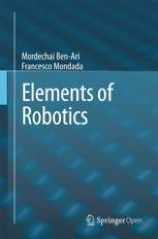
Elements of Robotics
Bridges the gap between playing with robots in school and studying robotics at the upper undergraduate and graduate levels to prepare for careers in industry and research. Robotic algorithms are presented formally, but using only mathematics known by high-school and first-year college students, such as calculus, matrices and probability. Concepts and algorithms are explained through detailed diagrams and calculations.

Electronic house finder
One of the most practical ways to help the Syrian citizens search for suitable and affordable houses is to build an android application for selling, buying and renting houses. This application will ease the process of searching for houses as a whole, and will benefit real estate business owners by enabling them to spread their houses’ offers online. Through exploiting the advantage of the recent wide usage of mobile-based applications by the majority of the Syrian people, we can create an application in which the users are able to post house offers, post specified orders, view posted houses details, and filter their search according to many features (i.e., price and area).

Electronic engineering for neuromedicine
Advances in electronics have revolutionized diagnostic tools and created mobile medicine, touch-sensitive prosthetics, remote surgery, and artificial organs such as hearts, retinas, and bionic skins. This reference text shows the number of ways in which electronic engineering feeds into neuromedicine namely: the modelling and simulation of the brain, providing access to the brain, analysis of the signals and activities of the brain and influencing the function of the brain for therapeutic purposes. The areas of electronic engineering considered are electronic circuits, spectral analysis, filtering of signals, electromagnetic fields and wave propagation. The book is a valuable source to medical students and practitioners as well as electronic engineering and physics students and graduates.

E-Learning Methodologies : Fundamentals, technologies and applications
Covers state of the art topics including user modeling for e-learning systems and cloud, IOT, and mobile-based frameworks. It also considers security challenges and ethical conduct using Blockchain technology. E-learning has become an important part of our educational life with the development of e-learning systems and platforms and the need for online and remote learning. ICT and computational intelligence techniques are being used to design more intelligent and adaptive systems. However, the art of designing good real-time e-learning systems is difficult as different aspects of learning need to be considered including challenges such as learning rates, involvement, knowledge, qualifications, as well as networking and security issues. The earlier concepts of standalone integrated virtual e-learning systems have been greatly enhanced with emerging technologies such as cloud computing, mobile computing, big data, Internet of Things (IoT), AI and machine learning, and AR/VT technologies.

ECSCW 2007 ; Proceedings of the 10th European Conference on Computer-Supported Cooperative Work, Limerick, Ireland, 24-28 September 2007
The volume includes papers addressing novel interaction technologies for CSCW systems, new models and architectures for groupware systems, studies of communication and coordination among mobile actors, studies of cooperative work in complex settings, studies of groupware systems in actual use in real-world settings, and theories and techniques to support the development of cooperative applications. The papers present emerging technologies alongside new methods and approaches to the development of this important class of applications.

ECSCW 2005 ; Proceedings of the ninth European conference on computer-supported cooperative work, 18-22 September 2005, Paris, France
These proceedings contain a collection of papers that reflect the variegated research activities in the field. The volume includes papers addressing novel interaction technologies for CSCW systems, new models and architectures for groupware systems, studies of communication and coordination among mobile actors, studies of cooperative work in complex settings, studies of groupware systems in actual use in real-world settings, and theories and techniques to support the development of cooperative applications. The papers present emerging technologies alongside new methods and approaches to the development of this important class of applications. The work in this volume represents the best of the current research and practice within CSCW. The collection of papers presented here will appeal to researchers and practitioners alike, as they combine an understanding of the nature of work with the possibility offered by new technologies.

E-Commerce and Web Technologies ; Vol. 4082 ; 7th International Conference, EC-Web 2006, Krakow, Poland, September 5-7, 2006, Proceedings
EC-Web 2006 served as a forum bringing together researchers from academia and practitioners from industry to discuss the current state of the art in e-commerce and Web technologies. Inspiration and new ideas emerged from intensive discussions that took place during the keynote address, the formal sessions and the social events. The conference attracted 88 paper submissions and each paper was reviewed by three Program Committee members. The Program Committee selected 24 papers for presentation and publication (an acceptance and publication rate of 27%).

E-Commerce and Web Technologies ; 8th International Conference, EC-Web 2007, Regensburg, Germany, September 3-7, 2007, Proceedings
This book contains sections on recommender systems, business process / design aspects, mobile commerce, security and e-payment, Web services computing / semantic Web, e-negotiation and agent mediated systems, and issues in Web advertising.

E-business and telecommunication networks ; 3rd International conference, ICETE 2006, Setúbal, Portugal, August 7-10, 2006. Selected Papers
This book constitutes the best papers of the Third International Conference on E-business and Telecommunication Networks, ICETE 2006, held in Setúbal, Portugal, August 7-10, 2006.

Dynamic Spectrum Management : From Cognitive Radio to Blockchain and Artificial Intelligence
This book, authored by a world-leading researcher in this field, describes fundamentals of dynamic spectrum management, provides a systematic overview on the enabling technologies covering cognitive radio, blockchain, and artificial intelligence, and offers valuable guidance for designing advanced wireless communications systems.

DSP for In-Vehicle and Mobile Systems
DSP for In-Vehicle and Mobile Systems is focused on digital signal processing strategies for improving information access, command and control, and communications for in-vehicle environments. It is expected that the next generation of human-to-vehicle interfaces will incorporate speech, video/image, and wireless communication modalities to provide more comfortable and safer driving ambiance

Drousi: A private lessons management system
Private teaching is considered to be an effective way to increase academic achievement of students and it seen as being a supplementary education, so it has become very common all around the world, however, previous studies have come to different conclusions regarding its necessity, so Drousi application had been made ,it’s a user-friendly mobile application to manage and arrange private lessons, and There has never been a better time to become a private tutor, as class sizes in schools increase, this can result in teachers being unable to give their undivided attention to students, and this document lays out a project plan for the development of “Drousi”, The plan will include a summary of the system functionality and how it implemented.

Distributed systems and mobile computing
About Distributed Systems and Mobile Computing. This is a branch of Computer Science devoted to the study of systems whose components are in different physical locations and have limited communication capabilities. Such components may be static, often organized in a network, or may be able to move in a discrete or continuous environment. The theoretical study of such systems has applications ranging from swarms of mobile robots (e.g., drones) to sensor networks, autonomous intelligent vehicles, the Internet of Things, and crawlers on the Web. The book includes five articles. Two of them are about networks: the first one studies the formation of networks by agents that interact randomly and have the ability to form connections; the second one is a study of clustering models and algorithms. The three remaining articles are concerned with autonomous mobile robots operating in continuous space.

Distributed network systems : From concepts to implementations
This textbook covers both theoretical and practical aspects of distributed computing. It describes the client-server model for developing distributed network systems, the communication paradigms used in a distributed network system, and the principles of reliability and security in the design of distributed network systems. Based on theoretical introductions, the book presents various implementation strategies and techniques for building distributed network systems, including examples in TCP/IP communications, the use of remote procedure call and remote method invocation techniques, and the development of web-based applications, distributed databases, and mobile computing systems.

Distributed computing in sensor systems Vol. 4026 ; 2nd IEEE International Conference, DCOSS 2006, San Francisco, CA, USA, June 18-20, 2006, Proceedings
The book constitutes the refereed proceedings of the Second International Conference on Distributed Computing in Sensor Systems, DCOSS 2006, held in San Francisco, California, USA in June 2006. The papers focus on distributed computing issues in large-scale networked sensor systems, including systematic design techniques and tools; they cover topics such as distributed algorithms and applications, programming support and middleware, data aggregation and dissemination, security, information fusion, lifetime maximization, and localization.

Distributed computing in sensor systems ; Vol. 3560 ; 1st IEEE International Conference, DCOSS 2005, Marina del Rey, CA, USA, June 30-July 1, 2005, Proceedings
Constitutes the refereed proceedings of the First International Conference on Distributed Computing in Sensor Systems, DCOSS 2005, held in Marina del Rey, California, USA in June/July 2005. The 26 revised full papers presented were carefully reviewed and selected from 85 submissions; also included are the abstracts of 3 invited talks, 2 short papers, 9 invited poster abstracts, and 10 contributed abstracts.The papers address all current aspects of distributed computing issues in large-scale networked sensor systems, including systematic design techniques and tools, algorithms, and applications.
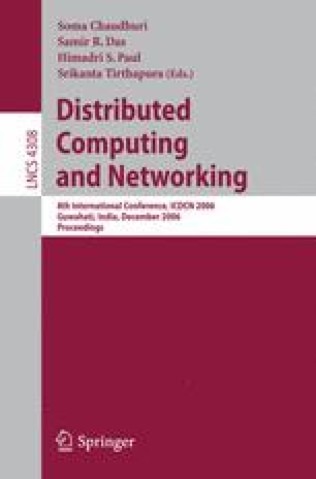
Distributed computing and networking ; 8th International conference, ICDCN 2006, Guwahati, India, December 27-30, 2006, Proceedings
VI realm between distributed computing and networking, namely, Modeling Biological Networks, Network Security, Algorithmic Issues in Wireless Sensor Networks, and Optical Networking. This was made possible by the efforts of the Tutorial Chairs, Sr- har Iyer and Pinaki Mitra. The Organizing Committee worked hard to ensure that the participants enjoyed a comfortable stay and the technical meetings proceeded as smoothly as possible.
