



الصفحة 8
الصفحة 8

Content based image retrieval systems
With an advent of technology, huge collection of digital images is formed as repositories on crime prevention, medical diagnosis, military, face finding, satellites and remote sensing. The task of searching for similar images in the repository is difficult. The data is growing enormously which makes it difficult to store and manage. The traditional image retrieval technique is inefficient in retrieving these images. Content-based image retrieval is an approach from data mining community, which provides the solution of managing this huge quantity of data. In this research, a Content-Based Image Retrieval (CBIR) system has been developed using color and texture as retrieval features from the image repository. The system allows the user to search for an image based on any of the two features alone or in combination by assigning weights to the features. The histogram and color moments approach is used to extract the color feature, texture feature is extracted using statistical moments and co-occurrence matrix method and the shape feature is extracted using the morphological operations. The images and the extracted feature vectors are stored in the Pickle file. The system is robust as it provides search based on the multiple features. The performance of the system was evaluated by analyzing the retrieval results using precision and recall.

Construction and analysis of safe, secure, and interoperable smart devices ; Vol. 3362 : International workshop, CASSIS 2004, Marseille, France, March 10-14, 2004, Revised Selected Papers
History based access control and secure information flow / The spec# programming system / Mastering test generation from smart card software formal models / A mechanism for secure, fine-grained dynamic provisioning of applications on small devices / A type system for checking applet isolation in java card / Verification of safety properties in the presence of transactions / Modelling mobility aspects of security policies / Smart devices for next generation mobile services / A flexible framework for the estimation of coverage metrics in explicit state software model checking / Combining several paradigms for circuit validation and verification / Smart card research perspectives

Computer Vision Systems ; 2nd International Workshop, ICVS 2001 Vancouver, Canada, July 7-8, 2001 Proceedings
Computer Vision has reached a level of maturity that allows us not only to p- form research on individual methods and system components but also to build fully integrated computer vision systems of signi cant complexity. This opens a number of new problems related to system architecture, methods for system synthesis and veri cation, active vision systems, control of perception and - tion, knowledge and system representation, context modeling, cue integration, etc. By focusing on methods and concepts for the construction of fully integrated vision systems, ICVS aims to bring together researchers interested in computer vision systems. Similar to the previous event in Las Palmas, ICVS 2001 was organized as a single-track workshop consisting of high-quality.

Computer Vision in Human-Computer Interaction ; Vol.3979 ; ECCV 2006 Workshop on HCI, Graz, Austria, May 13, 2006, Proceedings
This volume presents the proceedings of the HCI 2006 Workshop, held in conjunction with ECCV 2006 (European Conference on Computer Vision) in Graz, Austria. The goal of this workshop was to bring together researchers from the field of computer vision whose work is related to human–computer interaction.

Computer vision in human-computer interaction ; Vol. 3766
Human-Computer Interaction (HCI) lies at the crossroads of many scienti?c areas including arti?cial intelligence, computer vision, face recognition, motion tracking, etc. In order for HCI systems to interact seamlessly with people, they need to understand their environment through vision and auditory input. Mo- over, HCI systems should learn how to adaptively respond depending on the situation. The goal of this workshop was to bring together researchers from the ?eld of computer vision whose work is related to human-computer interaction. The selected articles for this workshop address a wide range of theoretical and - plication issues in human-computer interaction ranging from human-robot - teraction, gesture recognition, and body tracking, to facial features analysis and human-computer interaction systems.

Computer Science Logic ; 21 International Workshop, CSL 2007, 16th Annual Conference of the EACSL, Lausanne, Switzerland, September 11-15, 2007, Proceedings
This book covers logic and games, expressiveness, games and trees, logic and deduction, lambda calculus, finite model theory, linear logic, proof theory, and game semantics.

Computer Performance Engineering ; 5th European Performance Engineering Workshop, EPEW 2008, Palma de Mallorca, Spain, September 24-25, 2008. Proceedings
This book constitutes the proceedings of the Fifth European Performance Engineering Workshop, EPEW 2008, held in Palma de Mallorca, Spain, in September 24-25, 2008.

Computer Aided Verification ; Vol. 4144 ; 18th International Conference, CAV 2006, Seattle, WA, USA, August 17-20, 2006, Proceedings
Presents 35 revised full papers together with 10 tool papers and 4 invited papers adressing all current issues in computer aided verification and model checking - from foundational and methodological issues ranging to the evaluation of major tools and systems.

Computer Aided Systems Theory – EUROCAST 2007 ; 11th International Conference on Computer Aided Systems Theory, Las Palmas de Gran Canaria, Spain, February 12-16, 2007, Revised Selected Papers
This book presented formal approaches, Computation and Simulation in Modelling Biological Systems, Intelligent Information Processing, Computers in Education, Grid Computing, Applied Formal Verification, Cellular Automata, Computer Vision, Heuristic Problem So.

Computer Aided Systems Theory – EUROCAST 2005 ; 10th International Conference on Computer Aided Systems Theory, Las Palmas de Gran Canaria, Spain, February 7-11, 2005, Revised Selected Papers
The concept of CAST, computer aided systems Theory, was introduced by F. Pichler of Linz in the late 1980s to include those computer theoretical and practical developments used as tools to solve problems in system science. It was considered as the third component (the other two being CAD and CAM) that would provide for a complete picture of the path from computer and systems sciences to practical developments in science and engineering. Selected papers were published as Springer Lecture Notes in Computer Science vols. 410, 585, 763, 1030, 1333, 1728, 2178 and 2809 and in several special issues of Cybernetics and Systems: an lnternational

Computational logic in multi-agent systems ; Vol. 3487 ; 5th International Workshop, CLIMA V, Lisbon, Portugal, September 29-30, 2004, Revised Selected and Invited Papers
The notion of agency has recently increased its in?uence in the research and - velopment of computational logic based systems, while at the same time sign- cantly gaining from decades of research in computational logic. Computational logic provides a well-de?ned, general, and rigorous framework for studying s- tax, semantics and procedures, for implementations, environments, tools, and standards, facilitating the ever important link between speci?cation and ver- cation of computational systems. The purpose of the Computational Logic in Multi-agent Systems (CLIMA) international workshop series is to discuss techniques, based on computational logic, for representing, programming, and reasoning about multi-agent systems in a formal way. Former CLIMA editions were conducted in conjunction with other major computational logic and AI events Thesubmittedpapersshowedthatthelogicalfoundationsofmulti-agent systems are felt by a large community to be a very important research topic, upon which classical AI and agent-related issues are to be addressed.

Computational logic in multi-agent systems ; 8th International Workshop, CLIMA VIII, Porto, Portugal, September 10-11, 2007. Revised Selected and Invited Papers
This book constitutes the thoroughly refereed post-conference proceedings of the 8th International Workshop on Computational Logic for Multi-Agent Systems, CLIMA VIII, held in Porto, Portugal, in September 2007 - co-located with ICLP 2008, the International Conference on Logic Programming.

Computational Logic in Multi-Agent Systems ; 7th International Workshop, CLIMA VII, Hakodate, Japan, May 8-9, 2006, Revised Selected and Invited Papers
This book constitutes the thoroughly refereed post-proceedings of the 7th International Workshop on Computational Logic for Multi-Agent Systems. It was an associated event of AAMAS 2006, the main international conference on autonomous agents and multi-agent systems.

Computational logic in multi-agent systems ; 4th International Workshop, CLIMA IV, Fort Lauderdale, FL, USA, January 6-7, 2004, Revised Selected and Invited Papers
Though multiagent systems (MASs) are being increasingly used, few methods exist to ensure survivability of MASs. All existing methods suffer from two flaws. First, a centralized survivability algorithm (CSA) ensures survivability of the MAS – unfortunately, if the node on which the CSA exists goes down, the survivability of the MAS is questionable. Second, no mechanism exists to change how the MAS is deployed when external factors trigger a re-evaluation of the survivability of the MAS. In this paper, we present three algorithms to address these two important problems. Our algorithms can be built on top of any CSA. Our algorithms are completely distributed and can handle external triggers to compute a new deployment. We report on experiments assessing the efficiency of these algorithms.

Combinatorial and algorithmic aspects of networking ; Vol.3405 ; 1st Workshop on combinatorial and algorithmic aspects of networking, CAAN 2004, Banff, Alberta, Canada, August 5-7, 2004, Revised Selected Papers
The Internet is a massive global network of over 700 million users and it is addingusers at the rate of 300,000 per day. This large, distributed, and everchangingnetwork poses a challenge to researchers: How does one study, model, or under-stand such a decentralized, constantly evolving entity? The workshop Combi-natorial and Algorithmic Aspects of Networking and the Internet (CAAN 2004)provided a forum for the exchange of ideas on these topics. and among thepapers were some new and surprising results as well as some introductions tothe foundations of the field.The workshop program featured 12 peer-reviewed papers bracketed by Topics covered by the talks ranged from the Web graph to game theoryto string matching, all in the context of large-scale networks. This volume collectstogether the talks delivered at the workshop along with a number of survey articlesto round out the presentation and give a comprehensive introduction to the topic.
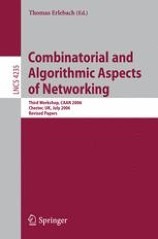
Combinatorial and Algorithmic Aspects of Networking (vol. # 4235) ; Third Workshop, CAAN 2006, Chester, UK, July 2, 2006, Revised Papers
This book constitutes the thoroughly refereed post-proceedings of the Third Workshop on Combinatorial and Algorithmic Aspects of Networking, held in Chester, UK in July 2006, co-located with the 13th Colloquium on Structural Information and Communication Complexity, SIROCCO 2006.The 10 revised full papers and one invited lecture cover a range from the Web graph to game theory to string matching, all in the context of large-scale networks.

Cold Micro Metal Forming : Research Report of the Collaborative Research Center “Micro Cold Forming” (SFB 747), Bremen, Germany
This book contains the research report of the Collaborative Research Center “Micro Cold Forming” (SFB 747) of the University of Bremen, Germany. The topical research focus lies on new methods and processes for a mastered mass production of micro parts which are smaller than 1mm (by forming in batch size higher than one million). The target audience primarily comprises research experts and practitioners in production engineering, but the book may also be of interest to graduate students alike.

Cloud Computing Infrastructure for Enabling Future Technology Advancement
Presents the most up-to-date information about cloud computing technologies and applications. This book provides a detailed introduction of the research fields, recent work, and open research questions in the emerging field of cloud computing. Also, the present book will look for potential research areas and technologies that will make it easier to build a global market for cloud computing services that support scientific, industrial, business, and consumer applications. The benefits associated with cloud computing are enormous, and for rapid development, there is a massive requirement of research and development in this field.
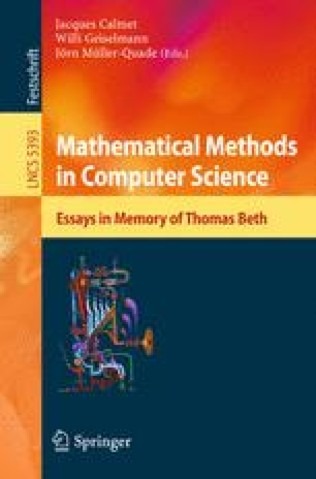
Mathematical Methods in Computer Science : Essays in Memory of Thomas Beth
This Festschrift volume contains the proceedings of the conference Mathematical Methods in Computer Science, MMICS 2008, which was held during December 17-19, 2008, in Karlsruhe, Germany, in memory of Thomas Beth.The themes of the conference reflected the many interests of Thomas Beth. Although, these interests might seem diverse, mathematical methods and especially algebra as a language constituted the common denominator of all of his scientific achievements.

Materials for Information Technology : Devices, Interconnects and Packaging
The Engineering Materials and Processes series focuses on all forms of materials and the processes used to synthesise and formulate them as they relate to the various engineering disciplines.
