



الصفحة 8
الصفحة 8

Differential Evolution Algorithm with Type-2 Fuzzy Logic for Dynamic Parameter Adaptation with Application to Intelligent Control
This book focuses on the fields of fuzzy logic, bio-inspired algorithm, especially the differential evolution algorithm and also considering the fuzzy control area. The main idea is that these two areas together can help solve various control problems and to find better results. In this book, the authors test the proposed method using five benchmark control problems. First, the water tank, temperature, mobile robot, and inverted pendulum controllers are considered. For these 4 problems, experimentation was carried out using a Type-1 fuzzy system and an Interval Type-2 system. The last control problem was the D.C. motor, for which the experiments were performed with Type-1, Interval Type-2, and Generalized Type-2 fuzzy systems. When we use fuzzy systems combined with the differential evolution algorithm, we can notice that the results obtained in each of the controllers are better and with increasing uncertainty, the results are even better. For this reason, the authors consider in this book the proposed method using fuzzy systems and the differential evolution algorithm to improve the fuzzy controllers’ behavior in complex control problems.

Developing a distributed medical system
Our project is a distributed medical system that is used by patients and multiple medical sectors such as doctors, pharmacists, analysis labs, hospitals, and medical insurance companies. The aim of the project is to add and store all the patient’s medical data in our system, such as previous treatments and past medical records from previous doctors, previous prescriptions and older lab test’s results, in addition, the insurance companies will have the ability to check on the medical treatment of its customers to do the necessary procedures needed for the them to perform their work. All of our actors are working in a secure and synchronized system in order to provide the best medical results possible, each actor has its own transactions to do in our system and can only manage and access the data allowed for him to perform his required job.

Designing Intelligent Construction Projects
Readers will find: Illuminating case study material that highlights how change management methodologies, game theory, and collaborative contractual design can deliver results Strategies for achieving lean, viable, and digitally oriented construction leadership fit for the modern market Rigorous discussions of the current and potential future impact of digitization on construction firms

Designing and Evaluating Value Added Services in Manufacturing E-Market Places
Presents the results of a research developed under a two years program titled “ “Distributed process and production planning in manufacturing enterprise networks” and funded by the Italian Ministry of Education, University and Research (MIUR) under the program PRIN2001.

Design of Embedded Control Systems : Models for Capacity Planning in Advanced Manufacturing Systems
A set of original results in the ?eld of high-level design of logical control devices and systems is presented in this book

Dependable Systems : Software, Computing, Networks : Research Results of the DICS Program
The present volume documents the results of a research program on Dependable Information and Communication Systems (DICS). The members of the project met in two workshops organized by the Hasler Foundation. This state-of-the-art survey contains 3 overview articles identifying major issues of dependability and presenting the latest solutions, as well as 10 carefully selected and revised papers depicting the research results originating from those workshops. The first workshop took place in Münchenwiler, Switzerland, in March 2004, and the second workshop, which marked the conclusion of the projects, in Löwenberg, Switzerland, in October 2005. The papers are organized in topical sections on surveys, dependable software, dependable computing, and dependable networks.
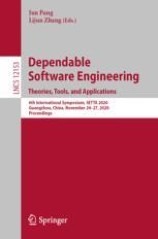
Dependable software engineering : Theories, tools, and applications ; 6th International Symposium, SETTA 2020, Guangzhou, China, November 24–27, 2020, Proceedings
This book constitutes the proceedings of the 6th International Symposium on Dependable Software Engineering, SETTA 2020, held in Guangzhou, China, in November 2020. The 10 full and 1 short paper included in this volume were carefully reviewed and selected from 20 submissions. They deal with latest research results and ideas on bridging the gap between formal methods and software engineering.

Declarative agent languages and technologies II ; 2nd international workshop, DALT 2004, New York, NY, USA, July 19, 2004, revised selected papers
Nearly 40 research groups worldwide were motivated to contribute to this event by submitting their most recent research achievements, covering a wide variety of the topics listed in the call for papers. More than 30 top researchers agreed to join the Program Committee, which then collectively faced the hard task of selecting the one-day event program. The fact that research in multi-agent systems is no longer only a novel and promising research horizon at dawn is, in our opinion, the main reason behind DALT’s (still short) success story. On the one hand, agent theories and app- cations are mature enough to model complex domains and scenarios, and to successfully address a wide range of multifaceted problems, thus creating the urge to make the best use of this expressive and versatile paradigm, and also pro?t from all the important results achieved so far. On the other hand, bui- ing multi-agent systems still calls for models and technologies that could ensure system predictability, accommodate ?exibility, heterogeneity and openness, and enable system veri?cation.

Database theory - ICDT 2005 ; 10th international conference, Edinburgh, UK, January 5-7, 2005, Proceedings
This volume collects the papers presented at the 10th International Conference on Database Theory, ICDT 2005, held during January 5–7, 2005, in Edinburgh, UK. ICDT (http://alpha.luc.ac.be/~lucp1080/icdt/) has now a long tra- tion of international conferences, providing a biennial scienti?c forum for the communication of high-quality and innovative research results on theoretical - pects of all forms of database systems and database technology. The conference usually takes place in Europe, and has been held in Rome (1986), Bruges (1988), Paris (1990), Berlin (1992), Prague (1995), Delphi (1997), Jerusalem (1999), London (2001), and Siena (2003) so far. ICDT has merged with the Sym- sium on Mathematical Fundamentals of Database Systems (MFDBS), initiated in Dresden in 1987, and continued in Visegrad in 1989 and Rostock in 1991. ICDT had a two-stage submission process. First, 103 abstracts were subm- ted, which were followed a week later by 84 paper submissions. From these 84 submissions, the ICDT Program Committee selected 24 papers for presentation at the conference. Most of these papers were “extended abstracts” and preli- nary reports on work in progress. It is anticipated that most of these papers will appear in a more polished form in scienti?c journals.

Data warehousing and knowledge discovery ; Vol.3589 ; 7th international conference, DaWak 2005, Copenhagen, Denmark, August 22-26, 2005, Proceedings
For more than a decade, data warehousing and knowledge discovery technologies have been developing into key technologies for decision-making processes in com- nies. Since 1999, due to the relevant role of these technologies in academia and ind- try, the Data Warehousing and Knowledge Discovery (DaWaK) conference series have become an international forum where both practitioners and researchers share their findings, publish their relevant results and dispute in depth research issues and experiences on data warehousing and knowledge discovery systems and applications.

Data Warehousing and Knowledge Discovery ; 4th International Conference, DaWaK 2002, Aix-en-Provence, France, September 4-6, 2002. Proceedings
Within the last few years Data Warehousing and Knowledge Discovery technology has established itself as a key technology for enterprises that wish to improve the quality of the results obtained from data analysis, decision support, and the automatic extraction of knowledge from data. The Fourth International Conference on Data Warehousing and Knowledge Discovery (DaWaK 2002) continues a series of successful conferences dedicated to this topic. Its main objective is to bring together researchers and practitioners to discuss research issues and experience in developing and deploying data warehousing and knowledge discovery systems, applications, and solutions.

Data Mining : A Knowledge Discovery Approach
This book on data mining details the unique steps of the knowledge discovery process that prescribe the sequence in which data mining projects should be performed. Data Mining offers an authoritative treatment of all development phases from problem and data understanding through data preprocessing to deployment of the results. This knowledge discovery approach is what distinguishes this book from other texts in the area. It concentrates on data preparation, clustering and association rule learning (required for processing unsupervised data), decision trees, rule induction algorithms, neural networks, and many other data mining methods, focusing predominantly on those which have proven successful in data mining projects.

Data and applications security XX ; 20th Annual IFIP WG 11.3 Working Conference on data and applications security, Sophia Antipolis, France, July 31-August 2, 2006, Proceedings
For 20 years, the IFIP WG 11. 3 Working Conference on Data and Appli- tions Security (DBSEC) has been a major forum for presenting originalresearch results, practical experiences, and innovative ideas in data and applications - curity.Like the previous conference, the 20th DBSEC has proved to be up to this challenge. DBSEC 2006 received 56 submissions, out of which the program committee selected22 high-qualitypaperscoveringanumber of diverseresearchtopicssuch as access control, privacy, and identity management.

Cybersecurity of Digital Service Chains : Challenges, Methodologies, and Tools
This book presents the main scientific results from the H2020 GUARD project. The GUARD project aims at filling the current technological gap between software management paradigms and cybersecurity models, the latter still lacking orchestration and agility to effectively address the dynamicity of the former. This book provides a comprehensive review of the main concepts, architectures, algorithms, and non-technical aspects developed during three years of investigation; the description of the Smart Mobility use case developed at the end of the project gives a practical example of how the GUARD platform and related technologies can be deployed in practical scenarios.

Cryptography and cryptanalysis in Java : Creating and programming advanced algorithms with Java SE 17 LTS and Jakarta EE 10
Includes challenging cryptographic solutions that are implemented in Java 17 and Jakarta EE 10. It provides a robust introduction to Java 17's new features and updates, a roadmap for Jakarta EE 10 security mechanisms, a unique presentation of the "hot points" (advantages and disadvantages) from the Java Cryptography Architecture (JCA), and more. You Will Learn : Develop programming skills for writing cryptography algorithms in Java / Dive into security schemes and modules using Java / Explore “good” vs “bad” cryptography based on processing execution times and reliability / Play with pseudo-random generators, hash functions, etc. / Leverage lattice-based cryptography methods, the NTRU framework library, and more

Convex functions and their applications : A contemporary approach ; 2nd ed.
This second edition provides a thorough introduction to contemporary convex function theory with many new results. A large variety of subjects are covered, from the one real variable case to some of the most advanced topics. The new edition includes considerably more material emphasizing the rich applicability of convex analysis to concrete examples. Chapters 4, 5, and 6 are entirely new, covering important topics such as the Hardy-Littlewood-Pólya-Schur theory of majorization, matrix convexity, and the Legendre-Fenchel-Moreau duality theory.

Content based image retrieval systems
With an advent of technology, huge collection of digital images is formed as repositories on crime prevention, medical diagnosis, military, face finding, satellites and remote sensing. The task of searching for similar images in the repository is difficult. The data is growing enormously which makes it difficult to store and manage. The traditional image retrieval technique is inefficient in retrieving these images. Content-based image retrieval is an approach from data mining community, which provides the solution of managing this huge quantity of data. In this research, a Content-Based Image Retrieval (CBIR) system has been developed using color and texture as retrieval features from the image repository. The system allows the user to search for an image based on any of the two features alone or in combination by assigning weights to the features. The histogram and color moments approach is used to extract the color feature, texture feature is extracted using statistical moments and co-occurrence matrix method and the shape feature is extracted using the morphological operations. The images and the extracted feature vectors are stored in the Pickle file. The system is robust as it provides search based on the multiple features. The performance of the system was evaluated by analyzing the retrieval results using precision and recall.

Computer-Aided Innovation (CAI) ; IFIP 20th World Computer Congress, Proceedings of the Second Topical Session on Computer-Aided Innovation, WG 5.4/TC 5 Computer-Aided Innovation, September 7-10, 2008, Milano, Italy
The IFIP series publishes state-of-the-art results in the sciences and technologies of information and communication. The principal aim of the IFIP series is to encourage education and the dissemination and exchange of information about all aspects of computing.

Computer Network Security ; Vol. 3685
This volume contains papers presented at the 3rd International Workshop on Mathematical Methods, Models and Architectures for Computer Network - curity (MMM-ACNS 2005) held in St. Petersburg, Russia, 2005. The 1st and the 2nd International Workshops on Mathematical Methods, Models and Architectures for Computer Network Security (MMM-ACNS 2001 and MMM-ACNS 2003), hosted by the St. Petersburg Institute for Informatics and Automation, demonstrated the keen interest of the international research community in the subject area. It was recognized that conducting a biannual series of such workshops in St. Petersburg stimulates fruitful exchanges between the di?erent schools of thought, facilitates the dissemination of new ideas and promotesthespirit of cooperationbetweenresearchersontheinternationalscale. MMM-ACNS 2005 provided an international forum for sharing original - search results and application experiences among specialists in fundamental and applied problems of computer network security. An important distinction of the workshop was its focus on mathematical aspects of information and computer network security addressing the ever-increasing demands for secure computing and highly dependable computer networks.

Computer And Computing Technologies In Agriculture, Vol. II ; 1st IFIP TC 12 International Conference on Computer and Computing Technologies in Agriculture (CCTA 2007), Wuyishan, China, August 18-20, 2007
The IFIP series publishes state-of-the-art results in the sciences and technologies of information and communication. The principal aim of the IFIP series is to encourage education and the dissemination and exchange of information about all aspects of computing.
