



الصفحة 8
الصفحة 8

Micro-ISV : From Vision to Reality
Micro-ISV: From Vision to Reality explains what works and why in today's emerging micro-ISV sector. Currently, thousands of programmers build and deliver great solutions ISV-style, earning success and revenues much larger than you might guess. Written by and for micro-ISVs, with help from some of the leaders of the field, this book takes you beyond just daydreaming to running your own business. It thoroughly explores how it is indeed possible to launch and maintain a small and successful ISV business, and is an ideal read if you're interested in getting started.

The 8051 microcontroller and embedded systems
The Classical Period: Nineteenth Century Sociology Auguste Comte (1798-1857) on Women in Positivist Society Harriett Martineau (1802-1876) on American Women Bebel, August (1840-1913) on Women and Socialism Emile Durkheim (1858-1917) on the Division of Labor and Interests in Marriage Herbert Spencer (1820-1903) on the Rights and Status of Women Lester Frank Ward (1841-1913) on the Condition of Women Anna Julia Cooper (1858-1964) on the Voices of Women Thorstein Veblen (1857-1929) on Dress as Pecuniary Culture The Progressive Era: Early Twentieth Cent.

Micro-Assembly Technologies and Applications ; IFIP TC5 WG5.5 Fourth International Precision Assembly Seminar (IPAS’2008) Chamonix, France February 10–13, 2008
The IFIP series publishes state-of-the-art results in the sciences and technologies of information and communication. The scope of the series includes: foundations of computer science; software theory and practice; education; computer applications in technology; communication systems; systems modeling and optimization; information systems; computers and society; computer systems technology; security and protection in information processing systems; artificial intelligence; and human-computer interaction. Proceedings and post-proceedings of referred international conferences in computer science and interdisciplinary fields are featured. These results often precede journal publication and represent the most current research.

MICAI 2008 : Advances in Artificial Intelligence ;7th Mexican International Conference on Artificial Intelligence, Atizapán de Zaragoza, Mexico, October 27-31, 2008 Proceedings
The 96 revised full papers presented together with 2 invited lectures were carefully reviewed and selected from 363 submissions. The papers are organized in topical sections on logic and reasoning, knowledge-based systems, knowledge representation and acquisition, ontologies, natural language processing, machine learning, pattern recognition, data mining, neural networks, genetic algorithms, hybrid intelligent systems, computer vision and image processing, robotics, planning and scheduling, uncertainty and probabilistic reasoning, fuzzy logic, intelligent tutoring systems, multi-agent systems and distributed ai, intelligent organizations, bioinformatics and medical applications, as well as applications.

MICAI 2007 : Advances in artificial intelligence ; 6th Mexican International Conference on Artificial Intelligence, Aguascalientes, Mexico, November 4-10, 2007, Proceedings
The Mexican International Conference on Artificial Intelligence (MICAI), a yearly international conference series organized by the Mexican Society for Artificial Intelligence (SMIA), is a major international AI forum and the main event in the academic life of the country’s growing AI community.
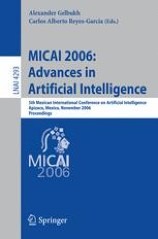
MICAI 2006 : Advances in Artificial Intelligence ; 5th Mexican International Conference on Artificial Intelligence, Apizaco, Mexico, November 13-17, 2006, Proceedings
This volume contains the papers presented during the oral session of the 5 Mexican International Conference on Artificial Intelligence, held on November 13–17, 2006, at the Technologic Institute of Apizaco, Mexico. The conference received for evaluation 448 submissions by 1207 authors from 42 different countries

MICAI 2005 : Advances in Artificial Intelligence ; 4th Mexican International Conference on Artificial Intelligence, Monterrey, Mexico, November 14-18, 2005, Proceedings
Constitutes the refereed proceedings of the 4th Mexican International Conference on Artificial Intelligence, MICAI 2005, held Mexico, in November 2005. This book is organized in topical sections on knowledge representation and management, logic and constraint programming, uncertainty reasoning, multiagent systems and distributed AI, and others.

Metalearning : Applications to Automated Machine Learning and Data Mining
This book as one of the fastest-growing areas of research in machine learning, metalearning studies principled methods to obtain efficient models and solutions by adapting machine learning and data mining processes. This adaptation usually exploits information from past experience on other tasks and the adaptive processes can involve machine learning approaches. As a related area to metalearning and a hot topic currently, automated machine learning (AutoML) is concerned with automating the machine learning processes. Metalearning and AutoML can help AI learn to control the application of different learning methods and acquire new solutions faster without unnecessary interventions from the user.

Metainformatics ; International Symposium, MIS 2004, Salzburg, Austria, September 15-18, 2004, Revised Selected Papers
Constitutes the refereed post-proceedings of the Metainformatics Symposium, MIS 2004, held in Salzburg, Austria. This book reviews 17 papers that are devoted to finding useful abstractions, analytical frameworks, and systems that improve the understanding of the underlying structure of disciplines and families of systems within computer science.

Messages security application
The rapid development of communication technology, is bringing many technological conveniences with it and simplifying our lives. On the other hand, it has disadvantages such as hiding the information that is continuously roaming through various communication media resources between senders and receivers and avoid sharing them with third parties. Eliminating these disadvantages via specific security methods and algorithms is related to the discipline called cryptography, which includes information security. Encryption is the process of turning a plaintext to jargon or the method of changing a confidential file to jargon in order to prevent unauthorized persons from gaining access to confidential message. A Message is the transfer of information from the sender to the receiver through a particular medium. Encryption is the most effective process for achieving data security.

Membrane Computing; 8th International Workshop, WMC 2007 Thessaloniki, Greece, June 25-28, 2007 Revised Selected and Invited Papers
This volume contains a selection of papers presented at the Eighth Workshop on Membrane Computing, WMC8, which took place in Thessaloniki, Greece, during June 25–28, 2008. Special attention was paid to the interaction of membrane computing with biology and computer science, focusing on the - ological roots of membrane computing, on applications of membrane computing in biology and medicine, and on possible electronically based implementations.

Membrane Computing ; Vol. 4361 ; 7th International Workshop, WMC 2006, Leiden, Netherlands, July 17-21, 2006, Revised, Selected, and Invited Papers
The present volume contains a selection of papers presented at the Seventh Workshop on Membrane Computing, WMC7, which took place in Leiden, The Netherlands, during July 17–21, 2006. The ?rst three workshops on membrane computing were organized in Curtea de Arge¸ s, Romania – they took place in August 2000 (with the proceedings published in Lecture Notes in Computer Science, volume2235),in August 2001(with a selection of papers published asa special issue of Fundamenta Informaticae, volume 49, numbers 1–3, 2002), and in August 2002 (with the proceedings published in Lecture Notes in Computer Science, volume 2597). The next three workshops were organized in Tarragona, Spain, in July 2003, in Milan, Italy, in June 2004, and in Vienna, Austria, in July 2005, with the proceedings published as volumes 2933, 3365, and 3850, respectively, of Lecture Notes in Computer Science. The 2006edition of WMC wasorganized(and supported) byLorentzCenter, Leiden, under the auspices of the European Molecular Computing Consortium (EMCC). Special attention was paid to the interaction of membrane computing with biology, focusing both on the biological roots of membrane computing and on applications of membrane computing in biology and medicine.

Membrane Computing ; Vol. 3850 ; 6th International Workshop, WMC 2005, Vienna, Austria, July 18-21, 2005, Revised Selected and Invited Papers
The papers in this volume cover all the main directions of research in membrane computing, ranging from theoretical topics in mathematics and computer science, to application issues, especially in biology. More specifically, these papers present research on topics such as: computational power and complexity classes, new types of P systems, relationships to Petri nets, quantum computing, and brane calculi, determinism vs. nondeterminism, hierarchies, the size of small families, algebraic approaches, and designing polynomial solutions to NP-complete problems through the use of membrane systems. Like the previous workshops,

Membrane Computing ; Vol. 3365 ; 5th International Workshop, WMC 2004, Milan, Italy, June 14-16, 2004, Revised Selected and Invited Papers
Constitutes the refereed extended postproceedings of the 5th International Workshop on Membrane Computing, held in Italy, in June 2004. This book addresses various topics in the area of membrane computing, ranging from mathematics and theoretical computer science to applications in biology, linguistics, and computer graphics.

Medical Imaging and Informatics ; 2nd International Conference, MIMI 2007, Beijing, China, August 14-16, 2007 Revised Selected Papers
This book constitutes the thoroughly refeered post-conference proceedings of the Second Interational Conference on Medical Imaging and Informatics, MIMI 2007, held in Beijing, China, in August 2007.The 40 revised full papers presented together with 4 keynote talks were carefully reviewed and selected from 110 submissions. The papers are organized in topical sections on medical image segmentation and registration, medical informatics, PET, fMRI, ultrasound and thermal imaging, 3D reconstruction and visualization. The volume is rounded off by 4 papers from 2 workshops on legal, ethical and social issues in medical imaging and informatics, as well as on computer-aided diagnosis (CAD).

Medical Imaging and Augmented Reality ; 4th International Workshop Tokyo, Japan, August 1-2, 2008 Proceedings
Constitutes the refereed proceedings of the 4th International Workshop on Medical Imaging and Augmented Reality, MIAR 2008, held in Tokyo, Japan, in August 2008.The 44 revised full papers presented together with 3 invited papers were carefully reviewed and selected from 90 submissions. The papers are organized in topical sections on surgical planning and simulation, medical image computing, image analysis, shape modeling and morphometry, image-guided robotics, image-guided intervention, interventional imaging, image registration, augmented reality, and image segmentation.

Medical Image Computing and Computer-Assisted Intervention - MICCAI 2008 ; 11th International Conference, New York, NY, USA, September 6-10, 2008, Proceedings, Part II
The program committee carefully selected 258 revised papers from numerous submissions for presentation in two volumes, based on rigorous peer reviews. The first volume includes 127 papers related to medical image computing, segmentation, shape and statistics analysis, modeling, motion tracking and compensation, as well as registration. The second volume contains 131 contributions related to robotics and interventions, statistical analysis, segmentation, intervention, modeling, and registration.
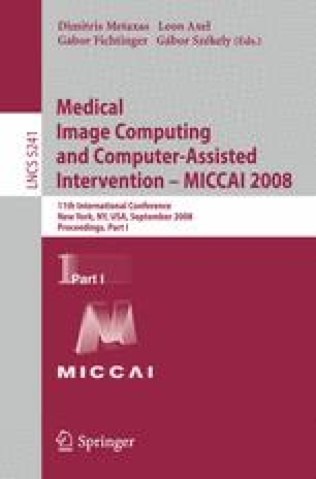
Medical Image Computing and Computer-Assisted Intervention - MICCAI 2008 ; 11th International Conference, New York, NY, USA, September 6-10, 2008, Proceedings, Part I
The program committee carefully selected 258 revised papers from numerous submissions for presentation in two volumes, based on rigorous peer reviews. The first volume includes 127 papers related to medical image computing, segmentation, shape and statistics analysis, modeling, motion tracking and compensation, as well as registration. The second volume contains 131 contributions related to robotics and interventions, statistical analysis, segmentation, intervention, modeling, and registration.
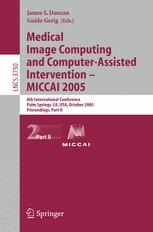
Medical Image Computing and Computer-Assisted Intervention -- MICCAI 2005 ; 8th International Conference, Palm Springs, CA, USA, October 26-29, 2005, Proceedings, Part II
Robotics, Image-Guided Surgery and Interventions -- Image Registration II -- Medical Image Computing -- Atlases -- Shape I -- Structural and Functional Brain Analysis -- Model-Based Image Analysis -- Image-Guided Intervention: Simulation, Modeling and Display -- Simulation and Modeling II -- Medical Image Computing -- Shape II -- Image Segmentation and Analysis II -- Image Registration III --
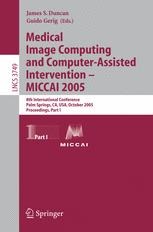
Medical Image Computing and Computer-Assisted Intervention – MICCAI 2005 ; 8th International Conference, Palm Springs, CA, USA, October 26-29, 2005, Proceedings, Part I
This paper presents a method for classification of medical images, using machine learning and deformation-based morphometry. A morphological representation of the anatomy of interest is first obtained using highdimensional template warping, from which regions that display strong correlations between morphological measurements and the classification (clinical) variable are extracted using a watershed segmentation, taking into account the regional smoothness of the correlation map which is estimated by a crossvalidation strategy in order to achieve robustness to outliers. A Support Vector Machine-Recursive Feature Elimination (SVM-RFE) technique is then used to rank computed features from the extracted regions, according to their effect on the leave-one-out error bound. Finally, SVM classification is applied using the best set of features, and it is tested using leave-one-out. The results from a group of 61 brain images of female normal controls and schizophrenia patients demonstrate not only high classification accuracy (91.8%) and steep ROC curves, but also exceptional stability with respect to the number of selected features and the SVM kernel size
