



الصفحة 77
الصفحة 77

Bilinear integrable systems : From classical to quantum, continuous to discrete ; Proceedings of the NATO Advanced Research Workshop on Bilinear Integrable Systems: From Classical to Quantum, Continuous to Discrete St. Petersburg, Russia, 15-19 September 2002
Trained as a physicistin his home university Kyushu University, Professor Hirota earned his PhD in’61 at Northwestern University with Professor Siegert in the field of “QuantumStatistical mechanics”. He wrote a widely appreciated Doctoral dissertation on“Functional Integral representation of the grand partition function”. As a youngresearcher, he entered the RCA Company in Tokyo to do research on semi-conductor plasmas. Professor Hirota was led to model the Toda lattice as a non-linear networkof ladder-type LC circuits. The self-dual case led to equations very reminiscentof the Sine-Gordon equation, with much the same features (existence of onesoliton, soliton-soliton interaction, etc)
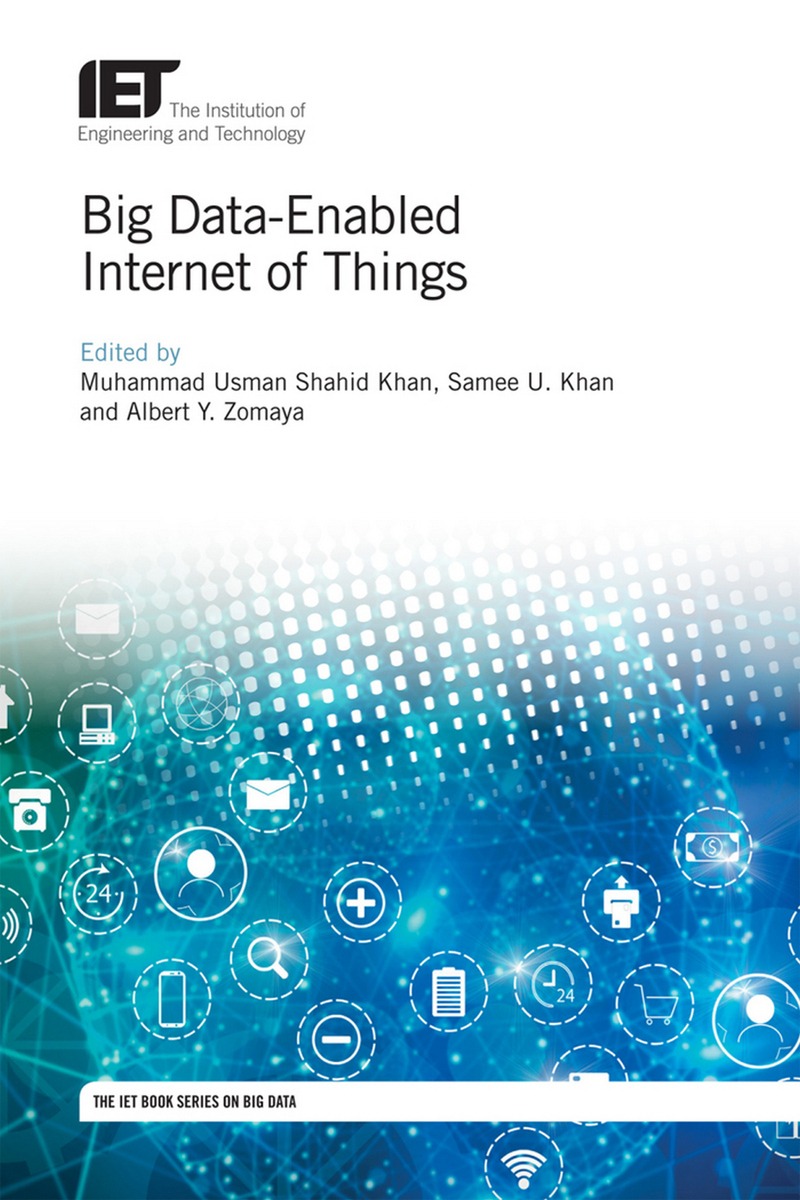
Big data-enabled internet of things
Covers analytical techniques for handling the huge amount of data generated by the Internet of Things, from architectures and platforms to security and privacy issues, applications, and challenges as well as future directions. The fields of Big Data and the Internet of Things (IoT) have seen tremendous advances, developments, and growth in recent years. The IoT is the inter-networking of connected smart devices, buildings, vehicles and other items which are embedded with electronics, software, sensors and actuators, and network connectivity that enable these objects to collect and exchange data. The IoT produces a lot of data. Big data describes very large and complex data sets that traditional data processing application software is inadequate to deal with, and the use of analytical methods to extract value from data. This edited book covers analytical techniques for handling the huge amount of data generated by the Internet of Things, from architectures and platforms to security and privacy issues, applications, and challenges as well as future directions.
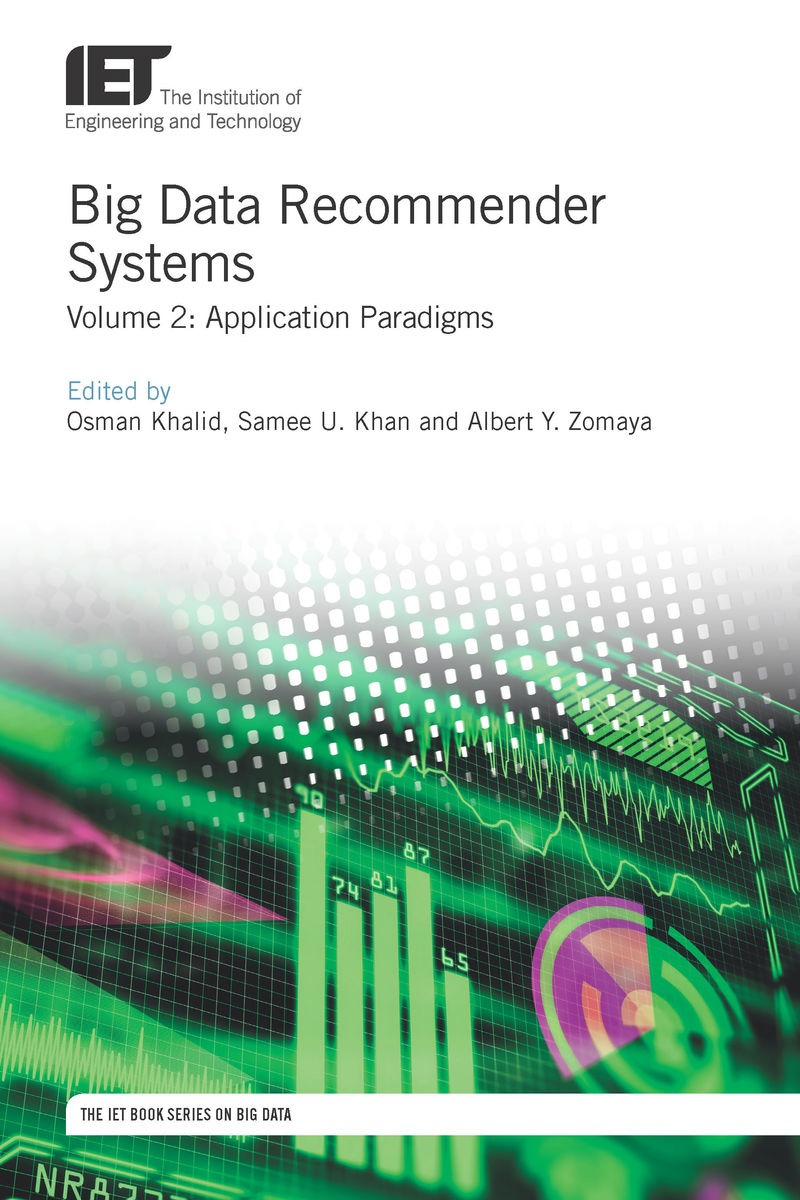
Big Data Recommender Systems ; Vol.2 : Application Paradigms
Combines experimental and theoretical research on big data recommender systems to help computer scientists develop new concepts and methodologies for complex applications. It includes original scientific contributions in the form of theoretical foundations, comparative analysis, surveys, case studies, techniques and tools. First designed to generate personalized recommendations to users in the 90s, recommender systems apply knowledge discovery techniques to users’ data to suggest information, products, and services that best match their preferences. In recent decades, we have seen an exponential increase in the volumes of data, which has introduced many new challenges. recommender systems. Volume 2 covers a broad range of application paradigms for recommender systems over 22 chapters
Big Data Recommender Systems ; Vol.1 : Algorithms, Architectures, Big Data, Security and Trust
Combines experimental and theoretical research on big data recommender systems to help computer scientists develop new concepts and methodologies for complex applications. It includes original scientific contributions in the form of theoretical foundations, comparative analysis, surveys, case studies, techniques and tools.
Big Data Intelligence for Smart Applications
Presents the latest discoveries in the field of machine intelligence and big data Proposes many case studies and applications of computational and Big data Combines theory and practice so that readers of the few books (beginners or experts)
Big Data in Context : Legal, Social and Technological Insights
Sheds new light on a selection of big data scenarios from an interdisciplinary perspective. It features legal, sociological and economic approaches to fundamental big data topics such as privacy, data quality and the ECJ’s Safe Harbor decision on the one hand, and practical applications such as smart cars, wearables and web tracking on the other. Addressing the interests of researchers and practitioners alike, it provides a comprehensive overview of and introduction to the emerging challenges regarding big data.All contributions are based on papers submitted in connection with ABIDA (Assessing Big Data), an interdisciplinary research project exploring the societal aspects of big data and funded by the German Federal Ministry of Education and Research.
Big data and artificial intelligence in digital finance : Increasing personalization and trust in digital finance using big data and AI
This book presents how cutting-edge digital technologies like Machine Learning, Artificial Intelligence (AI), and Blockchain are set to disrupt the financial sector. The book illustrates how recent advances in these technologies facilitate banks, FinTechs, and financial institutions to collect, process, analyze, and fully leverage the very large amounts of data that are nowadays produced and exchanged in the sector. To this end, the book also introduces some of the most popular Big Data, AI and Blockchain applications in the sector, including novel applications in the areas of Know Your Customer (KYC), Personalized Wealth Management and Asset Management, Portfolio Risk Assessment, as well as variety of novel Usage-based Insurance applications based on Internet-of-Things data.
Big data analytics and machine intelligence in biomedical and health informatics : Concepts, methodologies, tools and applications
Provides coverage of developments and state-of-the-art methods in the broad and diversified data analytics field and applicable areas such as big data analytics, data mining, and machine intelligence in biomedical and health informatics. Covers the latest advances and developments in health informatics, data mining, machine learning, and artificial intelligence. They have been organized with respect to the similarity of topics addressed, ranging from issues pertaining to the Internet of Things (IoT) for biomedical engineering and health informatics, computational intelligence for medical data processing, and Internet of Medical Things??(IoMT).
Big Data : Conceptual Analysis and Applications
The book is devoted to the analysis of big data in order to extract from these data hidden patterns necessary for making decisions about the rational behavior of complex systems with the different nature that generate this data. To solve these problems, a group of new methods and tools is used, based on the self-organization of computational processes, the use of crisp and fuzzy cluster analysis methods, hybrid neural-fuzzy networks, and others. The book solves various practical problems. In particular, for the tasks of 3D image recognition and automatic speech recognition large-scale neural networks with applications for Deep Learning systems were used.

Bifurcations, Instabilities, Degradation in Geomechanics
Leading international researchers and practitioners of bifurcations and instabilities in geomechanics debate the developments and applications which have occurred over the last few decades. The topics covered include modeling of bifurcation, structural failure of geomaterials and geostructures, advanced analytical, numerical and experimental techniques, and application and development of generalised continuum models etc. In addition analytical solutions, numerical methods, experimental techniques, and case histories are presented. Beside fundamental research findings, applications in geotechnical, petroleum, mining, and bulk materials engineering are emphasised.

Beyond the Worst-Case Analysis of Algorithms
There are no silver bullets in algorithm design, and no single algorithmic idea is powerful and flexible enough to solve every computational problem. Nor are there silver bullets in algorithm analysis, as the most enlightening method for analyzing an algorithm often depends on the problem and the application. However, typical algorithms courses rely almost entirely on a single analysis framework, that of worst-case analysis, wherein an algorithm is assessed by its worst performance on any input of a given size. The purpose of this book is to popularize several alternatives to worst-case analysis and their most notable algorithmic applications, from clustering to linear programming to neural network training. Forty leading researchers have contributed introductions to different facets of this field, emphasizing the most important models and results, many of which can be taught in lectures to beginning graduate students in theoretical computer science and machine learning.
Beyond the apparent Banality of the mathematics classroom
New research in mathematics education deals with the complexity of the mathematics’ classroom. The classroom teaching situation constitutes a pertinent unit of analysis for research into the ternary didactic relationship which binds teachers, students and mathematical knowledge. The classroom is considered as a complex didactic system, which offers the researcher an opportunity to gauge the boundaries of the freedom that is left with regard to choices about the knowledge to be taught and the ways of organizing the students’ learning, while giveing rise to the study of interrelations between three main elements of the teaching process the: mathematical content to be taught and learned, management of the various time dimensions, and activity of the teacher who prepares and manages the class, to the benefit of the students' knowledge and the teachers' own experience.
Between Mobility and Migration : The Multi-Level Governance of Intra-European Movement
Offers a critical perspective on intra-European mobility and migration by using new empirical data and theoretical discussions. It develops a theoretical and empirical analysis of the consequences of intra-European movement for sending and receiving urban regions in The Netherlands, Sweden, Austria, Turkey, Poland and Czech Republic.The book conceptualizes Central and Eastern European (CEE) migration by distinguishing between different types of CEE migrants and consequences. This involves a mapping of migration corridors within Europe, a unique empirical analysis of consequences for urban regions, and an analysis of governance responses. Next to the European and country perspectives on this phenomenon, the book focuses on the local perspective of urban regions where most mobile citizens settle (either permanently or temporarily). This way the book puts the analysis of intra-European movement in the perspective of broader theoretical debates in migration studies and beyond.
Between dirt and discussion : Methods, methodology and interpretation in historical archaeology
The cases presented in this volume revisit old methods and previous scholarly approaches with new perspectives, along with incorporating the newest technologies available to understanding the past.
Best practices in software measurement : How to use metrics to improve project and process performance
Not everything that counts can be counted. Not everything that is counted counts. Albert Einstein This is a book about software measurement from the practitioner’s point of view and it is a book for practitioners. Software measurement needs a lot of practical guidance to build upon experiences and to avoid repeating errors. This book t- gets exactly this need, namely to share experiences in a constructive way that can be followed. It tries to summarize experiences and knowledge about software measurement so that it is applicable and repeatable. It extracts experiences and lessons learned from the narrow context of the specific industrial situation, thus facilitating transfer to other contexts. Software measurement is not at a standstill. With the speed software engine- ing is evolving, software measurement has to keep pace. While the underlying theory and basic principles remain invariant in the true sense (after all, they are not specific to software engineering), the application of measurement to specific contexts and situations is continuously extended. The book thus serves as a ref- ence on these invariant principles as well as a practical guidance on how to make software measurement a success.
Benchmarking, Temporal Distribution, and Reconciliation Methods for Time Series
This book discusses the statistical methods most often applied for such adjustments, ranging from ad hoc procedures to regression-based models. The latter are emphasized, because of their clarity, ease of application, and superior results. Each topic is illustrated with many real case examples. In order to facilitate understanding of their properties and limitations of the methods discussed, a real data example, the Canada Total Retail Trade Series, is followed throughout the book.This book brings together the scattered literature on these topics and presents them using a consistent notation and a unifying view.
Beliefs about SLA : New Research Approaches
This edited collection of articles illustrates more recent work on beliefs about SLA, drawing on the thinking of (educational) philosophers and (discursive) psychologists, including Dewey, Bakhtin, Vygotsky, and Potter.

Beginning XSLT 2.0 : From novice to professional
This followup to Jeni Tennison's Beginning XSLT has been updated to accomodate the revised XSLT standard. Part one of this book introduces XML and XSLT at a comfortable pace, and gradually demonstrates techniques for generating HTML (plus other formats), from XML. In part two, Tennison applies theory to real-life XSLT capabilities—including generating graphics. Each chapter includes step-by-step examples (with code available online), plus review questions at the end, to help you grasp the discussed features. In fact, all of the examples and exercises revolve around an interesting common theme: making TV listings available online. This book lives up to its name, and will definitely take you from a novice to a professional, in no time!

Beginning XML with DOM and Ajax : From novice to professional
Don't waste time on 1,000-page tomes full of syntax; this book is all you need to get ahead in XML development. Renowned web developer Sas Jacobs presents an essential guide to XML. Beginning XML with DOM and Ajax is practical and comprehensive. It includes everything you need to know to get up to speed with XML development quickly and painlessly.

Beginning xml with C# 2008 : From novice to professional
Beginning XML with C# 2008 focuses on XML and how it is used within .NET 3.5. As you'd expect of a modern application framework, .NET 3.5 has extensive support for XML in everything from data access to configuration, from raw parsing to code documentation. This book demystifies all of this. It explains the basics of XML as well as the namespaces and objects you need to know in order to work efficiently with XML. You will see clear, practical examples that illustrate best practices in action. With this book, you'll learn everything you need to know from the basics of reading and writing XML data to using the DOM, from LINQ and SQL Server integration to SOAP and web services.
