



الصفحة 7
الصفحة 7

Medical Image Computing and Computer-Assisted Intervention - MICCAI 2008 ; 11th International Conference, New York, NY, USA, September 6-10, 2008, Proceedings, Part II
The program committee carefully selected 258 revised papers from numerous submissions for presentation in two volumes, based on rigorous peer reviews. The first volume includes 127 papers related to medical image computing, segmentation, shape and statistics analysis, modeling, motion tracking and compensation, as well as registration. The second volume contains 131 contributions related to robotics and interventions, statistical analysis, segmentation, intervention, modeling, and registration.
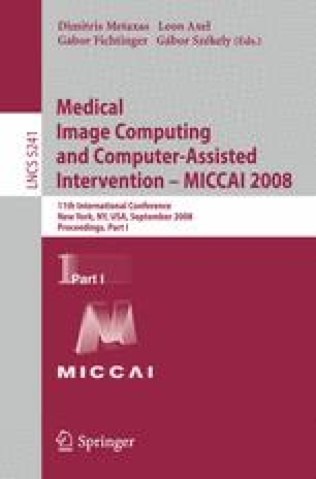
Medical Image Computing and Computer-Assisted Intervention - MICCAI 2008 ; 11th International Conference, New York, NY, USA, September 6-10, 2008, Proceedings, Part I
The program committee carefully selected 258 revised papers from numerous submissions for presentation in two volumes, based on rigorous peer reviews. The first volume includes 127 papers related to medical image computing, segmentation, shape and statistics analysis, modeling, motion tracking and compensation, as well as registration. The second volume contains 131 contributions related to robotics and interventions, statistical analysis, segmentation, intervention, modeling, and registration.

Medical Image Computing and Computer-Assisted Intervention – MICCAI 2006 ; Vol. 4191; 9th International Conference, Copenhagen, Denmark, October 1-6, 2006, Proceedings, Part II
T MICCAI papers are of high standard and have a long lifetime. In this v- ume as well as in the latest journal issues of Medical Image Analysis and IEEE Transactions on Medical Imaging papers cite previous MICCAIs including the ?rst MICCAI conference in Cambridge, Massachusetts, 1998. It is obvious that the community requires the MICCAI papers as archive material. Therefore the proceedingsofMICCAIarefrom2005andhenceforthbeing indexedbyMedline. Acarefulreviewandselectionprocesswasexecutedinordertosecurethebest possible program for the MICCAI 2006 conference. We received 578 scienti?c papers from which 39 papers were selected for the oral program and 193 papers for the poster program.

Medical Image Computing and Computer-Assisted Intervention – MICCAI 2006 ; Vol. 4190 ; 9th International Conference, Copenhagen, Denmark, October 1-6, 2006, Proceedings, Part I
MICCAI papers are of high standard and have a long lifetime. In this v- ume as well as in the latest journal issues of Medical Image Analysis and IEEE Transactions on Medical Imaging papers cite previous MICCAIs including the ?rst MICCAI conference in Cambridge, Massachusetts, 1998. It is obvious that the community requires the MICCAI papers as archive material. Therefore the proceedingsofMICCAIarefrom2005andhenceforthbeing indexedbyMedline. Acarefulreviewandselectionprocesswasexecutedinordertosecurethebest possible program for the MICCAI 2006 conference. We received 578 scienti?c papers from which 39 papers were selected for the oral program and 193 papers for the poster program.
Medical Image Computing and Computer-Assisted Intervention -- MICCAI 2005 ; 8th International Conference, Palm Springs, CA, USA, October 26-29, 2005, Proceedings, Part II
Robotics, Image-Guided Surgery and Interventions -- Image Registration II -- Medical Image Computing -- Atlases -- Shape I -- Structural and Functional Brain Analysis -- Model-Based Image Analysis -- Image-Guided Intervention: Simulation, Modeling and Display -- Simulation and Modeling II -- Medical Image Computing -- Shape II -- Image Segmentation and Analysis II -- Image Registration III --
Medical Image Computing and Computer-Assisted Intervention – MICCAI 2005 ; 8th International Conference, Palm Springs, CA, USA, October 26-29, 2005, Proceedings, Part I
This paper presents a method for classification of medical images, using machine learning and deformation-based morphometry. A morphological representation of the anatomy of interest is first obtained using highdimensional template warping, from which regions that display strong correlations between morphological measurements and the classification (clinical) variable are extracted using a watershed segmentation, taking into account the regional smoothness of the correlation map which is estimated by a crossvalidation strategy in order to achieve robustness to outliers. A Support Vector Machine-Recursive Feature Elimination (SVM-RFE) technique is then used to rank computed features from the extracted regions, according to their effect on the leave-one-out error bound. Finally, SVM classification is applied using the best set of features, and it is tested using leave-one-out. The results from a group of 61 brain images of female normal controls and schizophrenia patients demonstrate not only high classification accuracy (91.8%) and steep ROC curves, but also exceptional stability with respect to the number of selected features and the SVM kernel size

Medical data processing and analysis
Medical data can be defined as obtaining information from patients (such as signals, images, sounds, chemical components and their concentration, body temperature, respiratory rate, blood pressure, and different treatment measurements) to quantify the patient’s status and disease stage. Computer-aided diagnostic (CAD) systems use classical image processing, computer vision, machine learning, and deep learning methods for image analysis. Using image classification or segmentation algorithms, they find a region of interest (ROI) pointing to a specific location within the given image or an outcome of interest in the form of a label pointing to a diagnosis or prognosis. Computer science, with the evolution of artificial intelligence and machine learning techniques, facilitates the modeling and interpretation of results—from carrying out measurements to experiments and observations.

Max-Plus Linear Stochastic Systems and Perturbation Analysis
This book provides a thorough treatment of the theory of stochastic max-plus linear systems. Max-plus algebra is an algebraic approach to discrete event systems (DES), like queuing networks that are prone to synchronization. Perturbation analysis studies the sensitivity of the performance of DES with respect to changes in a particular system parameter.

Mathematics of Surfaces XI ; 11th IMA International Conference, Loughborough, UK, September 5-7, 2005, Proceedings
Constitutes the refereed proceedings of the 11th IMA International Conference on the Mathematics of Surfaces, held in Loughborough, UK in September 2005. Among the topics addressed are Voronoi diagrams, linear systems, curvatures on meshes, approximate parameterization, condition numbers, pythagorean hodographs, and more.

IP operations and management ; 7th IEEE International workshop, IPOM 2007 San José, USA, October 31 - November 2, 2007 Proceedings
This book constitutes the refereed proceedings of the 7th IEEE International Workshop on IP Operations and Management, IPOM 2007, held in the course of the 3rd International Week on Management of Networks and Services, Manweek 2007.

IoT and AI Technologies for Sustainable Living : A Practical Handbook
Brings together all the latest methodologies, tools and techniques related to the Internet of Things and Artificial Intelligence in a single volume to build insight into their use in sustainable living. The areas of application include agriculture, smart farming, healthcare, bioinformatics, self-diagnosis systems, body sensor networks, multimedia mining, and multimedia in forensics and security. Provides a comprehensive discussion of modeling and implementation in water resource optimization, recognizing pest patterns, traffic scheduling, web mining, cyber security and cyber forensics. It will help develop an understanding of the need for AI and IoT to have a sustainable era of human living. The tools covered include genetic algorithms, cloud computing, water resource management, web mining, machine learning, block chaining, learning algorithms, sentimental analysis and Natural Language Processing (NLP).
Introduction to Geometric Computing
The geometric ideas in computer science, mathematics, engineering, and physics have considerable overlap and students in each of these disciplines will eventually encounter geometric computing problems. The topic is traditionally taught in mathematics departments via geometry courses, and in computer science through computer graphics modules. This text isolates the fundamental topics affecting these disciplines and lies at the intersection of classical geometry and modern computing.

Introduction to blender 3.0 : Learn organic and architectural modeling, lighting, materials, painting, rendering, and compositing with blender
Explains modeling, materials, lighting, painting, and more with Blender and other external tools. You will configure a 3D architectural environment and set up the workflow of an art and design project within Blender. You will use Blender's main tools—mesh modeling and sculpting—to create virtual objects and environments. And, you will explore building materials and light scenes, followed by drawing and virtual painting. Chapters cover rendering scenes and transforming them into 2D images or videos. You will learn to use Blender 3.0 for video editing as a compositor and video sequence editor (VSE or sequencer) with a wide range of effects available through the nodal system. You Will Learn : Create objects and architectural buildings with different techniques of 3D modeling / Master creating an environment for your objects and how to light them / Determine how to create node materials and assign them to your Blender objects / Pick up UV unwrapping and texture painting / Get closer to painting and drawing in Blender / Render your scenes and create stunning videos

Introduction to Advanced System-on-Chip Test Design and Optimization
SOC test design and its optimization is the topic of Introduction to Advanced System-on-Chip Test Design and Optimization. It gives an introduction to testing, describes the problems related to SOC testing, discusses the modeling granularity and the implementation into EDA (electronic design automation) tools. The book is divided into three sections: i) test concepts, ii) SOC design for test, and iii) SOC test applications.

Intercultural Collaboration ; 1st International Workshop, IWIC 2007 Kyoto, Japan, January 25-26, 2007 Invited and Selected Papers
This book presents 29 revised invited and selected lectures given by top-researchers at the First International Workshop on Intercultural Collaboration, IWIC 2007, held in Kyoto, Japan in January 2007.

Interconnect-Centric Design for Advanced SoC and NoC
In Interconnect-centric Design for Advanced SoC and NoC, we have tried to create a comprehensive understanding about on-chip interconnect characteristics, design methodologies, layered views on different abstraction levels and finally about applying the interconnect-centric design in system-on-chip design.

Interactive systems. design, specification, and verification ; 15th International Workshop, DSV-IS 2008 Kingston, Canada, July 16-18, 2008 Revised Papers
This book constitutes the refereed proceedings of the 15th International Workshop on Design, Specification, and Verification of Interactive Systems, DSV-IS 2008, held in Kingston, Canada, in July 2008.The 21 revised full papers and 10 late breaking and experience report papers presented were carefully reviewed and selected from numerous submissions for inclusion in the book. The papers cover user interface evaluation and specification, with particular emphasis on the use of task models to provide high-level approaches for capturing the intended functionality of a user interface; examining techniques for modeling user interfaces, particularly for mobile and ubiquitous applications.

Interactive systems design, specification, and verification ; 13th International Workshop, DSVIS 2006, Dublin, Ireland, July 26-28, 2006, Revised Papers
This book constitutes the thoroughly refereed post-proceedings of the 13th International Workshop on Design, Specification, and Verification of Interactive Systems, DSVIS 2006, held in Dublin, Ireland in July 2006.
Interactive systems : Design specification, and verification ; 12th International Workshop, DSVIS 2005, Newcastle upon Tyne, UK, July 13-15, 2005, Revised Papers
This book constitutes the refereed post-proceedings of the 12th International Workshop on Design, Specification, and Verification of Interactive Systems, DSV-IS 2005. The 20 revised full papers, 1 keynote paper, and 4 summaries of group discussions are organized in topical sections on teams and groups, sketches and templates, away from the desktop, migration and mobility, analysis tools, model-based design processes and tools, and group discussions.
Interactive Curve Modeling : With Applications to Computer Graphics, Vision and Image Processing
Interactive curve modeling techniques and their applications are extremely useful in a number of academic and industrial settings, and specifically play a significant role in multidisciplinary problem solving, such as in font design, designing objects, CAD/CAM, medical operations, scientific data visualization, virtual reality, character recognition, and object recognition, etc. Various problems such as iris, fingerprint, and signature recognition, can also be intelligently solved and automated using curve techniques.
