



الصفحة 7
الصفحة 7

Information security applications ; 7th International Workshop, WISA 2006, Jeju Island, Korea, August 28-30, 2006, Revised Selected Papers
This book constitutes the thoroughly refereed post-proceedings of the 12th International Monterey Workshop on Networked Systems with special focus on realization of reliable systems on top of unreliable networked platforms, held in Laguna Beach, CA, USA, in September 2005.
Information security applications : Vol. 3325 : 5th International Workshop, WISA 2004, Jeju Island, Korea, August 23-25, 2004, Revised Selected Papers
The 5th International Workshop on Information Security Applications (WISA 2004) was held in Jeju Island, Korea during August 23-25, 2004. The workshop was sponsored by the Korea Institute of Information Security and Cryptology (KIISC), the Electronics and Telecommunications Research Institute (ETRI) and the Ministry of Information and Communication (MIC). The aim of the workshop is to serve as a forum for new conceptual and - perimental research results in the area of information security applications from the academic community as well as from the industry. The workshop program covers a wide range of security aspects including cryptography, cryptanalysis, network/system security and implementation aspects. The programcommittee received169 papersfrom 22 countries,andaccepted 37 papers for a full presentation track and 30 papers for a short presentation track. Each paper was carefully evaluated through peer-review by at least three members of the programcommittee. This volume contains revised versions of 36 papers accepted and presented in the full presentation track. Short papers were only published in the WISA 2004 pre-proceedings as preliminary versions and are allowed to be published elsewhere as extended versions. In addition to the contributed papers, Professors Gene Tsudik and Ross Andersongaveinvitedtalks,entitledSecurityinOutsourcedDatabasesandWhat does ‘Security’ mean for Ubiquitous Applications?, respectively.

Information Security ; Vol.3650 ; 8th International Conference, ISC 2005, Singapore, September 20-23, 2005, Proceedings
ISC 2005 brought together individuals from academia and - dustry involvedin manyresearchdisciplines of information security to foster the exchange of ideas. During recent years this conference has tried to place special emphasis on the practical aspects of information security, and since it passed from being an international workshop to being an international conference in 2001, it has become one of the most relevant forums at which researchers meet and discuss emerging security challenges and solutions. Advised by the ISC Steering Committee, and in order to provide students with more opportunities for publication, ISC 2005 accepted extra student papers - sides the regular papers. The initiative was very well accepted by the young sector of the scienti?c community, and we hope that the success of this idea will remainfornextISCevents. Another important factor for the success of ISC2005 was that selected papers in the proceedings will be invited for submission to a special issue of the International Journal of Information Security. The result was an incredible response to the call for papers; we received 271 submissions, the highest since ISC events started. It goes without saying that the paper selection process was more competitive and di?cult than ever before — only 33 regular papers were accepted, plus 5 student papers for a special student session.

Information Security ; Vol. 4176 ; 9th International Conference; ISC 2006, Samos Island, Greece, August 30 - September 2, 2006, Proceedings
th This volume contains the papers presented at the 9 Information Security Conference (ISC 2006) held on Samos Island, Greece, during August 30 – September 2, 2006. The Conference was organized by the University of the Aegean, Greece. ISC was first initiated as a workshop, ISW in Japan in 1997, ISW 1999 in Mal- sia, ISW 2000 in Australia and then changed to the current name ISC when it was held in Spain in 2001 (ISC 2001). The latest conferences were held in Brazil (ISC 2002), UK (ISC 2003), USA (ISC 2004), and Singapore (ISC 2005). ISC 2006 provided an international forum for sharing original research results and application experiences among specialists in fundamental and applied problems of - formation security. In response to the Call for Papers, 188 papers were submitted. Each paper was - viewed by three members of the PC, on the basis of their significance, novelty, and technical quality. Of the papers submitted, 38 were selected for presentation, with an acceptance rate of 20%.

Information Retrieval Technology ; Vol. 4182 ; 3rd Asia Information Retrieval Symposium, AIRS 2006, Singapore, October 16-18, 2006, Proceedings
Asia Information Retrieval Symposium (AIRS) 2006 was the third AIRS conf- ence in the series established in 2004.The ?rst AIRS washeld in Beijing, China, and the 2nd AIRS was held in Cheju, Korea. The AIRS conference series traces its roots to the successful Information Retrieval with Asian Languages (IRAL) workshop series which started in 1996. The AIRS series aims to bring together international researchers and dev- opers to exchange new ideas and the latest results in information retrieval. The scope of the conference encompassed the theory and practice of all aspects of information retrieval in text, audio, image, video, and multimedia data. Wearehappyto reportthatAIRS2006received148submissions,thehighest number since the conference series started in 2004. Submissions came from Asia and Australasia, Europe, and North America. We accepted 34 submissions as regular papers (23%) and 24 as poster papers (16%). We would like to thank all the authors who submitted papers to the conf- ence, the seven area chairs, who worked tirelessly to recruit the program c- mittee members and oversaw the review process, and the program committee members and their secondary reviewers who reviewed all the submissions.

Information Retrieval Technology ; Vol. 3689 ; 2nd Asia information retrieval symposium, AIRS 2005, Jeju Island, Korea, October 13-15, 2005, Proceedings
Asia Information Retrieval Symposium (AIRS) was established in 2004 by the Asian information retrieval community after the successful series of Information Retrieval with Asian Languages (IRAL) workshops held in six different locations in Asia, starting from 1996. The AIRS symposium aims to bring together international researchers and developers to exchange new ideas and the latest results in the field of information retrieval (IR). The scope of the symposium covers applications, systems, technologies and theoretical aspects of information retrieval in text, audio, image, video and multi-media data. We are very pleased to report that we saw a sharp and steady increase in the number of submissions and their qualities, compared with previous IRAL workshop series. We received 136 submissions from all over the world including Asia, North America, Europe, Australia, and even Africa, from which 32 papers (23%) were presented in oral sessions and 36 papers in poster sessions (26%). We also held a special session called “Digital Photo Albuming,” where 4 oral papers and 3 posters were presented. It was a great challenge and hard work for the program committee to select the best among the excellent papers. The high acceptance rates witness the success and stability of the AIRS series. All the papers and posters are included in this LNCS (Lecture Notes in Computer Science) proceedings volume, which is S- indexed. The technical program included two keynote talks by Prof. Walter Bender and Prof.
Information retrieval technology ; Vol. 3411 ; Asia information retrieval symposium, AIRS 2004, Beijing, China, October 18-20, 2004. Revised Selected Papers
TheAsiaInformationRetrievalSymposium(AIRS)wasestablishedbytheAsian information retrieval community after the successful series of Information - trieval with Asian Languages (IRAL) workshops held in six di?erent locations in Asia, starting from 1996. While the IRAL workshops had their focus on inf- mation retrieval problems involving Asian languages, AIRS covers a wider scope of applications, systems, technologies and theory aspects of information retrieval in text, audio, image, video and multimedia data. This extension of the scope re?ects and fosters increasing research activities in information retrieval in this region and the growing need for collaborations across subdisciplines. We are very pleased to report that we saw a sharp increase in the number of submissions and their quality, compared to the IRAL workshops. We received 106papersfromninecountriesinAsiaandNorthAmerica,fromwhich28papers (26%) were presented in oral sessions and 38 papers in poster sessions (36%). It was a great challenge for the Program Committee to select the best among the excellent papers. The low acceptance rates witness the success of this year’s conference. After a long discussion between the AIRS 2004 Steering Committee and Springer, the publisher agreed to publish our proceedings in the Lecture Notes in Computer Science (LNCS) series, which is SCI-indexed. We feel that this strongly attests to the excellent quality of the papers.

Information hiding ; Vol. 3727 ; 7th International workshop, IH 2005, Barcelona, Spain, June 6-8, 2005, Revised selected papers
Constitutes the refereed post-proceedings of the 7th International Workshop on Information Hiding, IH 2005, held in Barcelona, Spain in June 2005. This book features the papers that are organized in topical sections on anonymity, watermarking, theory, watermark attacks, steganography, hiding in unusual content, steganalysis, and fingerprinting.

Information Hiding ; 9th International Workshop, IH 2007, Saint Malo, France, June 11-13, 2007, Revised Selected Papers
This book constitutes the thoroughly refereed post-proceedings of the 9th International Workshop on Information Hiding, IH 2007, held in Saint Malo, France, in June 2007.
Information Hiding ; 8th International Workshop, IH 2006, Alexandria, VA, USA, July 10-12, 2006, Revised Seleceted Papers
This volume constitutes the refereed post-proceedings of the 8th International Workshop on Information Hiding held in Alexandria, Virginia, in July 2006.
Information hiding ; 6th International Workshop, IH 2004, Toronto, Canada, May 23-25, 2004, Revised selected papers
All papers were divided into eight sessions: digital media watermarking, steganalysis, digital forensics, steganography, software watermarking, security and privacy, anonymity, and data hiding in unusual content. This year, the workshop included a one-hour rump session that offered an opportunity to the delegates to share their work in progress and other brief but interesting contributions.

Information Hiding ; 10th International Workshop, IH 2008, Santa Barbara, CA, USA, May 19-21, 2008, Revised Selected Papers
This book constitutes the thoroughly refereed post-workshop proceedings of the 10th International Workshop on Information Hiding, IH 2008, held in Santa Barbara, CA, USA, in May 2008.The 25 revised full papers presented were carefully reviewed and selected from 64 submissions. The papers are organized in topical sections on anonymity and privacy, steganography, forensics, novel technologies and applications, watermarking, steganalysis, other hiding domains, network security, and fingerprinting.

Informatics Education - The Bridge between Using and Understanding Computers ; International Conference on Informatics in Secondary Schools - Evolution and Perspectives, ISSEP 2006, Vilnius, Lithuania, November 7-11, 2006, Proceedings
Although the school system is subject to specific national regulations, didactical issues warrant discussion on an international level. This applies specifically to informatics didactics. In contrast to most other scientific disciplines, informatics undergoes substantial technical and scientific changes and shifts of paradigms even at the basic level taught in secondary school. Moreover, informatics education is under more stringent observation from parents, potential employers, and policy makers than other disciplines. It is considered to be a modern discipline. Hence, being well-educated in informatics seemingly ensures good job perspectives. Further, policy makers pay attention to informatics education, hoping that a young population well-educated in this modern technology will contribute to the future wealth of the nation.
Inductive logic programming ; 15th International Conference, ILP 2005, Bonn, Germany, August 10-13, 2005, Proceedings
“Change is inevitable.” Embracing this quote we have tried to carefully exp- iment with the format of this conference, the 15th International Conference on Inductive Logic Programming, hopefully making it even better than it already was. But it will be up to you, the inquisitive reader of this book, to judge our success. The major changes comprised broadening the scope of the conference to include more diverse forms of non-propositional learning, to once again have tutorials on exciting new areas, and, for the ?rst time, to also have a discovery challenge as a platform for collaborative work. This year the conference was co-located with ICML 2005, the 22nd Inter- tional Conference on Machine Learning, and also in close proximity to IJCAI 2005, the 19th International Joint Conference on Arti?cial Intelligence. - location can be tricky, but we greatly bene?ted from the local support provided by Codrina Lauth, Michael May, and others. We were also able to invite all ILP and ICML participants to shared events including a poster session, an invited talk, and a tutorial about the exciting new area of “statistical relational lea- ing”. Two more invited talks were exclusively given to ILP participants and were presented as a kind of stock-taking—?ttingly so for the 15th event in a series—but also tried to provide a recipe for future endeavours.
Implementation of functional languages ; 15th International Workshop, IFL 2003, Edinburgh, UK, September 8-11, 2003. Revised Papers
This book constitutes the thoroughly refereed post-proceedings of the 15th International Workshop on the Implementation of Functional Languages, IFL 2003, held in Edinburgh, UK in September 2003. The 11 revised full papers presented were carefully selected during two rounds of reviewing and revision from 32 workshop presentations. The papers are organized in topical sections on language constructs and programming, static analysis and types, parallelism, and generic programming.
Implementation and Application of Functional Languages ; Vol. 4015 ; 17th International Workshop, IFL 2005, Dublin, Ireland, September 19-21, 2005, Revised Selected Papers
The 17th International Workshop on Implementation and Application of Functional Languages (IFL 2005) was held in Dublin, Ireland, September 19–21, 2005. It was organized by the Department of Computer Science at Trinity College, University of Dublin. IFL 2005 was the 17th event in the annual series of IFL workshops. The aim of the workshop series is to bring together researchers actively engaged in the implementation and application of functional and function-based programming languages. It provides an open forum for researchers who wish to present and discuss new ideas and concepts, work in progress, preliminary results, etc., related primarily, but not exclusively, to the implementation and application of functional languages. Topics of interest cover a wide range from theoretical aspects over language design and implementation towards applications and tool support.
Implementation and application of functional languages ; Vol. 3474 ; 16th International Workshop, IFL 2004, Lübeck, Germany, September 8-10, 2004, Revised Selected Papers
The 16th International Workshop on Implementation and Application of Fu- tional Languages (IFL 2004) was held in Lub ¨ eck, Germany, September 8–10, 2004. It was jointly organized by the Institute of Computer Science and Applied Mathematics of the University of Kiel and the Institute of Software Technology and Programming Languages of the University of Lub ¨ eck. IFL 2004 was the sixteenth event in the annual series of IFL workshops. The aim of the workshop series is to bring together researchers actively engaged in the implementation and application of functional and function-based progr- ming languages. It provides an open forum for researchers who wish to present and discuss new ideas and concepts, work in progress, preliminary results, etc., related primarily, but not exclusively, to the implementation and application of functional languages. Topics of interest cover a wide range from theoretical - pects over language design and implementation towards applications and tool support.

Implementation and Application of Functional Languages ; 19th International Workshop, IFL 2007, Freiburg, Germany, September 27-29, 2007. Revised Selected Papers
This book constitutes the thoroughly refereed post-proceedings of the 19th International Workshop on Implementation and Applications of Functional Languages, IFL 2007, held in Freiburg, Germany in September 2007.The 15 revised full papers presented went through two rounds of reviewing and improvement and were selected from 33 submissions. The papers address all current theoretical and methodological issues on functional and function-based languages such as type checking, contract checking, compilation, parallelism, development and debugging, data structures, parsing as well as various performance related concepts.
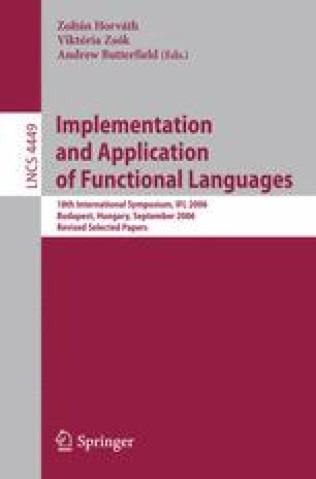
Implementation and application of functional languages ; 18th International Symposium, IFL 2006, Budapest, Hungary, September 4-6, 2006, Revised Selected Papers
This volume constitutes the post-proceedings of the 18th International Workshop on Implementation and Applications of Functional Languages. Each one was submitted to two rounds of reviews to ensure accuracy, thoroughness, and readability. The papers address all current theoretical and methodological issues in functional and function-based languages.

Image Analysis ; 14th Scandinavian Conference, SCIA 2005, Joensuu, Finland, June 19-22, 2005, Proceedings
This proceedings volume collects the scienti?c presentations of the Scandinavian Conference on Image Analysis, SCIA 2005, which was held at the University of Joensuu, Finland, June 19–22, 2005. The conference was the fourteenth in the series of biennial conferences started in 1980. The name of the series re?ects the fact that the conferences are organized in the Nordic (Scandinavian) countries, following the cycle Sweden, Finland, Denmark, and Norway. The event itself has always been international in its participants and presentations. Today there are many conferences in the ?elds related to SCIA. In this s- uation our goal is to keep up the reputation for the high quality and friendly environment of SCIA. We hope that participants feel that it’s worth attending the conference. Therefore, both the scienti?c and social program were designed to support the best features of a scienti?c meeting: to get new ideas for research and to have the possibility to exchange thoughts with fellow scientists.
