



الصفحة 7
الصفحة 7

Artificial intelligence and soft computing ; 19th International Conference, ICAISC 2020, Zakopane, Poland, October 12-14, 2020, Proceedings, Part I
The two-volume set LNCS 12415 and 12416 constitutes the refereed proceedings of of the 19th International Conference on Artificial Intelligence and Soft Computing, ICAISC 2020, held in Zakopane, Poland*, in October 2020. The 112 revised full papers presented were carefully reviewed and selected from 265 submissions. The papers included in the first volume are organized in the following six parts: neural networks and their applications; fuzzy systems and their applications; evolutionary algorithms and their applications; pattern classification; bioinformatics, biometrics and medical applications; artificial intelligence in modeling and simulation. The papers included in the second volume are organized in the following four parts: computer vision, image and speech analysis; data mining; various problems of artificial intelligence; agent systems, robotics and control.

Artificial intelligence and soft computing - ICAISC 2008 ; 9th International Conference Zakopane, Poland, June 22-26, 2008 Proceedings
This book constitutes the refereed proceedings of the 9th International Conference on Artificial Intelligence and Soft Computing, ICAISC 2008, held in Zakopane, Poland, in June 2008.
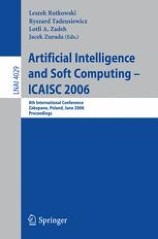
Artificial intelligence and soft computing – ICAISC 2006 ; 8th International Conference, Zakopane, Poland, June 25-29, 2006, Proceedings
This book constitutes the refereed proceedings of the 8th International Conference on Artificial Intelligence and Soft Computing, ICAISC 2006, held in Zakopane, Poland, in June 2006. The 128 revised contributed papers presented are organized in topical sections on neural networks and their applications, fuzzy systems and their applications, evolutionary algorithms and their applications, rough sets, classification and clustering, image analysis and robotics, bioinformatics and medical applications, various problems of artificial intelligence.

Artificial intelligence and neural networks ; 14th Turkish Symposium, TAINN 2005, Izmir, Turkey, June 16-17, 2005, Revised Selected Papers
The Turkish Artificial Intelligence and Neural Network Symposium (TAINN) is an annual meeting where scientists present their new ideas and algorithms on artificial intelligence and neural networks with either oral or poster presentation. The TAINN- Turkish Conference on AI and NN Series started in 1992 at Bilkent University in Ankara, envisioned by various researchers in AI and NN then at the Bilkent, Middle East Technical, Bo aziçi and Ege universities as a forum for local researchers to get together and communicate. Since then, TAINN has been held annually around early summer. This year the 14th TAINN conference was organized by the EE and CE departments of the zmir Institute of Technology with an emphasis on international contributions.

Artificial intelligence and innovations 2007 : from theory to applications ; Proceedings of the 4th IFIP International Conference on Artificial Intelligence Applications and Innovations (AIAI2007)
This book brings together leading research from engineers and practitioners interested in the technical advances, business and industrial applications of intelligent systems.It is focused on providing insights on how AI can be implemented in real world applications. Intelligent Internet Systems: Emerging Technologies and Applications

Artificial intelligence and data mining approaches in security frameworks
Offers solutions to the problems of security, outlining the concepts behind allowing computers to learn from experience and understand the world in terms of a hierarchy of concepts, with each concept defined through its relation to simpler concepts. provides state of the art approaches of artificial intelligence and data mining in these areas. It includes areas of detection, prediction, as well as future framework identification, development, building service systems and analytical aspects. In all these topics, applications of AI and data mining, such as artificial neural networks, fuzzy logic, genetic algorithm and hybrid mechanisms, are explained and explored. This book is aimed at the modeling and performance prediction of efficient security framework systems, bringing to light a new dimension in the theory and practice. This groundbreaking new volume presents these topics and trends, bridging the research gap on AI and data mining to enable wide-scale implementation. Whether for the veteran engineer or the student, this is a must-have for any library. This groundbreaking new volume: Clarifies the understanding of certain key mechanisms of technology helpful in the use of artificial intelligence and data mining in security frameworks ; Covers practical approaches to the problems engineers face in working in this field, focusing on the applications used every day ; Contains numerous examples, offering critical solutions to engineers and scientists ; Presents these new applications of AI and data mining that are of prime importance to human civilization as a whole

Applications of Fuzzy Sets Theory ; 7th International Workshop on Fuzzy Logic and Applications, WILF 2007, Camogli, Italy, July 7-10, 2007, Proceedings
The book is organized in topical sections on fuzzy set theory, fuzzy information access and retrieval, fuzzy machine learning, fuzzy architectures and systems; and special sessions on intuitionistic fuzzy sets and soft computing in image processing.

Applications of computational intelligence
Computational intelligence (CI) is the theory, design, application, and development of biologically and linguistically motivated computational paradigms. Traditionally, the three main pillars of CI have been neural networks, fuzzy systems, and evolutionary computation. However, in time, many nature-inspired computing paradigms have evolved. Thus, CI is an evolving field, and, at present, in addition to the three main constituents, it encompasses computing paradigms such as ambient intelligence, artificial life, cultural learning, artificial endocrine networks, social reasoning, and artificial hormone networks. CI plays a major role in developing successful intelligent systems, including games and cognitive developmental systems.

Applications and Theory of Petri Nets ; 29th International Conference, PETRI NETS 2008, Xi’an, China, June 23-27, 2008. Proceedings
This book constitutes the refereed proceedings of the 29th International Conference on Applications and Theory of Petri Nets and Other Models of Concurrency, PETRI NETS 2008, held in Xi'an, China, in June 2008.

Applications and Innovations in Intelligent Systems XIII ; Proceedings of AI-2005, the Twenty-fifth SGAI International Conference on Innovative Techniques and Applications of Artifical Intelligence
The papers in this volume present new and innovative developments in the field, divided into sections on Applied AI in Information Processing, Techniques for Applied AI, Industrial Applications and Medical Applications.This is the thirteenth volume in the Applications and Innovations series. The series serves as a key reference as to how AI technology has enabled organisations to solve complex problems and gain significant business benefit.

Application of power electronics converters in smart grids and renewable energy systems
Focuses on the applications of Power Electronics Converters in smart grids and renewable energy systems. The topics covered include methods to CO2 emission control, schemes for electric vehicle charging, reliable renewable energy forecasting methods, and various power electronics converters. The converters include the quasi neutral point clamped inverter, MPPT algorithms, the bidirectional DC-DC converter, and the push–pull converter with a fuzzy logic controller.

An introduction to ontology engineering
Provides the reader with a comprehensive introductory overview of ontology engineering. A secondary aim is to provide hands-on experience in ontology development that illustrate the theory. The book is divided into three blocks: Block I: logic foundations for ontologies both regarding the languages (mainly First Order predicate Logic, Description Logics, and OWL) and automated reasoning. Block II: developing good ontologies with methods and methodologies, the top-down approach with foundational ontologies, and the bottom-up approach to extract as much useful content as possible from legacy material. Block III: advanced topics with a selection of areas of specialisation, including Ontology-Based Data Access, the interaction between ontologies and natural languages (multilingual ontologies, controlled natural language), and advanced modelling with additional language features (fuzzy and temporal ontologies)

Algebraic and Proof-theoretic Aspects of Non-classical Logics : Papers in Honor of Daniele Mundici on the Occasion of His 60th Birthday
It profound connections between logic and such diverse fields of research as functional analysis, probability and measure theory, the geometry of toric varieties, piecewise linear geometry, and error-correcting codes. Several prominent logicians, mathematicians, and computer scientists

AI in banking : Practical applications and case studies
Delves into the application of AI from theory to practice, offering detailed insights into AI project design and code implementation across eleven business scenarios in four major sectors: retail banking, e-banking, bank credit, and tech operations. it provides hands-on examples of various technologies, including automatic machine learning, integrated learning, graph computation, recommendation systems, causal inference, generative adversarial networks, supervised learning, unsupervised learning, computer vision, reinforcement learning, fuzzy control, automatic control, speech recognition, semantic understanding, bayesian networks, edge computing, and more. this book stands as a rare and practical guide to AI projects in the banking industry.

Agents and peer-to-peer computing ; 2nd International workshop, AP2PC 2003, Melbourne, Australia, July 14, 2003, revised and invited papers
This book brings together an introduction, three invited articles, and revised versions of the papers presented at the Second International Workshop on Agents and Peer-to-Peer Computing, AP2PC 2003, held in Melbourne, Australia, July 2003."" "Peer-to-peer (P2P) computing is currently attracting enormous public attention, a very large number of autonomous computing nodes, the peers, rely on each other for services. P2P networks are emerging as a new distributed computing paradigm because of their potential to harness the computing power and the storage capacity of the hosts composing the network, and because they realize a completely open decentralized environment where everybody can join in autonomously.

Agent-mediated electronic commerce : automated negotiation and strategy design for electronic markets : AAMAS 2006 workshop, TADA/AMEC 2006, Hakodate, Japan, May 9, 2006 : selected and revised papers
The design and an alysis of trading agents and electronic trading systems in which they are deployed involve finding solutions to a diverse set of problems, invo- ing individual behaviors, interaction, and collective behavior in the context of trade. A wide variety of trading scenarios and systems, and agent approaches to these, have been studied in recent years. The AMEC series of wo- shops presents interdisciplinary researchon both theoretical and practical issues of agent-mediated electronic commerce ranging from the design of electronic marketplaces and e?cient protocols to behavioral aspects of agents operating in suchenvironments.

Agent and Multi-Agent Systems : Technologies and Applications ; 2nd KES International Symposium, KES-AMSTA 2008, Incheon, Korea, March 26-28, 2008. Proceedings
The KES-AMSTA Symposium Series is a sub-series of the KES Conference Series. The aim of the symposium was to provide an international forum for scientific research into the technologies and applications of agent and multi-agent systems.

Advances in neural networks -- ISNN 2007 ; 4th International symposium on neutral networks, ISNN 2007 Nanjing, China, June 3-7, 2007. Proceedings, Part II
An eural network is an information processing structure inspired by biological nervous systems, such as the brain. It consists of a large number of highly int- connected processing elements, called neurons. It has the capability of learning from example.

Advances in Neural Networks -- ISNN 2007 ; 4th International Symposium on Neutral Networks, ISNN 2007 Nanjing, China, June 3-7, 2007. Proceedings, Part I
An eural network is an information processing structure inspired by biological nervous systems, such as the brain. It consists of a large number of highly int- connected processing elements, called neurons. It has the capability of learning from example.

Advances in Neural Networks -- ISNN 2007 ; 4th International symposium on neural networks, ISNN 2007 Nanjing, China, June 3-7, 2007. Proceedings, Part III
An eural network is an information processing structure inspired by biological nervous systems, such as the brain. It consists of a large number of highly int- connected processing elements, called neurons. It has the capability of learning from example.
