



الصفحة 7
الصفحة 7

Intelleger = انتليجر
The project management system is a web application designed to assist software managers in efficiently managing their projects, including websites, mobile apps, and other software initiatives. Utilizing artificial intelligence, the application streamlines project creation and management processes, offering significant benefits in terms of organization and accuracy. Managers can create projects by inputting essential details such as the name, scope, deadline, and tasks. The system generates AI-based functional and non-functional requirements tailored to the project scope using gpt2 model on Pure dataset. Managers can then review and edit these requirements as needed before finalizing the project. The application facilitates comprehensive task management by allowing managers to assign tasks to developers, edit task details, and ensure task deadlines align with project deadlines. Developers can log their start and end times automatically when they begin and complete tasks, providing accurate time tracking and performance analysis.also they can use code generation model to generate their task’s code using codebert model on concode and codesearchnet dataset Real-time notifications keep both managers and developers informed of task assignments, completions, and other critical updates.
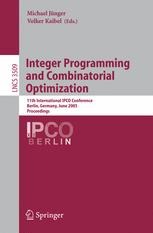
Integer Programming and Combinatorial Optimization ; 11th International IPCO Conference, Berlin, Germany, June 8-10, 2005, Proceedings
Since its start in 1990, the IPCO conference series (held under the auspices of theMathematicalProgrammingSociety)hasbecomeanimportantforumforthe presentation of recent results in Integer Programming and Combinatorial Op- mization. This volume compiles the papers presented at IPCO XI, the eleventh conference in this series, held June 8–10, 2005, at the Technische Universit¨ at Berlin. The high interest in this conference series is evident in the large number of submissions. For IPCO XI, 119 extended abstracts of up to 10 pages were submitted. During its meeting on January 29–30, 2005, the Program Committee carefully selected 34 contributions for presentation in non-parallel sessions at the conference. The ?nal choices were not easy at all, since, due to the limited number of time slots, many very good papers could not be accepted. During the selection process the contributions were refereed according to the standards of refereed conferences. As a result of this procedure, you have in your hands a volume that contains papers describing high-quality research e?orts. The page limit for contributions to this proceedings volume was set to 15. You may ?nd full versions of the papers in scienti?c journals in the near future. We thank all the authors who submitted papers. Furthermore, the Program Committee is indebted to the many reviewers who, with their speci?c expertise, helped a lot in making the decisions.

Instrumaster
Experiments with different neural network structures and algorithms in order to achieve musical note recognition as well as musical instrument recognition, all bundled in a mobile application. It also aims to create the most effective music-learning application that works completely offline, which is hard to find in modern music applications. The paper also explores why the instrument identifying AI is solely based on Multi-Layer Perceptron (MLP) and why the note-identifying AI system was chosen to be a ML system over CNN or other deep-learning trained AI. The paper presents feature extraction methods for audio signals and files and dives deep into the process, such as FFT, MFCCs, Wavelengths, sampling rates, etc. It also touches on Logistic Regression Algorithms, their limitations, and their performance with the different use cases in the application. All these techniques are then compared side by side for maximally added value, making this research paper a good reference for any future developers looking to find optimal neural networks techniques when it comes to audio processing and analysis.

Innovative Internet Community Systems ; Vol. 3473 ; 4th International Workshop, IICS 2004, Guadalajara, Mexico, June 21-23, 2004. Revised Papers
This book constitutes the thoroughly refereed postproceedings of the 4th International Workshop on Innovative Internet Community Systems, IICS 2004, held in Guadalajara, Mexico, in June 2004. The 25 revised full papers presented together with 2 invited papers have been carefully reviewed. They focus mainly on system-oriented problems, text processing, and theoretical foundations of distributed and Internet systems. They also deal with speed and quality-of-service problems of Internet protocols, aspects of cooperation and collaboration in Internet systems, as well as agent and text-processing-based methods. In addition, 9 papers stem from two mini-workshops, one on computational epidemiology and the other on optimization of urban traffic systems.

Innovative approaches for learning and knowledge sharing ; 1st European Conference on Technology Enhanced Learning, EC-TEL 2006, Crete, Greece, October 1-4, 2006, Proceedings
This book constitutes the refereed proceedings of the First European Conference on Technology Enhanced Learning, EiTEL 2006, held in Crete, Greece in October 2006. The 32 revised full papers, 13 revised short papers and 31 poster papers presented together with 2 keynote talks were carefully reviewed and selected from 192 submissions. The conference provides a unique forum for all research related to technology-enhanced learning, as well as its interactions with knowledge management, business processes and work environments. Topics addressed are collaborative learning, personalized learning, multimedia content, semantic web, metadata and learning, workplace learning, learning repositories and infrastructures for learning, as well as experience reports, assesment, and case studies.

Innovations in Applied Artificial Intelligence ; 18th International Conference on Industrial and Engineering Applications of Artificial Intelligence and Expert Systems, IEA/AIE 2005, Bari, Italy, June 22-24, 2005, Proceedings
The contributions oriented to the technological aspects of AI and the quality of the papers are witness to a research activity clearly aimed at consolidating the theoretical results that have already been achieved. The c- ference program also included two invited lectures, by Katharina Morik and Roberto Pieraccini. Many people contributed in different ways to the success of the conference and to this volume. The authors who continue to show their enthusiastic interest in applied intelligence research are a very important part of our success. We highly appreciate the contribution of the members of the Program Committee, as well as others who reviewed all the submitted papers with eficiency and dedication.

Infrastructure for Agents, Multi-Agent Systems, and Scalable Multi-Agent Systems ; International Workshop on Infrastructure for Scalable Multi-Agent Systems, Barcelona, Spain, June 3-7, 2000 Revised Papers
Building research grade multi-agent systems usually involves a broad variety of software infrastructure ingredients like planning, scheduling, coordination, communication, transport, simulation, and module integration technologies and as such constitutes a great challenge to the individual researcher active in the area. The book presents a collection of papers on approaches that will help make deployed and large scale multi-agent systems a reality. The first part focuses on available infrastructure and requirements for constructing research-grade agents and multi-agent systems. The second part deals with support in infrastructure and software development methods for multi-agent systems that can directly support coordination and management of large multi-agent communities; performance analysis and scalability techniques are needed to promote deployment of multi-agent systems to professionals in software engineering and information technology.

Informing Digital Futures : Strategies for Citizen Engagement
In the present digital revolution we often seem trapped in a Kafkaesque world of technological advances, some desired, some disliked or even feared, which we cannot influence but must accept. This book discusses the urgent need to redress this situation. The authors argue that technologies succeed or fail according to their relevance and value to people, who need to be actively engaged in order to create shared visions and influence their implementation. Strategies for citizen engagement and empowerment will enable citizens to influence and shape desirable digital futures. The book reviews the currently accepted ways of thinking about the design of systems and the reasons why these methods are no longer adequate. From an academically rigorous analysis of case histories across a wide variety of sectors, knowledge and best practice are captured in a rich, descriptive model of the contributions of citizen engagement to the design process. Finally, it provides specific practical guidance, based on sound academic research, for policy makers, administrators and ICT professionals on the strategies, methodologies, tools and techniques needed to change design practice.

Information technology and Lawyers : Advanced technology in the legal domain, from challenges to daily routine
The area of Information Technology & Lawyers is a fascinating one. Both from a practical and an academic perspective the opportunities of applying Information Technology to law are tremendous. At the same time, however, lawyers are amongst the most conservative professionals, and traditional late adapters of technology. Nowadays the gap between Information Technology & Lawyers is closing more and more, in particular due to the Internet and the richness of legal sources that can be found online. This book provides material to further bridge the gap by showing people with a legal background what is possible with Information Technology now and in the near future, as well as by showing people with an IT background what opportunities exist in the domain of law.
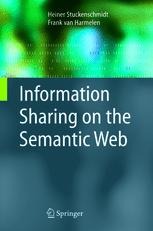
Information Sharing on the Semantic Web
The more information is available, the harder it is to locate any particular piece of it. And even when it has been successfully found, it is even harder still to usefully combine it with other information we may already possess. It is commonly understood that this problem of information sharing can only be solved by giving computers better access to the semantics of the information. While it has been recognized that ontologies play a crucial role in solving the open problems, most approaches rely on the existence of well-established data structures. To overcome these shortcomings, Stuckenschmidt and van Harmelen describe ontology-based approaches for resolving semantic heterogeneity in weakly structured environments, in particular the World Wide Web. Addressing problems like missing conceptual models, unclear system boundaries, and heterogeneous representations, they design a framework for ontology-based information sharing in weakly structured environments like the Semantic Web. For researchers and students in areas related to the Semantic Web, the authors provide not only a comprehensive overview of the State of the art, but also present in detail recent research in areas like ontology design for information integration, metadata generation and management, and representation and management of distributed ontologies. For professionals in areas such as e-commerce and knowledge management, the book provides decision support on the use of novel technologies, information about potential problems, and guidelines for the successful application of existing technologies.

Information Security Handbook
Provides a comprehensive collection of knowledge for emerging multidisciplinary research areas such as cybersecurity, IoT, Blockchain, Machine Learning, Data Science, and AI. This book brings together, in one resource, information security across multiple domains. It explores basic and high-level concepts and serves as a manual for industry while also helping beginners to understand both basic and advanced aspects in security-related issues. The handbook explores security and privacy issues through the IoT ecosystem and implications to the real world and, at the same time, explains the concepts of IoT-related technologies, trends, and future directions.

Information Security ; Vol.3650 ; 8th International Conference, ISC 2005, Singapore, September 20-23, 2005, Proceedings
ISC 2005 brought together individuals from academia and - dustry involvedin manyresearchdisciplines of information security to foster the exchange of ideas. During recent years this conference has tried to place special emphasis on the practical aspects of information security, and since it passed from being an international workshop to being an international conference in 2001, it has become one of the most relevant forums at which researchers meet and discuss emerging security challenges and solutions. Advised by the ISC Steering Committee, and in order to provide students with more opportunities for publication, ISC 2005 accepted extra student papers - sides the regular papers. The initiative was very well accepted by the young sector of the scienti?c community, and we hope that the success of this idea will remainfornextISCevents. Another important factor for the success of ISC2005 was that selected papers in the proceedings will be invited for submission to a special issue of the International Journal of Information Security. The result was an incredible response to the call for papers; we received 271 submissions, the highest since ISC events started. It goes without saying that the paper selection process was more competitive and di?cult than ever before — only 33 regular papers were accepted, plus 5 student papers for a special student session.
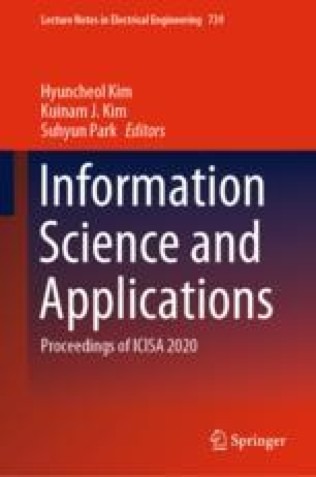
Information Science and Applications ; Proceedings of ICISA 2020
This book presents select proceedings of 11th International Conference on Information Science and Applications 2020 (ICISA 2020) and provides a snapshot of the latest issues encountered in technical convergence and convergences of security technology. It explores how information science is core to most current research, industrial and commercial activities and consists of contributions covering topics including Ubiquitous Computing, Networks and Information Systems, Multimedia and Visualization, Middleware and Operating Systems, Security and Privacy, Data Mining and Artificial Intelligence, Software Engineering, and Web Technology. Also the proceedings introduce the most recent information technology and ideas, applications and problems related to technology convergence, illustrated through case studies, and reviews converging existing security techniques. Through this book, readers can gain an understanding of the current state-of-the-art information strategies and technologies of convergence security.

Information Retrieval Technology ; Vol. 3689 ; 2nd Asia information retrieval symposium, AIRS 2005, Jeju Island, Korea, October 13-15, 2005, Proceedings
Asia Information Retrieval Symposium (AIRS) was established in 2004 by the Asian information retrieval community after the successful series of Information Retrieval with Asian Languages (IRAL) workshops held in six different locations in Asia, starting from 1996. The AIRS symposium aims to bring together international researchers and developers to exchange new ideas and the latest results in the field of information retrieval (IR). The scope of the symposium covers applications, systems, technologies and theoretical aspects of information retrieval in text, audio, image, video and multi-media data. We are very pleased to report that we saw a sharp and steady increase in the number of submissions and their qualities, compared with previous IRAL workshop series. We received 136 submissions from all over the world including Asia, North America, Europe, Australia, and even Africa, from which 32 papers (23%) were presented in oral sessions and 36 papers in poster sessions (26%). We also held a special session called “Digital Photo Albuming,” where 4 oral papers and 3 posters were presented. It was a great challenge and hard work for the program committee to select the best among the excellent papers. The high acceptance rates witness the success and stability of the AIRS series. All the papers and posters are included in this LNCS (Lecture Notes in Computer Science) proceedings volume, which is S- indexed. The technical program included two keynote talks by Prof. Walter Bender and Prof.

Information retrieval technology ; Vol. 3411 ; Asia information retrieval symposium, AIRS 2004, Beijing, China, October 18-20, 2004. Revised Selected Papers
TheAsiaInformationRetrievalSymposium(AIRS)wasestablishedbytheAsian information retrieval community after the successful series of Information - trieval with Asian Languages (IRAL) workshops held in six di?erent locations in Asia, starting from 1996. While the IRAL workshops had their focus on inf- mation retrieval problems involving Asian languages, AIRS covers a wider scope of applications, systems, technologies and theory aspects of information retrieval in text, audio, image, video and multimedia data. This extension of the scope re?ects and fosters increasing research activities in information retrieval in this region and the growing need for collaborations across subdisciplines. We are very pleased to report that we saw a sharp increase in the number of submissions and their quality, compared to the IRAL workshops. We received 106papersfromninecountriesinAsiaandNorthAmerica,fromwhich28papers (26%) were presented in oral sessions and 38 papers in poster sessions (36%). It was a great challenge for the Program Committee to select the best among the excellent papers. The low acceptance rates witness the success of this year’s conference. After a long discussion between the AIRS 2004 Steering Committee and Springer, the publisher agreed to publish our proceedings in the Lecture Notes in Computer Science (LNCS) series, which is SCI-indexed. We feel that this strongly attests to the excellent quality of the papers.

Information Processing and Security Systems
Information Processing and Security Systems is a collection of forty papers that were originally presented at an international multi-conference on Advanced Computer Systems (ACS) and Computer Information Systems and Industrial Management Applications (CISIM) held in Elk, Poland. This volume describes the latest developments in advanced computer systems and their applications within artificial intelligence, biometrics and information technology security. The volume also includes contributions on computational methods, algorithms and applications, computational science, education and industrial management applications.

Information extraction : Algorithms and prospects in a retrieval context
The book focuses on content recognition in text. It elaborates on the past and current most successful algorithms and their application in a variety of domains (e.g., news filtering, mining of biomedical text, intelligence gathering, competitive intelligence, legal information searching, and processing of informal text). An important part discusses current statistical and machine learning algorithms for information detection and classification and integrates their results in probabilistic retrieval models. The book also reveals a number of ideas towards an advanced understanding and synthesis of textual content.

Information assurance : Security in the information environment
This updated edition of Information Assurance: Security in the Information Environment was written to help IT managers and assets protection professionals to assure the protection and availability of vital digital information and related information systems assets. This Second Edition of Information Assurance includes major updates, including three new chapters • The Role of Policy in Information Assurance • Incident Management and Response • Security Standards Bridging the gap between information security, information systems security and information warfare, this edition re-examines and explains why organisations need to take information assurance seriously, and discusses the business, legal, and technical knowledge needed to secure these vital government and business assets.

Information and Communication Technology for Intelligent Systems ; Proceedings of ICTIS 2020, Vol.2
This book gathers papers addressing state-of-the-art research in all areas of information and communication technologies and their applications in intelligent computing, cloud storage, data mining and software analysis. It presents the outcomes of the Fourth International Conference on Information and Communication Technology for Intelligent Systems, which was held in Ahmedabad, India. Divided into two volumes, the book discusses the fundamentals of various data analysis techniques and algorithms, making it a valuable resource for researchers and practitioners alike.

Information and Communication Technology for Intelligent Systems ; Proceedings of ICTIS 2020, Vol.1
This book gathers papers addressing state-of-the-art research in all areas of information and communication technologies and their applications in intelligent computing, cloud storage, data mining and software analysis. It presents the outcomes of the Fourth International Conference on Information and Communication Technology for Intelligent Systems, which was held in Ahmedabad, India. Divided into two volumes, the book discusses the fundamentals of various data analysis techniques and algorithms, making it a valuable resource for researchers and practitioners alike.
