



الصفحة 67
الصفحة 67
Dissemination of Information in Optical Networks : From Technology to Algorithms In Cooperation with Ralf Klasing
This book gives a broad overview of techniques used in the design of WDM networks for efficient dissemination of information in computer networks.
Dissemination of information in communication networks : Broadcasting, gossiping, leader election, and fault-tolerance
Preface Due to the development of hardware technologies (such as VLSI) in the early 1980s, the interest in parallel and distributive computing has been rapidly growingandinthelate1980sthestudyofparallelalgorithmsandarchitectures became one of the main topics in computer science. To bring the topic to educatorsandstudents,severalbooksonparallelcomputingwerewritten. The involvedtextbook“IntroductiontoParallelAlgorithmsandArchitectures”by F. Thomson Leighton in 1992 was one of the milestones in the development of parallel architectures and parallel algorithms. But in the last decade or so the main interest in parallel and distributive computing moved from the design of parallel algorithms and expensive parallel computers to the new distributive reality – the world of interconnected computers that cooperate (often asynchronously) in order to solve di?erent tasks.

Discrete, continuous, and hybrid Petri Nets
The book is a scientific monograph as well as a didactic tutorial which is easy to understand due to many exercises with solutions, detailed figures and several case studies. It demonstrates that Petri nets are a deep, practical and alive field important for researchers, engineers and graduate students in engineering and computer science.

Discrete Mathematics Using a Computer
Discrete Mathematics Using a Computer offers a new, "hands-on" approach to teaching Discrete Mathematics. Using software that is freely available on Mac, PC and Unix platforms, the functional language Haskell allows students to experiment with mathematical notations and concepts -- a practical approach that provides students with instant feedback and allows lecturers to monitor progress easily.

Discrete Geometry, Combinatorics and Graph Theory ; 7th China-Japan Conference, CJCDGCGT 2005, Tianjin, China, November 18-20, 2005, and Xi'an, China, November 22-24, 2005, Revised Selected Papers
Theis book includes discrete algorithmic geometry, combinatorics and graph theory

Discrete Geometry for Computer Imagery Vol. 4245 ; 13th International Conference, DGCI 2006, Szeged, Hungary, October 25-27, 2006, Proceedings
This book constitutes the refereed proceedings of the 13th International Conference on Discrete Geometry for Computer Imagery, DGCI 2006, held in Szeged, Hungary in October 2006. The 28 revised full papers and 27 revised poster papers presented together with two invited papers were carefully reviewed and selected from 99 submissions.

Discrete geometry for computer imagery ; Vol. 3429 ; 12th International Conference, DGCI 2005, Poitiers, France, April 11-13, 2005, Proceedings
This book constitutes the refereed proceedings of the 12th International Conference on Discrete Geometry for Computer Imagery, DGCI 2005, held in Poitiers, France in April 2005. The 36 revised full papers presented together with an invited paper were carefully reviewed and selected from 53 submissions. The papers are organized in topical sections on applications, discrete hierarchical geometry, discrete tomography, discrete topology, object properties, reconstruction and recognition, uncertain geometry, and visualization.

Discrete Geometry for Computer Imagery ; 14th IAPR International Conference, DGCI 2008, Lyon, France, April 16-18, 2008. Proceedings
This book constitutes the refereed proceedings of the 14th IAPR TC-18 International Conference on Discrete Geometry for Computer Imagery, DGCI 2008, held in Lyon, France, in April 2008.

Discrete and computational geometry; Japanese Conference, JCDCG 2004, Tokyo, Japan, October 8-11, 2004
This book constitutes the thoroughly refereed post-proceedings of the Japanese Conference on Discrete Computational Geometry, JCDCG 2004, held in Tokyo, Japan in October 2004, to honor Janos Pach on his fiftieth year. The 20 revised full papers presented were carefully selected during two rounds of reviewing and improvement from over 60 talks at the conference. All current issues in discrete algorithmic geometry are addressed.

Discovery Science ; Vol. 4265 ; 9th International Conference, DS 2006, Barcelona, Spain, October 7-10, 2006, Proceedings
This LNAI volume, containing the proceedings of the 9th International C- ference onDiscoveryScience, is structured in three parts. The ?rstpart contains the papers/abstracts of the invited talks, the second part contains the accepted long papers, and the third part the accepted regular (short) papers. Out of 87 submitted papers, 23 were accepted for publication as long papers, and 18 as regular papers. All the submitted papers were reviewed by two or three ref- ees. In addition to the presentations of accepted papers, the DS 2006 conference program consisted of three invited talks, two tutorials, the collocated ALT 2006 conference and the Pascal Dialogues workshop.

Discovery science ; Vol. 3735 ; 8th International Conference, DS 2005, Singapore, October 8-11, 2005, Proceedings
This book constitutes the refereed proceedings of the 8th International Conference on Discovery Science, DS 2005, held in Singapore in October 2005, co-located with the International Conference on Algorithmic Learning Theory (ALT 2005). The 21 revised long papers and the 6 revised regular papers presented together with 9 project reports and 5 invited papers were carefully reviewed and selected from 112 submissions. The papers cover all issues in the area of automating scientific discovery or working on tools for supporting the human process of discovery in science.

Discovery Science ; 11th International Conference, DS 2008, Budapest, Hungary, October 13-16, 2008. Proceedings
This book constitutes the refereed proceedings of the 11th International Conference on Discovery Science, DS 2008, held in Budapest, Hungary, in October 2008, co-located with the 19th International Conference on Algorithmic Learning Theory, ALT 2008.

Discovery Science ; 10th International Conference, DS 2007 Sendai, Japan, October 1-4, 2007. Proceedings
This volume consists of three parts. The first part contains the papers/abstracts of the invited talks, the second part contains the accepted long papers, and the third part contains the accepted regular papers.

Direct Transistor-level Layout for Digital Blocks
The essential flaw in prior efforts is an over-reliance on geometric assumptions from large-scale cell-based layout algorithms. Individual transistors may seem simple, but they do not pack as gates do. Algorithms that ignore these shape-level issues suffer the consequences when thousands of devices are poorly packed. The approach described in this book can pack devices much more densely than a typical cell-based layout

Direct and inverse Sturm-Liouville problems : A method of solution
This book provides an introduction to the most recent developments in the theory and practice of direct and inverse Sturm-Liouville problems on finite and infinite intervals. A universal approach for practical solving of direct and inverse spectral and scattering problems is presented, based on the notion of transmutation (transformation) operators and their efficient construction. Analytical representations for solutions of Sturm-Liouville equations as well as for the integral kernels of the transmutation operators are derived in the form of functional series revealing interesting special features and lending themselves to direct and simple numerical solution of a wide variety of problems.
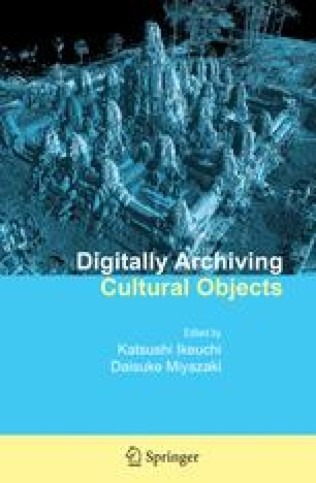
Digitally Archiving Cultural Objects
Digitally Archiving Cultural Objects describes thorough research and methods for preserving cultural heritage objects through the use of 3D digital data. These methods were developed through using computer vision and computer graphics technologies.

Digital watermarking ; Vol. 4283 ; 5th International Workshop, IWDW 2006, Jeju Island, Korea, November 8-10, 2006, Proceedings
IWDW 2006 was held on Jeju, the dream island in Korea. The main theme of the workshop was “Meet the Challenges in this Digital World!” As we all know, digital watermarking and its related technologies have emerged as the key ingredients of this digital world. We report on new developments and discuss how to best utilize the watermarking and its related new technologies to cope with many challenging issues in this digital world.

Digital Watermarking ; Vol. 3710 ; 4th International Workshop, IWDW 2005, Siena, Italy, September 15-17, 2005, Proceedings
We are delighted to welcome the attendees of the Fourth International Wo- shop on Digital Watermarking (IWDW). Watermarking continues to generate strong academic interest. Commercialization of the technology is proceeding at a steadypace. We haveseen watermarkingadoptedfor DVD audio.Fingerpri- ing technology was successfully used to determine the source of pirated video material. Furthermore, a number of companies are using watermarking as an enabling technology for broadcast monitoring services. Watermarking of digital cinema contentis anticipated. Future applications may also come from areas- related to digital rights management. For example, the use of watermarking to enhance legacy broadcast and communication systems is now being considered. IWDW 2005 o?ers an opportunity to re?ect upon the state of the art in digital watermarking as well as discuss directions for future research and applications. This year we accepted 31 papers from 74 submissions. This 42% acceptance rate indicates our commitment to ensuring a very high quality conference.

Digital watermarking ; Vol. 3304 ; 3rd International Workshop, IWDW 2004, Seoul, Korea, October 30 - November 1, 2004, revised selected papers
We are happy to present to you the proceedings of the 3rd International Workshop on Digital Watermarking, IWDW 2004. Since its modern reappearance in the academic community in the early 1990s, great progress has been made in understanding both the capabilities and the weaknesses of digital watermarking. On the theoretical side, we all are now well aware of the fact that digital watermarking is best viewed as a form of communication using side information. In the case of digital watermarking the side information in question is the document to be watermarked. This insight has led to a better understanding of the limits of the capacity and robustness of digital watermarking algorithms. It has also led to new and improved watermarking algorithms, both in terms of capacity and imperceptibility. Similarly, the role of human perception, and models thereof, has been greatly enhanced in the study and design of digital watermarking algorithms and systems. On the practical side, applications of watermarking are not yet abundant. The original euphoria on the role of digital watermarking in copy protection and copyright protection has not resulted in widespread use in practical systems. With hindsight, a number of reasons can be given for this lack of practical applications.

Digital watermarking ; 6th International Workshop, IWDW 2007 Guangzhou, China, December 3-5, 2007 Proceedings
This book constitutes the refereed proceedings of the 6th International Workshop, IWDW 2007, held in Guangzhou, China, in December 2007.
