



الصفحة 62
الصفحة 62
Computable Models of the Law : Languages, Dialogues, Games, Ontologies
This book originate from a workshop held at the European University Institute of Florence, Italy, in December 2006. The workshop was devoted to the discussion of the different ways of understanding and explaining contemporary law, for the purpose of building computable models of it -- especially models enabling the development of computer applications for the legal domain.

Comprehensive mathematics for computer scientists 1 : Sets and numbers, graphs and algebra, logic and machines, linear geometry
This two-volume textbook Comprehensive Mathematics for Computer Scientists is a self-contained comprehensive presentation of mathematics including sets, numbers, graphs, algebra, logic, grammars, machines, linear geometry, calculus, ODEs, and special themes such as neural networks, Fourier theory, wavelets, numerical issues, statistics, categories, and manifolds. The concept framework is streamlined but defining and proving virtually everything.

Composition of embedded systems : Scientific and industrial issues ; 13th Monterey Workshop 2006 Paris, France, October 16-18, 2006 Revised Selected Papers
This book discussed a range of challenges in embedded systems design that require further major advances in software and systems composition technology. The papers are organized in topical sections on model driven develo.
Component-Based Software Testing with UML
Component-based software development regards software construction in terms of conventional engineering disciplines where the assembly of systems from readily-available prefabricated parts is the norm. Because both component-based systems themselves and the stakeholders in component-based development projects are different from traditional software systems, component-based testing also needs to deviate from traditional software testing approaches. Gross first describes the specific challenges related to component-based testing like the lack of internal knowledge of a component or the usage of a component in diverse contexts. He argues that only built-in contract testing, a test organization for component-based applications founded on building test artifacts directly into components, can prevent catastrophic failures like the one that caused the now famous ARIANE 5 crash in 1996. This book is the first comprehensive treatment of the intricacies of testing component-based software systems. With its strong modeling background, it appeals to researchers and graduate students specializing in component-based software engineering. Professionals architecting and developing component-based systems will profit from the UML-based methodology and the implementation hints based on the XUnit and JUnit frameworks.

Component-based software engineering ; Vol. 3489 ; 8th International Symposium, CBSE 2005, St. Louis, MO, USA, May 14-15, 2005
this book present the proceedings of the 2005 Symposium on Component-Based Software Engineering (CBSE). CBSE is concerned with the development of software-intensive systems from reusable parts (components), the development of reusable parts, and system maintenance and improvement by means of component replacement and c- tomization. CBSE 2005, “Software Components at Work,” was the eighth in a series of events that promote a science and technology foundation for achieving predictable quality in software systems through the use of software component technology and its associated software engineering practices.

Component-based software engineering ; 11th International Symposium, CBSE 2008, Karlsruhe, Germany, October 14-17, 2008. Proceedings
This book constitutes the refereed proceedings of the 11th International ACM SIGSOFT Symposium on Component-Based Software Engineering, CBSE 2008, held in Karlsruhe, Germany in October 2008.

Component-based software engineering ; 10th International Symposium, CBSE 2007, Medford, MA, USA, July 9-11, 2007, Proceedings
Providing all the latest on a topic of extreme commercial relevance, this book contains new trends in global software services and distributed systems architectures to push the limits of established and tested component-based methods, tools and platforms.

Component models and systems for grid applications ; Proceedings of the Workshop on Component Models and Systems for Grid Applications held June 26, 2004 in Saint Malo, France.
This first volume of the CoreGRID series addresses such vital issues as the architecture of the Grid, the way software will influence the development of the Grid, and the practical applications of Grid technologies for individuals and businesses alike. Part I of the book, Application-Oriented Designs, focuses on development methodology and how it may contribute to a more component-based use of the Grid. Middleware Architecture, the second part, examines portable Grid engines, hierarchical infrastructures, interoperability, as well as workflow modeling environments. The final part of the book, Communication Frameworks, looks at dynamic self-adaptation, collective operations, and higher-order components. With Component Models and Systems for Grid Applications, editors Vladimir Getov and Thilo Kielmann offer the computing professional and the computing researcher the most informative, up-to-date, and forward-looking thoughts on the fast-growing field of Grid studies.
Complexity Theory and Cryptology : An Introduction to Cryptocomplexity
Modern cryptology employs mathematically rigorous concepts and methods from complexity theory. Conversely, current research in complexity theory often is motivated by questions and problems arising in cryptology. This book takes account of this trend, and therefore its subject is what may be dubbed "cryptocomplexity,'' some sort of symbiosis of these two areas. This textbook is suitable for undergraduate and graduate students of computer science, mathematics, and engineering, and can be used for courses on complexity theory and cryptology, preferably by stressing their interrelation. Starting from scratch, it is an accessible introduction to cryptocomplexity and works its way to the frontiers of current research. It provides the necessary mathematical background, has numerous figures, exercises, and examples, and presents some central, up-to-date research topics and challenges. Due to its comprehensive bibliography and subject index, it is also a valuable source for researchers, teachers, and practitioners working in these fields.
Complexity Theory : Exploring the Limits of Efficient Algorithms
Complexity theory is the theory of determining the necessary resources for the solution of algorithmic problems and, therefore, the limits of what is possible with the available resources. An understanding of these limits prevents the search for non-existing efficient algorithms. This textbook considers randomization as a key concept and emphasizes the interplay between theory and practice: New branches of complexity theory continue to arise in response to new algorithmic concepts, and its results - such as the theory of NP-completeness - have influenced the development of all areas of computer science. The topics selected have implications for concrete applications, and the significance of complexity theory for today's computer science is stressed throughout.

Complex, Intelligent, and Software Intensive Systems ; Proceedings of the 13th International Conference on Complex, Intelligent, and Software Intensive Systems (CISIS-2019)
This book presents scientific interactions between the three interwoven and challenging areas of research and development of future ICT-enabled applications: software, complex systems and intelligent systems.
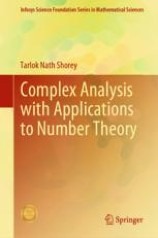
Complex Analysis with Applications to Number Theory
The book discusses major topics in complex analysis with applications to number theory.It 's including the theory of several finitely and infinitely complex variables, hyperbolic geometry, two- and three-manifolds, and number theory. In addition to solved examples and problems, the book covers most topics of current interest, such as Cauchy theorems, Picard’s theorems, Riemann–Zeta function, Dirichlet theorem, Gamma function, and harmonic functions.
Compilers : Principles, techniques, and tools
This introduction to compilers is the direct descendant of the well-known book by Aho and Ullman, Principles of Compiler Design. The authors present updated coverage of compilers based on research and techniques that have been developed in the field over the past few years. The book provides a thorough introduction to compiler design and covers topics such as context-free grammars, fine state machines, and syntax-directed translation.
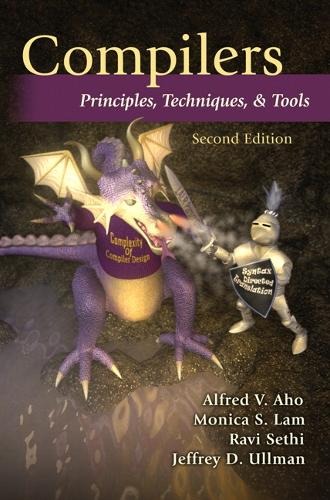
Compilers : Principles, techniques & tools
This introduction to compilers is the direct descendant of the well-known book by Aho and Ullman, Principles of Compiler Design. The authors present updated coverage of compilers based on research and techniques that have been developed in the field over the past few years. The book provides a thorough introduction to compiler design and covers topics such as context-free grammars, fine state machines, and syntax-directed translation.

Compiler construction ; Vol. 3443 : 14th International Conference, CC 2005, Held as Part of the Joint European Conferences on Theory and Practice of Software, ETAPS 2005, Edinburgh, UK, April 4-8, 2005. Proceedings
"This book constitutes the refereed proceedings of 14th International Conference, CC 2005, Held as Part of the Joint European Conferences on Theory and Practice of Software, ETAPS 2005, including Topics Programming Languages, Compilers, Interpreters Logics and Meanings of Programs / Mathematical Logic and Formal Languages / Software Engineering / Artificial Intelligence"
Compiler construction ; 17th International Conference, CC 2008, Held as Part of the Joint European Conferences on Theory and Practice of Software, ETAPS 2008, Budapest, Hungary, March 29 - April 6, 2008. Proceedings
This book constitutes the proceedings of the 17th International Conference on Compiler Construction, CC 2008. It covers analysis and transformations, compiling for parallel architectures, runtime techniques and tools, analyses, and atomicity and transactions.

Compiler construction ; 16th International Conference, CC 2007, Held as Part of the Joint European Conferences on Theory and Practice of Software, ETAPS 2007, Braga, Portugal, March 26-30, 2007, Proceedings
This book covered Theory and Practice of Software. The sections includes architecture, garbage collection and program analysis, register allocation, and program analysis.

Comparative genomics ; Vol. 3678 : RECOMB 2005 International Workshop, RCG 2005, Dublin, Ireland, September 18-20, 2005, Proceedings
This book constitutes the refereed proceedings of the RECOMB 2005 Satellite Workshop, the 3rd RECOMB Comparative Genomics meeting RCG 2005, held in Dublin, Ireland in September 2005. The 14 revised full papers presented were carefully reviewed and selected from 21 initial submissions. The papers address a broad variety of aspects and components of the field of comparative genomics, ranging from new quantitative discoveries about genome structure and process to theorems on the complexity of computational problems inspired by genome comparison.

Comparative genomics ; RECOMB 2007, International Workshop, RECOMB-CG 2007, San Diego, CA, USA, September 16-18, 2007, Proceedings
This book provides an evolutionary conceptual framework for comparative genomics, with the ultimate objective of understanding the loss and gain of genes during evolution, the interactions among gene products, and the relationship between genotype, phenotype and the environment. The many examples in the book have been carefully chosen from primary research literature based on two criteria: their biological insight and their pedagogical merit. The phylogeny-based comparative methods, involving both continuous and discrete variables, often represent a stumbling block for many students entering the field of comparative genomics. They are numerically illustrated and explained in great detail.
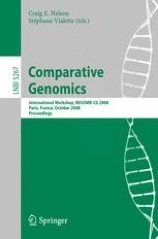
Comparative genomics ; International Workshop, RECOMB-CG 2008, Paris, France, October 13-15, 2008. Proceedings
This book constitutes the refereed proceedings of the 6th RECOMB Comparative Genomics Satellite Workshop, RECOMB-CG 2008, held in Paris, France, in October 2008.
