



الصفحة 6
الصفحة 6
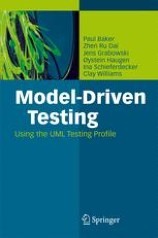
Model-Driven Testing : Using the UML Testing Profile
Written by the original members of this standardization group, this book shows you how to use UML to test complex software systems. The authors introduce UTP step-by-step, using a case study that illustrates how UTP can be used for test modeling and test specification. You’ll learn how UTP concepts can be used for functional and non-functional testing, with example applications and best practices for user-interfaces and service oriented architectures. In addition, the authors demonstrate how to apply UTP using frameworks like TTCN-3 and the JUnit test framework for Java.
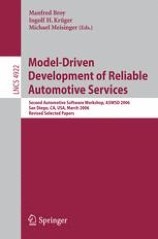
Model-Driven Development of Reliable Automotive Services ; 2nd Automotive Software Workshop, ASWSD 2006, San Diego, CA, USA, March 15-17, 2006, Revised Selected Papers
This book constitutes the thoroughly refereed post-workshop proceedings of the Second Automotive Software Workshop, ASWSD 2006, held in San Diego, CA, USA in March 2006.The 11 revised full papers presented were carefully reviewed and selected from 18 lectures held at the workshop, that brought together experts from industry and academia, working on highly complex, distributed, reactive software systems related to the automotive domain. The papers are organized in topical sections on modeling techniques and infrastructures, model transformations, quality assurance, real-time control, as well as services and components.
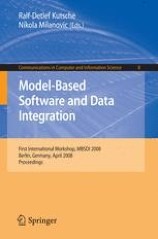
Model-Based Software and Data Integration ; 1st International Workshop, MBSDI 2008, Berlin, Germany, April 1-3, 2008. Proceedings
The First International Workshop on Model-Based Software and Data Integ- tion (MBSDI 2008), was ourfrst event of this kind in a forthcoming series of activities at TU Berlin, where a scientifc discussion and exchange forum was provided for both academic and industrial researchers. We aimed at researchers, engineersand practitionerswho focus onadvanced, model-basedsolutions inthe area of software and information integration and interoperability. As withevery beginning, the resonanceonour callsin today's overfoodingof workshops was somewhat unpredictable, and we did not really know how many paper submissions to expect. We were nicely surprised, considering the rather short lead time to organize the meeting and the very specialized and focused topic.

Model driven Engineering Languages and Systems; 10th International Conference, MoDELS 2007, Nashville, USA, September 30 - October 5, 2007, Proceedings
This book constitutes the refereed proceedings of the 10th International Conference on Model Driven Engineering Languages and Systems (formerly the UML series of conferences), MODELS 2007, held in Nashville, USA, September 30 - October 5, 2007. The 45 revised full papers were carefully reviewed and selected from 158 initial submissions.

Model Driven Engineering Languages and Systems ; Vol. 4199 ; 9th International Conference, MoDELS 2006, Genova, Italy, October 1-6, 2006, Proceedings
This book constitutes the refereed proceedings of the 9th International Conference on Model Driven Engineering Languages and Systems (formerly the UML series of conferences), MoDELS 2006, held in Genova, Italy, in October 2006. The 51 revised full papers and 2 invited papers presented were carefully reviewed and selected from 178 initial submissions. The papers are organized in topical sections on evaluating UML, MDA in software development, concrete syntax, applying UML to interaction and coordination, aspects, model integration, formal semantics of UML, security, model transformation tools and implementation, analyzing dynamic models, specifying transformations, MOF, bridging models, risk, trust and dependability, tool environments, OCL, roundtrip engineering, real time and embedded systems, as well as workshops, tutorials and panels.

Model Driven Engineering Languages and Systems ; 11th International Conference, MoDELS 2008, Toulouse, France, September 28 - October 3, 2008. Proceedings
The book also contains three keynote speeches and contributions to workshops, symposia, tutorials and panels at the conference. The papers are organized in topical sections on Model Transformation: Foundations; Requirements Modeling; Domain-Specific Modeling; Model Transformation: Techniques, Composition and Analysis of Behavioral Models; Model Comprehension; Model Management; Behavioral Conformance and Refinement; Metamodeling and Modularity; Constraints; Model Analysis; Service-Oriented Architectures; Adaptive and Autonomic Systems; Empirical Studies; Evolution and Reverse Engineering; Modeling Language Semantics; Dependability Analysis and Testing; Aspect-Oriented Modeling; Structural Modeling;and Embedded Systems.

Model Driven Architecture - Foundations and Applications ; 4th European Conference, ECMDA-FA 2008, Berlin, Germany, June 9-13, 2008. Proceedings
The 31 revised full papers presented - 21 research papers and 10 industry papers - were carefully reviewed and selected from 87 submissions. The papers address all current issues of model-driven architecture, i.e. model management, executable models, concrete syntaxes, aspects, and concerns, validation and testing, model-based systems engineering, model-driven development and service-oriented architectures, and the application of model-driven development. The papers are organized in topical sections on model management, executable models, concrete syntaxes, aspects and concerns, validation and testing, model-based systems engineering, model-driven development and service-oriented architectures, as well as surveys on applying model-driven development.

Model Checking Software ; 15th International SPIN Workshop, Los Angeles, CA, USA, August 10-12, 2008 Proceedings
This book constitutes the refereed proceedings of the 15th International SPIN workshop on Model Checking Software, SPIN 2008, held in Los Angeles, CA, USA, in August 2008.The 17 revised full papers presented together with 1 tool paper and 4 invited talks were carefully reviewed and selected from 41 submissions. The main focus of the workshop series is software systems, including models and programs. The papers cover theoretical and algorithmic foundations as well as tools for software model checking and foster interactions and exchanges of ideas with related areas in software engineering, such as static analysis, dynamic analysis, and testing.

Model and Mathematics : From the 19th to the 21st Century
This book collects the historical and medial perspectives of a systematic and epistemological analysis of the complicated, multifaceted relationship between model and mathematics, ranging from, for example, the physical mathematical models of the 19th century to the simulation and digital modelling of the 21st century. The aim of this anthology is to showcase the status of the mathematical model between abstraction and realization, presentation and representation, what is modeled and what models.

Mobility Aware Technologies and Applications ; 2nd International Workshop, MATA 2005, Montreal, Canada, October 17 -- 19, 2005, Proceedings
The beginning of the twenty-first century is characterized by global markets, and the mobility of people is becoming an important fact of life. Consequently, the mobile user is demanding appropriate technical solutions to make use of customized information and communication services. In this context the notion of next-generation networks (NGNs), which are driven by the convergence of the entertainment sector, the mobile Internet, and fixed/mobile telecommunications, is emerging. Such NGNs are aggregating a variety of different access networks and supporting the seamless connection of an open set of end-user devices, and due to the adoption of an all-IP network paradigm they enable a much better integration of voice and data services. Coincidently the buzzword ‘fixed mobile convergence’ (FMC) describes the current trend towards providing common services across fixed and mobile networks resulting in the medium term in the full integration of fixed and mobile telecommunication networks. The adoption of appropriate middleware technologies and the provision of - called service delivery platforms driven by the ongoing innovation in the field of information technologies provides today the technical foundation for supporting terminal, personal and service mobility and thus the implementation of real seamless information and communication services. Furthermore, users are nowadays looking, in light of an omnipresent service environment, for a much higher degree of customization and context awareness in the services they use. The papers in this volume look at these enabling mobility-aware technologies and their use for implementing mobility-aware and context-aware applications.

Mobile World : Past, Present and Future
Key reading for all those involved with the future of mobile communications, this book is a valuable resource, particularly for advanced undergraduate and postgraduate students on Mobile Technology courses, practitioners, and researchers working in mobile communications, CSCW and HCI. This volume is a sequel to Brown et al: Wireless World: Social and Interactional Aspects of the Mobile Age, also in the CSCW series. "This book presents a rich insight into how and why the mobile has become so important in today’s society. It explores the strong emotional attachment that people have to these devices, and argues that it is people and not the technology that developers must put at the heart of future mobile offerings. A valuable book for industry and academics alike."
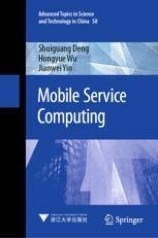
Mobile Service Computing
This book introduces readers to the background and principles of mobile service computing. It discusses various aspects of service computing in mobile environments, including key methods and techniques for service selection, recommendation, composition, offloading, execution, deployment, and provision.
Mobile Information Systems ; Vol. 158 : IFIP TC 8 Working Conference on Mobile Information Systems (MOBIS) 15-17 September 2004, Oslo, Norway
This book contains the proceedings of the IFIP TC8 Working Conference on Mobile Information Systems, which was held in September 2004 in Oslo, Norway and sponsored by the International Federation for Information Processing (IFIP). Mobile Information Systems aims to: Clarify differences and similarities between the development of mobile vs. more traditional information system. Investigate the organizational impact of mobile information systems Investigate mCommerce relative to eCommerce Investigate mobile commerce applications combined with the advantages of mobile communications technologies, the drivers of which have been identified as ubiquity, reachability, security, convenience, localization, instant connectivity and personalization. Evaluate existing and newly developed approaches for analysis, design, implementation, and evolution of mobile information systems. Investigate technical issues and the constraints they pose on mobile information systems functionalities and design

Mobile Information Systems : Infrastructure and Design for Adaptivity and Flexibility
The book is divided into three parts: core technologies for mobile information systems (e.g., adaptive middleware and flexible e-services), enabling technologies (like data management on small devices or adaptive low-power hardware architectures or wireless networks), and methodological aspects of mobile information systems design (such as service profiling or user interface and e-service design for context-aware applications). It provides researchers in academia and industry with a comprehensive vision on innovative aspects which can be used as a basis for the development of new frameworks and applications.

Mobile health technologies for ambient assisted living and healthcare
The use of telemedicine and mobile devices is growing, and sensors might aid in creating creative solutions. Developing these solutions is crucial for monitoring senior citizens, lifestyles, and medical procedures. The development of assistive technology for various users to follow sports and other activities is strongly tied to this study area. Data protection is crucial, and the development of these solutions for medical uses should be verified. The security and privacy of the information may be tied to other recognized research projects for their acceptability. ICT research has considerably improved quality of life and has fully assimilated all citizens into society through medical rehabilitation and assistive technology. The technologies and research fields that influence medical informatics include databases, networking, graphical user interfaces, data mining, machine learning, intelligent decision support systems, and specialized programming languages.

Mobile forensics : The file format handbook : Common file formats and file systems used in mobile devices
This book summarizes knowledge about several file systems and file formats commonly used in mobile devices. In addition to the fundamental description of the formats, there are hints about the forensic value of possible artefacts, along with an outline of tools that can decode the relevant data.

Mobile computing, applications, and services ; 11th EAI International Conference, MobiCASE 2020, Shanghai, China, September 12, 2020, Proceedings
This book constitutes the thoroughly refereed post-conference proceedings of the 11th International Conference on Mobile Computing, Applications, and Services, MobiCASE 2020, held in Shanghai, China, in September 2020. The conference was held virtually due to the COVID-19 pandemic. The 15 full papers were carefully reviewed and selected from 49 submissions. The papers are organized in topical sections on mobile application and framework; mobile application with data analysis; and AI application.

Mobile and Wireless Communications with Practical Use-Case Scenarios
While wireless technologies had a spectacular evolution over the past years, the present trend is to adopt a global heterogeneous network of shared standards that enables the provisioning of Quality of Service and Quality of Experience to the end-user. To this end, enabling technologies like Machine Learning, Internet of Things, Digital Twins, are seen as promising solutions for next generation networks that will enable an intelligent adaptive interconnected environment with support for prediction and decision making so that the heterogeneous applications and users requirements can be highly satisfied. The aim of this textbook is to provide the readers with a comprehensive technical foundation of the mobile communication systems and wireless network design, operations and applications of various radio access technologies. Additionally, it also introduces the reader to the latest advancements in technologies in terms of Internet of Things ecosystem, Machine Learning and Digital Twins for IoT-enabled intelligent environments. Furthermore, this textbook also includes practical use-case scenarios using Altair WinProp Software as well as Phyton, TensorFlow and Jupiter as support for practice-based laboratory sessions"

Mobile and Wireless Communications Networks ; IFIP TC6 / WG6.8 Conference on Mobile and Wireless Communication Networks (MWCN 2004) October 25-27, 2004 Paris, France
Mobile Ad hoc NETworks (MANETs) has attracted great research interest in recent years. A Mobile Ad Hoc Network is a self-organizing multi-hop wireless network where all hosts (often called nodes) participate in the routing and data forwarding process. The dependence on nodes to relay data packets for others makes mobile ad hoc networks extremely susceptible to various malicious and selfish behaviors. This point is largely overlooked during the early stage of MANET research. Many works simply assume nodes are inherently cooperative and benign. However, experiences from the wired world manifest that the reverse is usually true; and many works [3] [10] [9] [8] [12] [19] have pointed out that the impact of malicious and selfish users must be carefully investigated. The goal of this research is to address the cooperation problem and related security issues in wireless ad hoc networks. As a rule of thumb, it is more desirable to include security mechanisms in the design phase rather than continually patching the system for security breaches. As pointed out in [2] [1], there can be both selfish and malicious nodes in a mobile ad hoc network. Selfish nodes are most concerned about their energy consumption and intentionally drop packets to save power. The purpose of malicious nodes, on the other hand, is to attack the network using various intrusive techniques. In general, nodes in an ad hoc network can exhibit Byzantine behaviors.

Mobile and Wireless Communication Networks; IFIP 19th World Computer Congress, TC-6, 8th IFIP/IEEE Conference on Mobile and Wireless Communications Networks, August 20-25, 2006, Santiago, Chile
International Federation for Information Processing The IFIP series publishes state-of-the-art results in the sciences and technologies of information and communication. The scope of the series includes: foundations of computer science; software theory and practice; education; computer applications in technology; communication systems; systems modeling and optimization; information systems; computers and society; computer systems technology; security and protection in information processing systems; artificial intelligence; and human-computer interaction. Proceedings and post-proceedings of referred international conferences in computer science and interdisciplinary fields are featured. These results often precede journal publication and represent the most current research. The principal aim of the IFIP series is to encourage education and the dissemination and exchange of information about all aspects of computing.
